






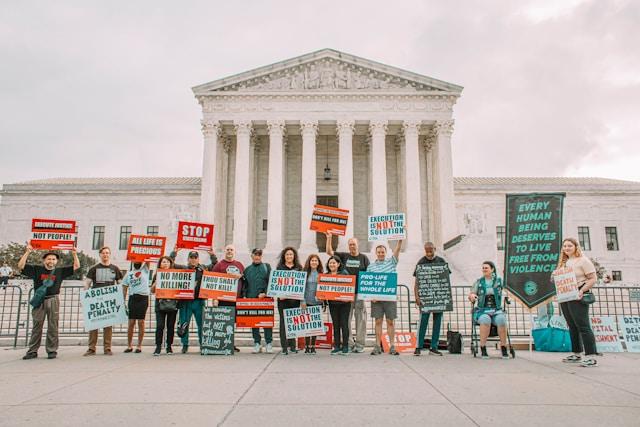
US executions surged in 2025, reviving debate as Catholic leaders and advocates call for abolition and respect for human dignity.
Newsroom (17/06/2026 Gaudium Press ) In 2025, the United States witnessed a significant surge in the use of capital punishment, with 47 executions carried out across the country—more than double the annual average over the past decade. The increase, concentrated in a limited number of states, has reignited debate among policymakers, advocates, and faith leaders about the future of the death penalty in America.
Krisanne Vaillancourt Murphy, Executive Director of the Catholic Mobilizing Network, described the rise as both striking and troubling. “This is a marked, tragic increase in executions, especially at a time when the American public is finding the death penalty unacceptable and movement toward abolition is growing,” she said during a recent visit to Rome.
Despite declining public support for capital punishment, the policy continues to hold political traction in certain regions. “The death penalty is an easy conduit to perhaps communicate that someone is tough on crime,” Murphy noted. “And it also wins political points in some cases in certain states.”
A Divided National Landscape
A closer look at execution data reveals a fragmented national picture. Only 11 states carried out all 47 executions in 2025, while the remaining 39 states recorded none. Meanwhile, 23 states have abolished the death penalty altogether, reflecting a growing legislative shift away from capital punishment.
Florida stood out as the most active state, accounting for 19 executions—effectively putting someone to death roughly every two weeks throughout the year. For Murphy, such figures represent more than statistics; they point to what she describes as a broader cycle of harm.
“Every death sentence brings more collateral damage and more broken families,” she said. “For victims, it does not bring a sense of closure; it doesn’t bring healing; it brings more violence and more hurt. It just creates more harm and more victims in a system of violence where violence begets more violence.”
Catholic Teaching and Moral Opposition
The Catholic Church has taken a clear stance against capital punishment, a position rooted in its teaching on human dignity. The Catechism of the Catholic Church states that “the death penalty is inadmissible because it is an attack on the inviolability and dignity of the person” (CCC 2267).
This position has been reinforced at the highest levels of the Church. In an April 24, 2026, video message marking the 15th anniversary of Illinois abolishing the death penalty, Pope Leo XIV expressed explicit support for abolition efforts.
“I offer my support to those who advocate for the abolition of the death penalty in the United States of America and around the world,” the Pope said. “I pray that your efforts will lead to a greater acknowledgement of the dignity of every person, and will inspire others to work for the same just cause.”
Murphy emphasized that beyond moral considerations, the death penalty is no longer necessary as a tool for public safety. Modern justice systems, she argues, can ensure accountability and prevent further harm without resorting to execution.
Ohio at a Crossroads
Attention has increasingly turned to Ohio, where 114 individuals currently sit on death row, including two women. Of these, 28 have exhausted all appeals, leaving their fate in the hands of Governor Mike DeWine.
Murphy points to what she calls a “unique opportunity” for the governor, whose term ends in January 2027. A practicing Catholic, DeWine has voiced opposition to the death penalty and implemented a moratorium during his tenure.
“He has the opportunity to commute the death sentences of all 114 people,” Murphy said. “Human life matters. Even when harm has been caused, we can create opportunities for redemption and again keep society safe and keep wrongdoers accountable.”
Commuting a sentence—typically converting it to life imprisonment without parole—ensures that offenders remain incarcerated while avoiding execution. Advocates argue this approach not only preserves life but also opens a path toward repentance and reconciliation.
Breaking the Cycle of Violence
From a Christian perspective, opponents of the death penalty frame abolition as part of a broader effort to break cycles of violence. Rather than perpetuating retribution, they emphasize restorative justice—an approach focused on healing, accountability, and, where possible, reconciliation.
“We need to take victims seriously,” Murphy said, “and we need to try to address their hurt and the harm that has been caused and to try to bring pathways towards healing and maybe even create opportunities where forgiveness might be possible.”
As capital punishment gradually loses favor in public opinion polls, Murphy believes faith communities—particularly Catholics—can play a leading role in shaping a new moral consensus.
“Pope Leo has made it very clear,” she concluded, “that he is encouraging the Church to move forward and to be that hope to show the United States and the world that we can respect life at all stages—and the death penalty is contrary to our faith.”
- Raju Hasmukh with files from Vatican News
Related Images:


