






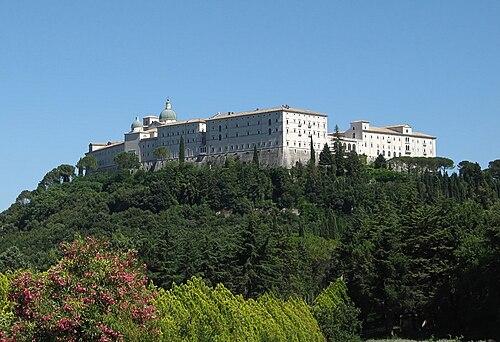
Pope Leo XIV visited Monte Cassino, prayed for peace at St. Benedict’s tomb, and reflected on a monastery shaped by faith and war.
Newsroom (20/07/2026 Gaudium Press ) Pope Leo XIV made a private visit to the Abbey of Monte Cassino and its monastic community, according to an announcement from the Holy See Press Office. During the visit, the Pontiff prayed at the tomb of St. Benedict, entrusting to the saint’s intercession regions of the world currently afflicted by violence and conflict.
The visit carried both spiritual and historical significance. After praying at the founder’s tomb, Pope Leo shared lunch with the Benedictine community before returning to Castel Gandolfo, where he is currently spending a period of rest at the Apostolic Palace.
The journey continues a pattern established by the Pope during previous summer retreats. In August 2025, while vacationing in the Castelli Romani area, he made a surprise visit to the Sanctuary of Our Lady of Grace of Mentorella in Guadagnolo, near Capranica Prenestina, where he also prayed for peace.
A Monastery at the Heart of Western Christianity
Monte Cassino stands among the most important religious sites in Europe. Founded around the year 529 by Saint Benedict of Nursia after his arrival from Subiaco, the monastery became the cradle of the Benedictine Order and a defining center of Western monasticism.
The hilltop site overlooking the town of Cassino had already possessed great historical importance long before Benedict’s arrival. An ancient Roman road more than a thousand years old passed nearby, and the location was once home to a temple dedicated to Apollo.
From Monte Cassino, Benedict’s monastic rule spread across Europe. Monasteries established under the same principles became pillars of religious, cultural, and intellectual life. Within the abbey’s walls, generations of monks painstakingly copied and preserved both contemporary and ancient texts, safeguarding manuscripts and documents that might otherwise have been lost through war, neglect, or the passage of time.
Although the monastery endured repeated destruction from natural disasters and military sieges throughout the centuries, it was rebuilt again and again, maintaining its role as a center of scholarship and faith. The complex that dominated the mountain during the Second World War was largely constructed between the sixteenth and seventeenth centuries.
From Symbol of Peace to Battlefield
For centuries, Monte Cassino symbolized spiritual grandeur and peace. Yet during World War II, it became one of the most contested and tragic locations of the Italian campaign.
As Allied forces advanced northward toward Rome in early 1944, military operations stalled along the formidable Gustav Line. The failed amphibious landing at Anzio and fierce fighting along the Rapido River left the campaign deadlocked. Four separate attempts to capture the heights around Monte Cassino failed, producing heavy casualties and sapping Allied morale.
General Mark Clark, commander of the U.S. Fifth Army, later described the struggle at Cassino as “the most grueling, the most harrowing, and in one aspect the most tragic” phase of the war in Italy. The battle also became one of the defining engagements for the all-Nisei 100th Infantry Battalion, whose extraordinary sacrifices earned it the nickname “Purple Heart Battalion.”
The Controversial Bombing of 1944
The most controversial chapter in Monte Cassino’s history occurred on February 15, 1944, when Allied bombers attacked the abbey.
Military commanders believed German forces were using the monastery as a fortified observation post overlooking Allied positions. Although evidence remained ambiguous, many Allied officers considered the abbey a legitimate military target.
However, according to accounts from those inside the monastery, German troops had not occupied the building itself before the bombing. Monk Martino Matronola, who remained at Monte Cassino during the battle, maintained that the Wehrmacht was not using the monastery. At the time of the attack, only two monks and a number of civilians seeking refuge were inside.
Waves of B-17, B-25, and B-26 bombers reduced much of the abbey to rubble. The German forces positioned lower on the mountain escaped the bombardment unharmed. While the monks survived, an estimated 115 refugees sheltering within the monastery perished.
Later descriptions of the destruction portrayed a scene of devastation. Cloisters and colonnades lay shattered, monumental stairways had vanished beneath piles of debris, and even the statue of Saint Benedict, though still standing, had been decapitated.
The decision to bomb the monastery came only months after General Dwight D. Eisenhower issued his Protection of Cultural Property Order in December 1943. While acknowledging that military necessity could require the destruction of historic structures, Eisenhower also warned against allowing convenience or indifference to justify attacks on cultural treasures.
A Debate That Endures
The destruction of Monte Cassino remains one of the most debated decisions of the Second World War.
At the time, many Americans supported the bombing, believing it would save soldiers’ lives and eliminate a German stronghold. Some troops and journalists even gathered to witness the attack, and early reports in sections of the American press incorrectly claimed that German soldiers had occupied the monastery.
The bombing also became a powerful propaganda tool for Nazi Germany, which portrayed the attack as evidence of Allied disregard for religious and cultural heritage.
Ironically, the destruction ultimately aided German defenders. In the months that followed, German troops occupied and fortified the ruins, transforming the shattered monastery into a stronger defensive position than the intact abbey had been. Subsequent Allied assaults suffered heavy losses while making little progress.
The battle finally ended on May 18, 1944, when Polish forces captured Monte Cassino after five months of brutal fighting and four months after the monastery itself had been destroyed.
A Prayer for Peace at a Place Marked by War
Pope Leo XIV’s visit brought renewed attention to a site where the histories of faith, culture, and conflict intersect. By praying at the tomb of St. Benedict for peace in today’s troubled regions, the Pontiff connected contemporary global conflicts with a place that bears the scars of one of the twentieth century’s most devastating wars.
Monte Cassino remains both a sacred Benedictine monastery and a lasting reminder of the human cost of conflict. Its reconstruction after the devastation of 1944 stands as a symbol of resilience, while Pope Leo’s prayer underscored the enduring relevance of its message: that peace, preservation, and reconciliation remain among humanity’s highest aspirations.
- Raju Hasmukh with files from ACI Prensa
Related Images:


