














Kaunas Christian Maternity Home may be merged under government optimization, prompting protests from pro-life families and advocates.
Newsroom (07/05/2026 Gaudium Press ) Lithuania’s only consistently pro-life maternity home—once blessed by St. John Paul II—stands on the brink of closure following a government-backed merger plan that has drawn widespread opposition, including more than 12,000 petition signatures.
The proposal targets the Kaunas Christian Maternity Home (KGN), founded as a specialized maternity setting for low-risk pregnant mothers. Under an optimization plan, KGN is expected to be reorganized and merged into its parent hospital, LSMU Kaunas Hospital. Families and pro-life advocates say the consolidation threatens to strip the maternity home of its defining identity: an environment they argue is family-centered, emotionally safe, and built around dignified, personal care.
The plan: KGN to be absorbed into LSMU Kaunas Hospital
KGN is owned by LSMU Kaunas Hospital, which is governed through two equal shareholders: the Ministry of Health and the Lithuanian University of Health Sciences (LSMU), each holding 50% ownership. Both shareholders recently approved an optimization plan designed to streamline operations and reduce costs linked to obstetrics—placing KGN’s independent operations in the crosshairs.
Supporters of preserving KGN say the issue is not only administrative. They argue that merging the maternity home into a larger hospital system would not replicate the care culture that families associate with the facility—and that the practical realities of a general multi-specialty hospital would change daily life for mothers in labor.
Founded in 1926, recognized for care shaped by dignity
KGN traces its origins to 1926 and is described in the available reporting as the last major maternity home of its kind in Lithuania. It focuses on low-risk pregnancies and has long emphasized a model of care that combines medical support with a highly personal family environment.
In 1997, Pope John Paul II received a report describing KGN’s family-friendly atmosphere and quality care. After learning of its work, the Pope later sent a handwritten greeting blessing the maternity home. According to the same reporting, KGN has continued to be consistently rated among the best places to give birth in Lithuania.
Partnerships and “privacy and dignity” concerns
The maternity home has partnered with Caritas Lithuania, the Archdiocese of Kaunas, and various pregnancy crisis centers, with supporters arguing that this network helps mothers give birth in a safe and deeply personal setting—one that they say differs from what is commonly experienced in large hospital obstetrics wards.
Critics of the merger argue that eliminating KGN, despite its 100-year history, recognition associated with the late Pope, and its strong reputation, would leave families feeling unheard. They contend that consolidating services would weaken the trust families place in an environment designed around dignity and individual attention.
Why families say the merger would mean a real deterioration
Jarūnė Rimavičė, head of the “Let’s Save the Kaunas Maternity Home” initiative—which has gathered more than 12,000 signatures—told EWTN News that the merger plans would negatively alter care for mothers.
Rimavičė said the infrastructure at LSMU Kaunas Hospital is less family-friendly, and that routing higher volumes of pregnant women into the larger facility would result in “less privacy and less individual attention.” She also pointed to specific conditions, saying some delivery rooms and wards do not have private sanitary facilities—an issue she said undermines the sense of privacy and dignity during childbirth.
Beyond logistics, Rimavičė argued that KGN’s defining strength is more than architecture. She described a care culture focused on emotional safety, close personal attention, and respectful communication between staff and mothers—adding that such a culture “cannot be simply transferred to another environment by administrative decision alone.”
For Rimavičė, the merger is therefore not an equivalent transfer of services. She characterized it as a “real deterioration of conditions for women in labor.”
An appeal carried to Church leadership
Reports circulated that representatives connected to the petition met with Archbishop Georg Gänswein, the apostolic nuncio to the Baltic states. When EWTN News reached him for confirmation, Gänswein acknowledged the meeting and said the representatives presented the situation surrounding the Kaunas Christian Maternity Home. He added that they gave him a letter for Pope Leo XIV and that he later informed the archbishop of Kaunas of the meeting while discussing the facts of the matter. Gänswein said he promised to take care on the issue.
Following this, the Archdiocese of Kaunas issued a statement supporting the petition. It highlighted the long-standing role of maternity homes whose activities are based on Christian values, describing their mission as providing both medical care and dignity-based care. Kaunas Archbishop Kęstutis Kėvalas also called for cooperation to find solutions that would preserve the maternity home.
Mother’s Day protest reflects broader pro-life visibility
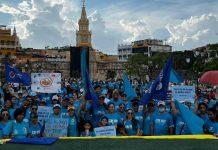
On May 3—marked as Mother’s Day in Lithuania—supporters gathered outside KGN, calling for its preservation and underscoring the importance of the maternity home to families. The demonstration also reflects what Rimavičė described as a broader rise in visibility of Lithuania’s pro-life movement, including a major pro-life march held last year in Vilnius.
At the same time, supporters say the current policy conversation about supporting families and addressing Lithuania’s declining birth rate appears to conflict with decisions affecting mothers’ care options.
Rimavičė framed the contradiction directly: “On one hand, the state talks about encouraging birth rates, but on the other hand, it reduces the choices available to mothers and destroys precisely those places that families trust the most and where they feel safe.”
Healthcare system pressures: volume-driven incentives and staff strain
The debate extends beyond KGN itself. Critics highlighted structural concerns in Lithuania’s healthcare system, particularly a funding model that reimburses hospitals largely based on the number of deliveries performed. They argue this can incentivize volume over quality.
Supporters say such pressure contributes to staff burnout, reduces individual care, and encourages faster, more intervention-heavy procedures—citing concerns such as C-section births being favored over natural births. Rimavičė stated that maternity wards face low pay and heavy workloads, making it difficult to attract and retain staff and leaving obstetrics systematically undervalued.
A reform model mentioned: payments covering fixed costs
Observers referenced Germany as a potential example of how reform might help. According to the available reporting, funding changes there introduced payments that cover fixed costs regardless of delivery volume—aiming to maintain service availability while reducing incentives tied to the number of births.
Rimavičė said the objective of her initiative is to preserve the Kaunas Christian Maternity Home as an independent, family-oriented facility. She described it as a “safe alternative between home birth and hospital inpatient birth,” and said the initiative supports reform only if it improves conditions for mothers—specifically including changes to the funding model and quality-focused service optimization.
The fight ahead: preserving a mission families say cannot be duplicated
With KGN’s future tied to an optimization plan and a merger decision, families and pro-life advocates are arguing that what is being threatened is not simply a service line. They say KGN represents an integrated model—medical care combined with a recognizable, family-focused environment—one they fear cannot survive when absorbed into a larger hospital system.
- Raju Hasmukh with files from CNA
Related Images: