






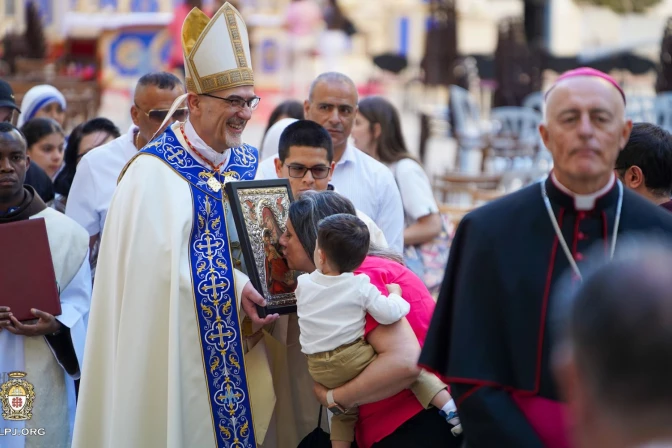
Jerusalem’s Christian leaders visit Gaza, delivering aid, pastoral support, and opening a clinic amid a deepening humanitarian crisis.
Newsroom (23/06/2026 Gaudium Press ) Nearly a year after their last joint visit, two of Jerusalem’s most senior Christian leaders returned to the Gaza Strip in a renewed show of solidarity with a population still grappling with the devastating consequences of prolonged conflict.
On Tuesday morning, Cardinal Pierbattista Pizzaballa, the Latin Patriarch of Jerusalem, and Greek Orthodox Patriarch Theophilos III arrived in Gaza for a pastoral mission that underscores both Christian unity and the urgency of humanitarian assistance in the enclave.
Their visit echoes a similar journey undertaken in July 2025, reinforcing what church leaders describe as a shared commitment to stand alongside communities enduring years of war, deprivation, and uncertainty. Accompanying them this time is a delegation from the Sovereign Military Order of Malta, including Grand Hospitaller Dr. Josef D. Blotz and representatives of Malteser International, the organization’s humanitarian arm.
A Pastoral Mission in a Humanitarian Crisis
According to a statement from the Latin Patriarchate, the visit reflects the “pastoral responsibility of the Churches of Jerusalem” not only toward local Christian communities but toward the entire population of Gaza. The message emphasizes a mission of “consolation, mercy and steadfast Christian witness” grounded in faith while addressing the acute suffering experienced across the territory.
The patriarchs’ itinerary includes meetings with clergy, religious figures, and local families, with a particular emphasis on personal encounters aimed at offering psychological and spiritual support. Early Tuesday, Pizzaballa and Theophilos III visited children attending a summer camp at the Latin parish of the Holy Family. There, alongside parish priest Fr. Gabriel Romanelli and the Sisters of the Incarnate Word, they engaged with young residents whose lives have been marked by repeated displacement and trauma.
The visit comes at a time when Gaza’s humanitarian conditions remain dire, despite a ceasefire officially entering into force more than six months ago. While hostilities have lessened in some areas, violence persists, and daily life remains fraught with insecurity and scarcity.
Aid Efforts Expand Amid Collapse of Services
The presence of the Order of Malta delegation highlights a growing focus on material relief alongside spiritual support. Since 2024, the organization has worked through the Latin Patriarchate to distribute food and essential supplies to vulnerable populations.
However, the current mission signals a shift toward more structured healthcare interventions—an urgent necessity in a region where infrastructure has been severely compromised. Efforts are increasingly focused on primary healthcare, now considered one of Gaza’s most critical needs.
This need was underscored by the inauguration and blessing of a new clinic in Gaza City. The facility, operated with the support of the Sovereign Order of Malta, is staffed by approximately 30 professionals—including doctors, nurses, and pharmacists—and is expected to serve up to 100 patients daily.
Dr. Ali Ibrahim Al-Musaddar, the clinic’s medical director, painted a stark picture of conditions on the ground. “Healthcare for the population of Gaza is currently in catastrophic condition,” he said, noting that around 60 percent of healthcare facilities have been completely destroyed, with many others severely damaged.
He further described widespread sanitation challenges and the rapid spread of disease: “Skin diseases are spreading. Nearly the entire population has been repeatedly displaced and is dependent on humanitarian aid. People arrive here sick, exhausted, and deeply traumatized, in urgent need of care.”
Children Bear the Brunt
The scale of human suffering is particularly evident among children. Just days before the visit, UNICEF reported that 265 Palestinian children had been killed and more than 400 injured in Israeli attacks since the ceasefire came into effect on October 10. The statistics highlight the fragility of the truce and the ongoing risks faced by civilians, especially the youngest.
Against this backdrop, the patriarchs’ presence takes on heightened symbolic and practical significance. Their engagement with children at the parish—many of whom have experienced loss, displacement, or injury—reflects an attempt to restore a sense of hope and continuity amid disruption.
A Historic Gesture of Faith and Service
The blessing of the new clinic carries both immediate and symbolic weight. Conducted on the eve of the Feast of Saint John the Baptist—patron saint of the Order of Malta—the ceremony marks what Dr. Josef Blotz described as a “historic milestone.”
“More than nine hundred years after our foundation in the Holy Land, we continue to serve people in need regardless of their religion or origin,” Blotz said. “This clinic will provide life-saving medical care to those in need and show them that they have not been forgotten.”
Blotz also emphasized the organization’s intention to expand its humanitarian operations despite the formidable logistical and security challenges present in Gaza.
Unity in Adversity
Perhaps the most enduring message of the visit lies in the visible unity between different Christian traditions. The joint appearance of the Latin Patriarch and the Greek Orthodox Patriarch reflects a rare moment of cohesion, signaling that shared humanitarian concerns can transcend ecclesiastical divisions.
For Gaza’s small but resilient Christian population—as well as its broader civilian community—the visit offers a reminder that their plight has not gone unnoticed. Through a combination of prayer, presence, and practical assistance, the visiting leaders aim to affirm a fundamental principle articulated in their message: the dignity of every human life must be safeguarded, even in the most difficult of circumstances.
- Raju Hasmukh with files from Asianews.it
Related Images:


