




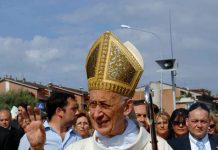










Bishop Marc Aillet urges opposition, prayer, and action as France’s Senate debates a controversial assisted dying law May 11–13, 2026.
Newsroom (07/05/2026 Gaudium Press ) As France’s Senate prepares to debate a controversial bill on assisted dying between May 11 and 13, 2026, Bishop Marc Aillet of Bayonne, Lescar, and Oloron has issued a public call urging Catholics in his diocese to oppose the legislation through political engagement and prayer.
Describing the proposed law as “extremely serious,” Aillet warned that it seeks to “abolish the prohibition against killing upon which life in society has always rested.” He has asked the faithful to write to senators and deputies in their department and to observe a day of prayer and fasting on May 13, the date of the Senate vote, which coincides with the feast of Our Lady of Fatima.
A Contested Legislative Path
The bill, which would legalize both assisted suicide and euthanasia, has followed a complex legislative trajectory. Initially introduced by MP Olivier Falorni on March 11, 2025, after a Citizens’ Convention in which 75.6% of participants supported legalization, the proposal reflects a campaign promise made by President Emmanuel Macron in 2022.
The National Assembly approved the text on first reading on May 27, 2025, by 305 votes to 199, and again on February 25, 2026, by 299 to 226. Despite these approvals, the relatively narrow margins—just 53% support in the most recent vote—highlight deep divisions over the issue.
Under the proposed framework, patients could request the administration of a lethal substance, either self-administered or delivered by a healthcare professional, provided five conditions are met: legal adulthood, stable residence in France, free and informed consent, a serious and incurable illness with a compromised prognosis, and suffering resistant to treatment.
The Senate, where conservatives hold a majority, rejected the bill on first reading on January 28, 2026, by 181 votes to 122. Its Social Affairs Committee has since revised the text, replacing “assisted dying” with a narrower “medical assistance in dying,” limiting eligibility to patients with short-term life expectancy. The revised version also broadens conscience protections for healthcare professionals and introduces institutional exemptions for facilities, including religiously affiliated hospitals.
If the Senate and National Assembly fail to reconcile their differences, the government may convene a joint committee, though the Assembly ultimately holds the constitutional authority to impose its version. Health Minister Stéphanie Rist has indicated that the legislation is in its “final stages.”
Ethical Concerns Beyond the Church
Opposition to the bill extends beyond religious leaders. The French Society for Accompaniment and Palliative Care (SFAP) has criticized the Senate committee’s amendments, arguing they further blur the line between care and induced death.
In a formal statement, the organization warned that the revised text “places induced death within the realm of care,” undermining medical clarity and ethical standards while potentially exposing vulnerable individuals to harm. SFAP president Ségolène Perruchio stated that the legislation creates a “dangerous continuum between relieving suffering and intentionally causing death,” despite attempts to impose stricter conditions.
Gaps in Palliative Care
Aillet and palliative care professionals alike point to systemic shortcomings in France’s healthcare system. According to the bishop, nearly half of the population lacks access to adequate palliative care, despite repeated legislative efforts to expand such services.
He argues that many patients who initially consider assisted suicide or euthanasia abandon those plans when they receive proper palliative support. In the absence of such care, however, he warns that vulnerable individuals—including the poor or those who fear burdening their families or the healthcare system—may feel pressured to choose death.
The bishop also cited examples from countries such as Belgium, the Netherlands, and Canada, where euthanasia and assisted suicide are legal, suggesting that similar dynamics have emerged in those contexts.
Shifting Political Landscape
Despite the bill’s progress, Aillet emphasized that its outcome remains uncertain. He pointed to recent developments in other countries, including the rejection of euthanasia proposals by the Scottish Parliament on March 17 and the UK House of Lords on April 24.
Within France, he noted a growing parliamentary opposition, with the number of deputies voting against the bill increasing from 199 in May 2025 to 226 in February 2026.
Call to Action
Framing the legislation as a “major anthropological rupture,” Aillet revealed that he has personally written to lawmakers in his department, urging them to reject the proposal. He called on citizens to remind elected officials of their accountability on what he described as a “crucial end-of-life issue.”
The bishop’s appeal culminates in a spiritual dimension, linking the Senate vote to the feast of Our Lady of Fatima. He has invited the faithful to pray and fast, asking that “the Lord enlighten the consciences of the senators and our elected officials regarding the fearful moral and spiritual consequences” of legalizing euthanasia and assisted suicide in France.
- Raju Hasmukh with files from Infocatholica
Related Images: