Iraq’s Christian community faces collapse amid displacement, militia dominance, and political neglect, despite renewed hope in restored churches.
Newsroom (10/06/2026 Gaudium Press ) The installation of Polis III Nona as patriarch of the Chaldean Catholic Church carried the ceremonial grandeur of continuity—vestments, clergy, and tradition signaling a new chapter for Iraq’s largest Christian denomination. Yet beneath the spectacle lay a stark reality: the community he now leads has been reduced to a fraction of its former size.
Before the 2003 U.S.-led invasion, Iraq was home to approximately 1.5 million Christians. Today, fewer than 150,000 remain. What appears on the surface as a moment of renewal is, in truth, a leadership transition within a community struggling for survival.
A community hollowed by war
The collapse of Iraq’s Christian population traces directly to the upheaval following the fall of Saddam Hussein. The invasion dismantled the Iraqi state’s grip on security, creating a vacuum quickly filled by extremist groups. Al-Qaeda in Iraq targeted Christians as alleged collaborators with the West, initiating a campaign of violence that shattered communities and accelerated emigration.
The brutality reached a peak in October 2010, when gunmen attacked Baghdad’s Our Lady of Salvation Cathedral, killing 58 worshippers. By then, half of Iraq’s Christian population had already fled. Once-thriving Christian neighborhoods such as Dora—long dubbed the “Vatican of Iraq”—were emptied by kidnappings, assassinations, and extortion.
The situation deteriorated further after U.S. forces withdrew in 2011. By 2013, the Christian population had declined to roughly 500,000, signaling not merely displacement but systemic collapse.
ISIS and the breaking point
If the post-2003 violence fractured Iraq’s Christians, the rise of the Islamic State (ISIS) nearly erased them. In June 2014, ISIS seized Mosul and issued an ultimatum: convert, pay tribute, flee, or die. Churches were destroyed, including all 45 in Mosul, and the ancient Monastery of Saint Elijah was reduced to rubble.
An estimated 120,000 Christians were driven from the Nineveh Plains. By 2016, when the U.S. formally recognized ISIS’s actions as genocide, roughly 90 percent of Iraq’s pre-war Christian population had fled the country.
ISIS was eventually defeated, but the damage proved irreversible for many. When Pope Francis visited Qaraqosh in 2021, only about half of those displaced had returned. Reconstruction and recognition have not translated into meaningful repopulation, largely due to a lack of economic opportunity and security.
From massacres to slow attrition
While large-scale massacres have subsided, a quieter but equally damaging threat has emerged: gradual erosion under militia control.
The Nineveh Plains—historically a Christian stronghold—are now dominated by the Popular Mobilization Forces (PMF), a state-backed network of militias, many with ties to Iran. These groups exert control over land, trade routes, and local governance.
Figures such as Waad Qado, leader of the PMF’s 30th Brigade, and Rayan al-Kildani, founder of the Babylon Brigades, have been sanctioned by the U.S. Treasury Department for abuses including extortion, kidnapping, torture, and the seizure of Christian property. Militias reportedly block returning Christians and acquire land through forged documents, intimidation, and squatting.
This environment has made post-ISIS recovery nearly impossible. Instead of drawing displaced families back, the region remains unstable and economically stagnant. “Many here are losing hope,” said Sarah, a Christian volunteer worker in the area. “There are no services, no jobs… it is hard to imagine a future.”
Political representation undermined
Political dynamics have compounded the crisis. Iraq allocates five parliamentary seats to Christians, intended to ensure minority representation. However, the system allows votes from the broader electorate, enabling dominant political blocs to influence outcomes.
In 2021, Shiite political groups helped al-Kildani’s Babylon Movement secure four of those five seats. Critics, including former Patriarch Louis Sako, argued that al-Kildani does not genuinely represent Christian interests. Subsequent elections in 2025 saw the movement lose two seats, reflecting pushback from Christian voters.
Yet the broader problem remains. The use of nominally Christian political structures as vehicles for external influence—particularly by Iran-aligned factions—has diluted authentic representation and deepened mistrust within the community.
The pressures are intensified by Iraq’s constitutional framework, which privileges Islam and effectively prohibits conversion away from it through apostasy laws. Combined with chronic unemployment, these conditions have fueled an ongoing exodus: 57 percent of Christians in Nineveh have considered emigrating, and 36 percent expect to leave within five years.
A test for U.S. policy
For the United States, the plight of Iraqi Christians presents both a humanitarian concern and a strategic challenge. Efforts to preserve Christian heritage—such as funding church restoration—have symbolic value but fail to address the underlying threats.
The central issue lies in governance. Weak state institutions have ceded authority to militia groups that control security, commerce, and property in key regions. Without restoring state authority, reconstruction alone cannot sustain a meaningful Christian presence.
Policy recommendations include reinstating Iraq as a “Country of Particular Concern” for religious freedom violations—a designation previously urged by the U.S. Commission on International Religious Freedom. Strengthening and expanding sanctions against militia leaders and their backers is also seen as critical.
Washington has already pressed Iraq’s new prime minister, Ali al-Zaidi, to exclude militia-affiliated figures from key government positions. Maintaining that stance will be essential in curbing militia influence.
A fragile future
Ultimately, the survival of Christianity in Iraq hinges on reversing trends that have persisted for more than two decades. Reforming the electoral quota system, restoring state authority, and creating economic opportunities are all essential steps.
Religious leaders have underscored the urgency. During his 2021 visit to Qaraqosh, Pope Francis urged Christians not to forget their roots. Patriarch Louis Sako warned that without systemic change, the community could disappear. Now, that responsibility falls to Polis III Nona.
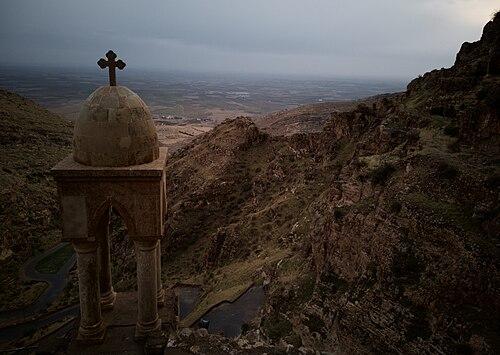
The stakes are stark. The churches of the Nineveh Plains—some newly restored, others centuries old—stand as both symbols of resilience and reminders of loss. Whether they remain living centers of faith or become relics of a vanished community depends not only on local leadership, but on national reform and international resolve.
For Iraq’s Christians, unity may be the last defense against extinction—but it may not be enough without a state capable of protecting them.
- Raju Hasmukh with files from Providence