






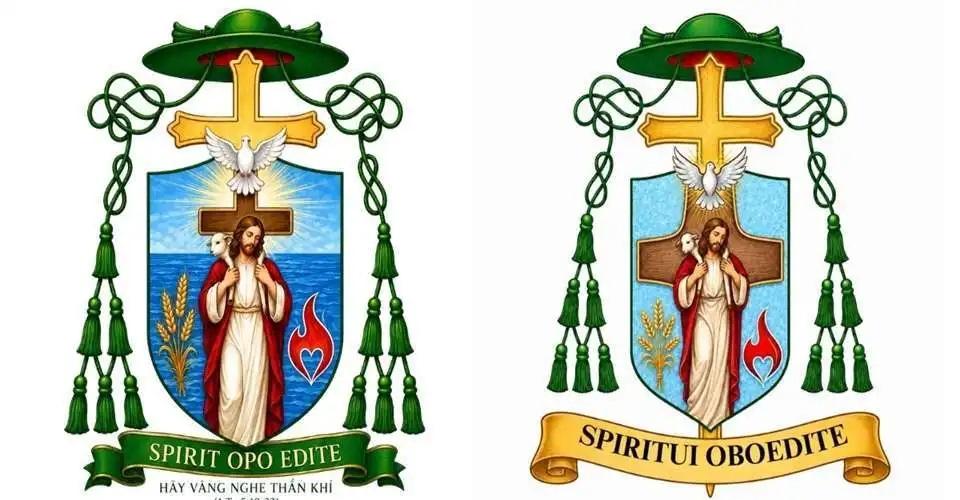
A flawed AI-generated bishop’s crest in Vietnam sparks debate on faith, symbolism, and Pope Leo XIV’s warning on artificial intelligence.
Newsroom (25/05/2026 Gaudium Press ) At first glance, it seemed like a minor digital mishap—almost humorous in its awkwardness. But within hours, a newly released bishop’s coat of arms in Vietnam had triggered a wave of scrutiny, revealing far more than a design error.
Observers quickly pointed out unusual details. The hand of Christ appeared to have six fingers. The lamb draped over his shoulders had elongated, unnatural legs. The dove representing the Holy Spirit appeared to be missing its beak. Most striking of all, the Latin episcopal motto was incorrect: instead of“Spiritui oboedite” (“Obey the Spirit”), the image read“Spirit Opo Edite,” roughly translating to “Edit with the Help of the Spirit.”
Screenshots spread rapidly across Vietnamese Catholic social media communities. Some joked about artificial intelligence being rushed into ecclesiastical design before “learning Latin.” Others reacted with a quieter disappointment.
Within a day, Church-affiliated pages attempted to circulate a revised version of the crest, fixing the motto and background. Yet many of the original distortions remained. Soon after, the Archdiocese of Ho Chi Minh City withdrew the images entirely from official platforms, offering no detailed explanation.
By then, however, the conversation had already shifted. What began as an online curiosity had become a focal point for broader anxieties about technology, tradition, and the speed of modern communication.
Symbols Meant to Endure, Content Built to Disappear
In Catholic tradition, a bishop’s coat of arms is far more than decorative. It encodes theological meaning, personal vocation, and pastoral vision through carefully chosen symbols and mottos—often intended to represent decades of ministry.
Such symbols are typically developed slowly, with deliberation and consultation. They are meant to endure.
Digital culture operates by a different logic. Social media content is fast, visually optimized, and disposable—designed to capture attention for minutes, if not seconds. The value of an image is often measured by its immediate appeal rather than its lasting meaning.
This contrast helps explain the intensity of the reaction. For many Vietnamese Catholics, the issue was not merely the possible use of artificial intelligence, but the perception that something sacred had been produced at the speed—and perhaps with the standards—of a Facebook post.
Vietnam’s Digital Catholic Surge
The incident unfolded within one of Southeast Asia’s most dynamic digital environments. Vietnam’s online ecosystem is deeply integrated into daily life, with Facebook and TikTok shaping communication across institutions—from schools and government agencies to religious organizations.
The Catholic Church in Vietnam has actively embraced this transformation. In recent years, dioceses and parishes have expanded into livestreamed liturgies, short-form videos, podcasts, and daily visual content aimed especially at younger audiences.
This expansion has strengthened engagement—but also intensified pressure.
Many local Church communities lack professionally trained designers or experts in liturgical symbolism. Media production frequently relies on volunteers or clergy working under tight deadlines. In such conditions, artificial intelligence tools offer an attractive solution: fast, inexpensive, and capable of producing visually convincing results.
But as this controversy illustrates, “good enough” aesthetics may fall short when applied to symbols rooted in theology and tradition.
When AI Imitates Form but Misses Meaning
Artificial intelligence has proven remarkably adept at replicating religious imagery—glowing churches, serene saints, evocative devotional scenes. Yet it operates through pattern recognition, not understanding.
The distorted elements in the Vietnamese crest—the extra finger, the malformed lamb, the erroneous Latin—exposed this limitation. They were not merely technical glitches. They reflected a deeper gap between imitating sacred style and comprehending sacred meaning.
Significantly, public reaction was less angry than unsettled. The controversy revealed a quiet concern that something important had been handled too hastily.
As one commenter asked before the images were removed: if even the Latin motto was not carefully verified, what, ultimately, was treated as essential?
A Global Echo: Pope Leo XIV’s Warning on AI
The timing of the incident is striking. On May 25, 2026, Pope Leo XIV released his first encyclical, Magnifica Humanitas, a sweeping reflection on artificial intelligence and the future of humanity.
In the document, the pope warns that AI poses not only technical risks but profound moral challenges, including threats to human dignity, labor, and democratic life. He cautions against a future shaped by efficiency alone, comparing unchecked technological ambition to the biblical “Tower of Babel.”
At its core, the encyclical insists that technology must remain guided by ethical responsibility and the common good. “We must remain profoundly human,” the pope writes, emphasizing that AI should serve humanity rather than redefine it.
He also stresses that technology is never neutral—it reflects the values of those who design and deploy it.
In that light, the Vietnamese crest controversy appears less like an isolated mistake and more like a small but telling example of the very tensions the encyclical describes.
Beyond the Mistake
The true significance of the episode lies not in flawed digital artwork, but in what it revealed.
Across Vietnam—and indeed much of the world—communication is increasingly shaped by algorithms, engagement metrics, and the drive for constant visibility. Even institutions built on centuries of tradition are adapting to this environment.
The risk is not simply technological error. It is the gradual shift in priorities: from contemplation to speed, from meaning to appearance.
In earlier eras, religious art invited the faithful to pause and reflect. Today, those same symbols appear amid a continuous stream of memes, advertisements, and short videos—competing for attention in crowded feeds.
The controversy over a bishop’s crest may seem minor. Yet beneath the jokes about six fingers and broken Latin lies a deeper question—one now echoed at the highest levels of the Church:
In an age of artificial intelligence and endless content, how can the sacred remain truly meaningful?
As Magnifica Humanitas suggests, the answer may not depend on rejecting technology, but on rediscovering the patience, care, and intention that once defined the creation of symbols meant to last.
- Raju Hasmukh with files from UCA News
Related Images:


