






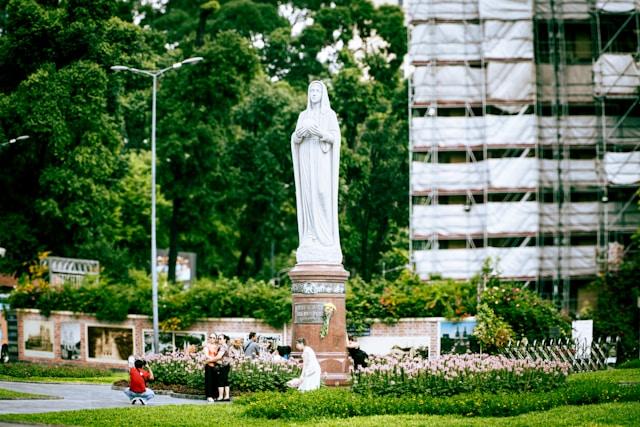
Vietnamese Catholics mark Marian month with vibrant flower offerings, blending faith, culture, and community in a deeply rooted tradition.
For Lan, these nightly gatherings in May are not merely acts of devotion. They are living memories of resilience, community, and faith stretching back nearly five decades. “This tradition has continued since May 1978,” he said softly, recalling the difficult years when it first took root.
Across Vietnam, the Marian month transforms Catholic parishes into vibrant centers of prayer and cultural expression. Known locally as dâng hoa kính Đức Mẹ, or offering flowers to the Blessed Mother, the tradition is among the country’s most cherished forms of Catholic devotion. Throughout May, parishes organize processions, flower dances, and nightly gatherings in churches and homes, where hymns, prayers, and offerings are dedicated to Mary, affectionately called the Queen of Heaven.
A Distinctly Vietnamese Expression of Faith
What began as a missionary-introduced practice has evolved into something deeply Vietnamese. According to Father Joseph Dao Huu Tho, an expert in Marian devotion, the tradition dates back to the 17th century, when missionaries from the Paris Foreign Missions Society first introduced the practice. Over time, local communities reshaped it, blending Catholic spirituality with Vietnamese artistry, music, and symbols.
“Flower offerings here are not simply copies of Western devotions,” Tho explained. “They are the result of a historical and pastoral process in which the universal faith of the Church is expressed creatively through Vietnamese culture.”
Today, Church leaders describe this blending as a successful example of inculturation—the integration of faith into local traditions. The result is a uniquely Vietnamese expression of Catholicism that strengthens both spiritual and communal identity.
That identity is vividly displayed in large-scale celebrations. On May 10, more than 700 women wearing colorful ao dai, Vietnam’s traditional dress, gathered at Tuong Le Parish in Bac Ninh Diocese for a mass Marian flower performance. Elsewhere, such as in Hoa An Parish, entire communities—from children to elders—take part in ceremonies described as “a living garden,” symbolizing not just natural beauty but the “flowers of the human heart.”
Preparations for these events often take weeks. Youth groups, women’s associations, brass bands, and drum teams rehearse synchronized movements, fostering cooperation and mutual learning. “These gatherings enrich popular piety and foster solidarity and friendship among communities,” said Father John Baptist Bui Quang Sang of Phan Lam Parish in Hai Phong.
Roots in Hardship and Renewal
For Lan and many like him, the tradition carries the weight of personal and collective history. After the Vietnam War ended, his family—like many Catholic households—returned from urban areas to their rural homeland after losing their livelihoods. They faced the dual challenge of rebuilding their lives and restoring a church damaged by wartime bombing.
At the time, the parish had no resident priest. In response, the faithful organized Marian devotions themselves. They gathered at the church on the first and last days of May, while nightly rosary prayers rotated among family homes in between. Each household contributed what it could—teaPreview (opens in a new tab), flowers, or leadership in prayer.
“We were poor, but we shared what we had,” Lan recalled.
This grassroots devotion quickly became integral to parish life, weaving together spiritual practice and social solidarity.
The Cultural Power of Motherhood
The enduring appeal of Marian devotion in Vietnam is also rooted in cultural values. Archbishop Joseph Vu Van Thien of Hanoi highlighted how devotion to Mary resonates naturally within Vietnamese society, where motherhood symbolizes sacrifice, endurance, and unconditional love.
“The image of a mother in our culture represents the foundation of family and society,” he said. “That is why Vietnamese people—even many non-Catholics—feel naturally drawn to Mary.”
This cultural alignment has influenced religious art as well. Local bishops have commissioned statues depicting Mary with Vietnamese facial features and traditional dress, reinforcing her connection to the local faithful. One such statue was even blessed by Pope John Paul II.
Today, Marian statues stand before countless Catholic homes, while grottoes adorn church grounds. Nearly half of Vietnam’s 27 dioceses have established Marian shrines, with the national shrine of La Vang holding particular significance in the country’s spiritual life.
Flowers as Symbols of Faith and Life
In Vietnamese Catholic devotion, flowers carry profound symbolic meaning. Father Joseph Nguyen Huu An explained that different colors represent spiritual virtues: blue for hope, red for love, white for purity, purple for sacrifice, and yellow for faith. When believers offer flowers to Mary, they are also offering their personal joys, struggles, and aspirations.
For Lan, these offerings are inseparable from memories of survival. He recalls a cholera epidemic in 1978 that devastated the surrounding region. “We believe Our Lady protected our parish families,” he said. “None of our Catholic families died during that epidemic.”
The connection between flowers and life extends beyond ritual into childhood memories. Sister Mary Nguyen fondly described how children would roam fields and ponds each May, gathering blossoms for offerings. Scratches from thorns or slips into muddy water were inconsequential compared to the excitement of participation.
“In offering flowers, the Church offers not only physical flowers, but the human heart itself,” said Tho. “The flowers symbolize lives being purified, transformed, and offered to God.”
As night deepens over Mai Vinh Parish, the glow of candles and the echoes of hymns continue to illuminate not just a home, but a tradition—one that binds generations through faith, culture, and shared humanity.
- Raju Hasmukh with files form UCA News
Related Images:


