






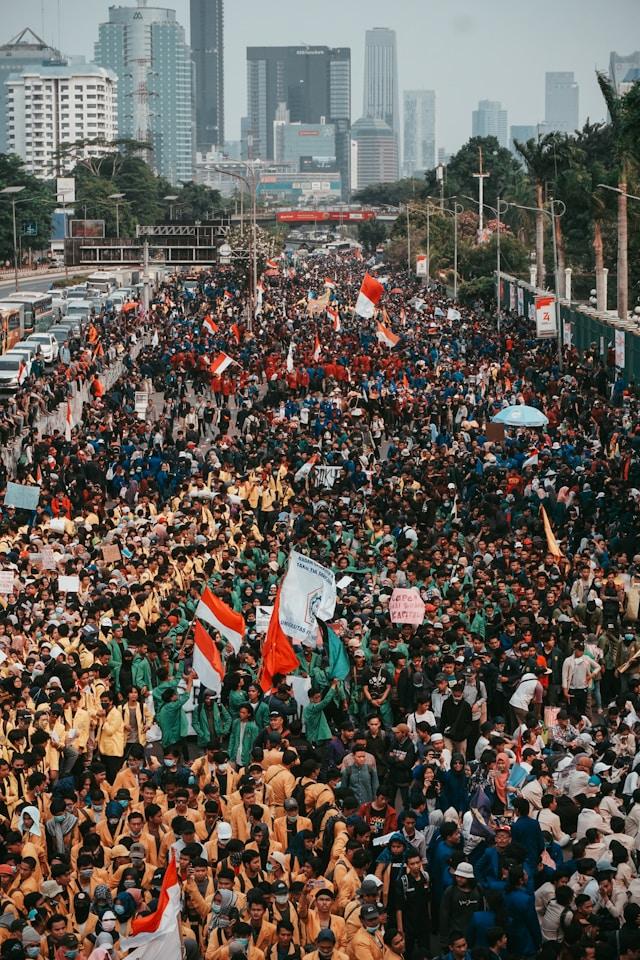
Indonesia faces rising inequality, democratic decline, and social unrest, Catholic bishops warn, urging justice, reform, and national solidarity.
Newsroom (22/05/2026 Gaudium Press ) Nearly three decades after the fall of authoritarian ruler Suharto, Indonesia is confronting a convergence of political, economic, and social challenges that threaten the foundations of its democracy, according to the country’s Catholic bishops.
In a statement released on May 22, the Bishops’ Conference of Indonesia described the nation as entering a period of “democratic backsliding, widening inequality, and deepening social fractures,” warning that hard‑won reforms since 1998 are at risk of erosion.
The statement coincided with the 28th anniversary of Suharto’s resignation on May 21, 1998, which followed a violent public uprising that ended his 32-year rule. Marking the occasion, the bishops called on Indonesians to “rise together in hope” and rebuild public trust through justice, solidarity, and ethical governance.
Economic Pressures and Social Fallout
The bishops highlighted mounting economic pressures as a major source of public distress. Financial experts have warned that Indonesia may be facing its most severe economic crisis in a decade, with slowing growth, rising capital outflows, and persistent youth unemployment undermining household welfare and financial stability.
“These pressures show that economic growth has not been felt by those at the grassroots,” the bishops said, pointing to growing inequality between urban elites and ordinary citizens.
The economic strain is also taking a psychological toll. A 2023 survey by the Health Ministry found that one in four Indonesian adolescents experiences symptoms of depression or anxiety. The crisis is compounded by a severe shortage of mental health resources, with only one psychiatrist available for every 400,000 people nationwide.
The bishops described these developments as “persistent social wounds” requiring urgent attention, particularly as young people face uncertain futures.
Papua Conflict Remains a Deep Scar
The statement also raised alarm about ongoing violence in Papua, a predominantly Christian region that has endured decades of conflict. According to Amnesty International, more than 100 extrajudicial killings have been recorded since 2018, while rights groups estimate that over 76,000 Papuans have been displaced during the same period.
“A security approach is neither the quick nor the right path,” the bishops said, urging a shift away from militarized responses.
Bishop Yanuarius Theofilus Matopai You of Jayapura emphasized the long-term human cost of the conflict, stating that “violence, fear, and the erosion of trust” have left deep psychological scars across generations. He warned that Indonesians cannot ignore “the long and painful wounds still experienced by Papuans.”
Development, Environment, and Justice
The bishops also criticized aspects of Indonesia’s development strategy, particularly large-scale projects implemented without meaningful consultation with local communities. They pointed to food-estate initiatives in Papua and geothermal development projects in Flores as examples of top-down policymaking.
While acknowledging the importance of food and energy security, the bishops warned that such initiatives are often overshadowed by corruption and economic interests that “wound the sense of justice.”
The environmental consequences are equally concerning. Indonesia has lost more than one million hectares of forest since 2021, and official data shows over 3,000 ecological disasters occurred in 2024 alone. These figures, the bishops argued, call into question a development model that sidelines vulnerable communities and exacerbates inequality.
Democratic Concerns and Shrinking Civic Space
Beyond economic and environmental issues, the bishops expressed concern over what they described as “autocratic legalism,” pointing to a sustained decline in democratic indicators.
Human rights groups have accused President Prabowo Subianto’s administration of reviving military influence in civilian governance, raising fears of a return to authoritarian practices.
Divine Word Archbishop Paulus Budi Kleden of Ende warned that public discourse is becoming increasingly constrained. “The space for public dialogue feels narrower,” he said, noting that differences of opinion are increasingly met with hostility and that criticism is often perceived as a threat.
Kleden urged political leaders to prioritize “the small, the weak, and the voiceless,” emphasizing that power “is a mandate to serve, not a tool for domination.” He also called on citizens to resist authoritarian tendencies and to foster a culture of dialogue, freedom of expression, and cooperation.
Calls for Accountability and Grassroots Action
Despite their strong message, the bishops themselves face calls for accountability. Yosef Erwin Rahmat, a Catholic and tribal rights activist opposing geothermal development on Flores Island, emphasized the need for the Church to ensure its statements translate into action.
“There are many concrete examples of the gap between the Church’s institutional statements and the attitudes of its leaders on the ground,” he said, highlighting concerns about consistency and follow-through.
A Critical Juncture
As Indonesia stands at a critical juncture, the bishops’ warning underscores the interconnected nature of the country’s challenges. Economic hardship, social inequality, environmental degradation, and democratic erosion, they argue, are not isolated issues but part of a broader pattern requiring comprehensive reform.
Their message is both a caution and a call to action: without renewed commitment to justice, transparency, and inclusion, the gains of Indonesia’s post-Suharto era could continue to slip away.
- Raju Hasmukh with files from UCA News
Related Images:


