






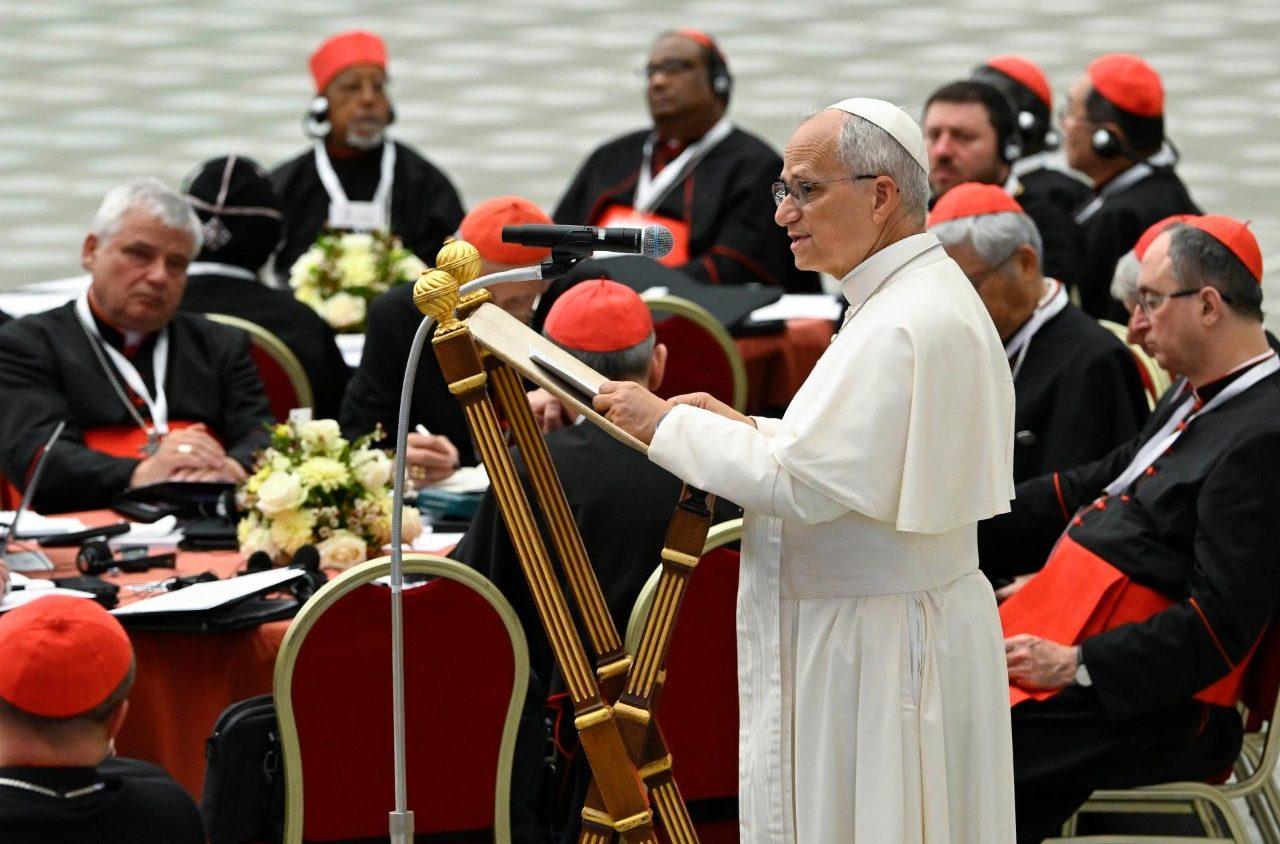
Pope Leo XIV opens Consistory, urging Cardinals to offer candid counsel as they discern Church mission, synodality, and global challenges.
Newsroom (26/06/2026 Gaudium Press ) Pope Leo XIV on Friday formally opened the Extraordinary Consistory of Cardinals, issuing a clear and personal appeal for collaboration rooted in honesty, unity, and shared discernment as the Church confronts contemporary challenges.
Addressing the Cardinals gathered in the Paul VI Hall, the Pope emphasized his reliance on their counsel, urging them to speak candidly as they reflect together on the life and mission of the Church. “I need your freedom, your frankness, and your loyalty,” he said. “Sincere counsel is always an act of communion.”
The Consistory, which runs through Saturday evening, has been convened as a working meeting intended not merely for discussion but for collective discernment. Pope Leo XIV framed the gathering as a continuation of his earlier call, first expressed in January, for closer collaboration between the papacy and the College of Cardinals in guiding the Church. These sessions, he said, are meant to foster a deeper understanding of how to “work together in the service of the Church” while sustaining an ongoing conversation that supports the Church’s global mission.
At the heart of the Pope’s message was the concept of communion—one he described not as a static achievement but as a dynamic, ongoing journey. He stressed that true unity within the Church requires daily conversion, sustained prayer, and relationships built on trust and attentive listening. This relational approach reflects his broader emphasis on synodality, an ecclesial vision in which all members contribute according to their distinct roles and charisms.
The Consistory’s agenda is structured around four major themes, each aimed at grounding the Cardinals’ reflections in both theological insight and real-world awareness.
The first session focuses on understanding the contemporary world in which the Church is called to proclaim the Gospel. Pope Leo encouraged the Cardinals to cultivate a heightened awareness of global realities, noting that such attentiveness enables the Church to recognize the presence of Christ active within history. This perspective underscores his insistence that the Church must engage the world not from a distance, but in close proximity to its lived experiences.
The second area of discussion turns to the tension between what the Pope described as a “culture of power” and the “civilization of love.” Acknowledging that many Cardinals come from regions marked by war, he emphasized that no part of the world is untouched by division, conflict, or systems of domination. In this context, he pointed to his encyclical Magnifica humanitas as a guiding framework, inviting the Cardinals to interpret the realities of their local Churches through its lens.
The third session addresses the Church’s contribution to the common good of humanity. Here, Pope Leo underscored the importance of shared responsibility, noting that the common good does not emerge automatically but must be actively pursued. He linked this responsibility directly to the Church’s social doctrine, highlighting a “synodal style” as essential to advancing the mission of the Kingdom. This approach emphasizes collaboration and participation as integral to the Church’s engagement with broader society.
In the final session, the Cardinals will reflect on the continued implementation of the Synod on Synodality, a major initiative shaping the Church’s current direction. Pope Leo described synodality not simply as a structure or process, but as an “attitude” marked by openness and a willingness to understand. He indicated that this concluding discussion would integrate insights from the previous sessions, placing them within the broader framework of synodal practice.
Significantly, the Pope urged the Cardinals to look beyond internal ecclesiastical concerns and instead focus on the Church’s mission in the world. He posed a central question to guide their deliberations: “How can we help our Churches today to proclaim the Gospel with greater fidelity, freedom, and credibility?”
For Pope Leo XIV, mission is not one task among many but the defining purpose of the Church. This conviction, he suggested, demands attentive listening, responsible leadership, and shared discernment of the Holy Spirit’s action in the present moment.
Closing his address, the Pope reiterated his dependence on the Cardinals’ support, calling for it to be “strong, explicit, and public.” He framed their collaboration not only as a functional necessity but as a fraternal bond essential to his ministry. “I need to feel sustained by you as brothers,” he said, reinforcing the tone of mutual responsibility that has characterized his vision for the Consistory.
As the sessions continue, the gathering stands as a key moment in Pope Leo XIV’s effort to deepen synodal practice and strengthen the Church’s engagement with a complex and often divided world.
- Raju Hasmukh with files from Vatican News
Related Images:


