






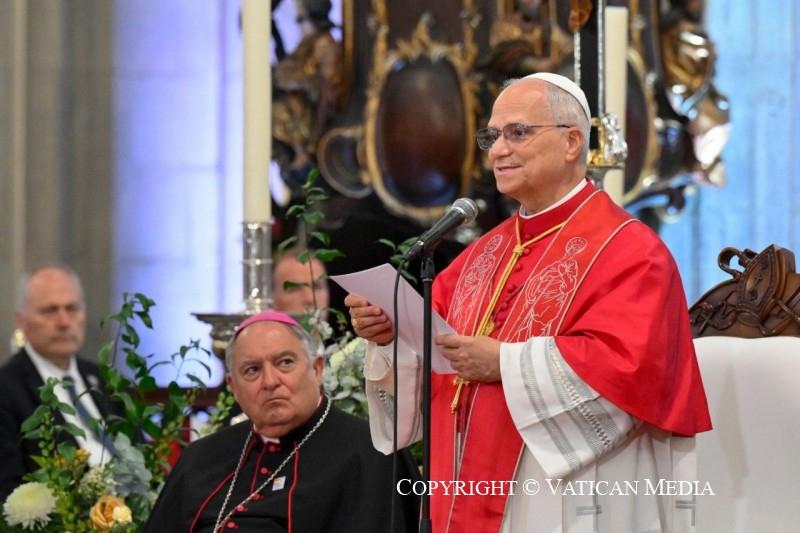
Pope Leo XIV approves beatification of 20 Spanish Civil War martyrs and recognizes five Servants of God for heroic virtue and service.
Newsroom (18/06/2026 Gaudium Press ) Pope Leo XIV has authorised the beatification of 20 diocesan priests martyred during the Spanish Civil War and formally recognised the heroic virtues of five Servants of God, marking a significant moment in the Catholic Church’s process of honouring lives of faith, sacrifice, and service.
The decrees were approved during an audience on 18 June with Cardinal Marcello Semeraro, Prefect of the Dicastery for the Causes of Saints. The decision advances the causes of those killed in religious persecution and elevates the spiritual legacy of individuals whose lives were defined by missionary zeal, charity, and unwavering devotion.
Martyrs of the Spanish Civil War
At the centre of the announcement is the recognition of 20 priests from the islands of Ibiza and Formentera, who were killed between August and September 1936 “in hatred of the faith.” Their martyrdom occurred during one of the most turbulent periods of the Spanish Civil War, when anti-religious violence escalated sharply.
The group, led by Juan Torres Torres, represented nearly half of the local clergy on Ibiza at the time. Increasing hostility toward religious institutions had already forced authorities to suspend public religious processions for security concerns. The situation deteriorated further as persecution intensified, marked by acts of violence and desecration aimed at eradicating Catholic identity from the islands.
Juan Torres Torres, the youngest among the priests, was remembered for his humility and generosity, qualities that deeply impressed those who knew him. Over the decades, the memory of the martyrs has remained alive within the local Church, sustained by testimony and devotion within the community.
Their recognition as martyrs clears the path for their beatification, one of the final steps before possible canonization in the Catholic Church.
Recognition of Heroic Virtue
Alongside the declaration of martyrdom, Pope Leo XIV acknowledged the heroic virtues of five Servants of God, granting them the title “Venerable.” The recognition reflects a diverse range of lives dedicated to faith, from contemplative religious life to missionary work and charitable outreach.
Mother Clara Andreu y Malferit, born in Mallorca in 1596, spent her life in the Monastery of Saint Bartholomew in Inca. Entering at a young age, she became known for her deep prayer life and mystical experiences. When these experiences were examined by Church authorities, she responded with humility and obedience—qualities that have sustained her reputation for holiness to this day. Her monastery continues to attract pilgrims.
Sister Maria Petra Giordano, born in Naples in 1912 and raised in Rome, discerned her vocation at the Basilica of Santa Maria sopra Minerva. She later joined the Dominican Monastery of Santa Maria del Sasso in Tuscany. Despite her youth, she was appointed novice mistress and later elected prioress. She dedicated her life to the formation of religious sisters and to living the Gospel with fidelity. Her cause is supported by numerous eyewitness testimonies following her death in 2006.
Mother Maria Teresa Tallon, born in New York State in 1867 to Irish immigrant parents, embodied a life of service from an early age. After joining the Sisters of the Holy Cross, she worked as a teacher and cared for the sick, even contracting diphtheria during an epidemic in San Francisco while assisting patients. In 1908, she founded the Parish Visitors of Mary Immaculate in Manhattan, envisioning a community dedicated to bringing Christ into homes and neighbourhoods, particularly among the poor and marginalised.
Father Júlio Emílio Alberto De Lombaerde, a Belgian-born missionary priest, dedicated his life to evangelisation and pastoral service. Born in 1878, he joined the Missionaries of the Holy Family and received further missionary formation before being sent to Brazil in 1912. There, he worked extensively in education and catechesis, particularly in remote Amazonian regions. He founded three religious congregations and later became a Brazilian citizen. Known for his deep prayer life and perseverance, he died in a car accident on Christmas Eve, 1944.
Mother Maria Agnese Tribbioli, born in Florence in 1879, overcame a difficult childhood to embrace religious life. She founded the Congregation of the Pious Workers of Saint Joseph and dedicated herself to aiding those in need. During the Second World War, she demonstrated remarkable courage by sheltering Jews despite the risks—a deed for which she was later recognised as Righteous Among the Nations. Inspired by the simplicity of Saint Francis of Assisi, she continued her mission of service until her death in 1965.
A Testament to Faith and Witness
The decrees approved by Pope Leo XIV highlight both the historical reality of religious persecution and the enduring example of individuals who lived their faith with conviction. From the martyrdom of priests in Spain to the quiet heroism of religious figures across continents and centuries, the recognitions underscore the global and timeless character of the Church’s witness.
With the beatification of the Spanish martyrs now in motion and the five Servants of God recognised as Venerable, the Church continues to preserve and honour stories of sacrifice, courage, and faithful service—offering them as examples for future generations.
- Raju Hasmukh with files from Vatican News
Related Images:


