






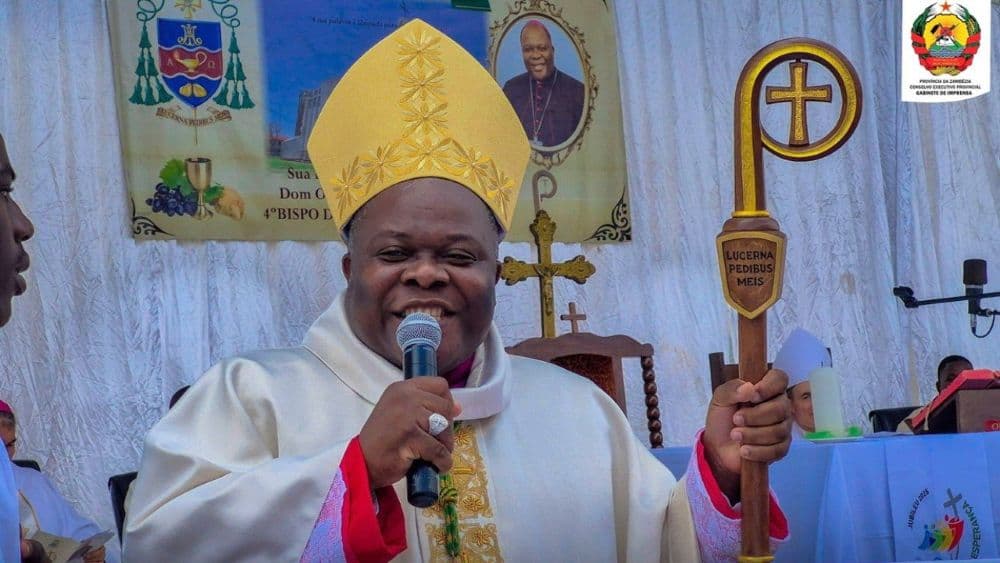
Bishop Estêvão Fernando urges restraint as investigations into Bishop Osório Afonso’s murder spark allegations, leaks, and deep divisions in Quelimane.
Newsroom (08/07/2026 Gaudium Press ) The murder of Bishop Osório Citora Afonso has plunged Mozambique’s Diocese of Quelimane into turmoil, prompting calls for restraint from Church authorities as media reports, investigative leaks, and competing theories continue to fuel public speculation.
In a statement released on July 4, Bishop Estêvão Ângelo Fernando of Alto Molócuè, who has been appointed apostolic administrator of Quelimane following Afonso’s death, strongly criticized what he described as irresponsible reporting and the circulation of unverified claims surrounding the case.
Fernando warned that leaked information from the ongoing investigation and public accusations against individuals risk undermining due process and obstructing efforts to determine the truth.
“I, Dom Estevão Ângelo Fernando, apostolic administrator of the Diocese of Quelimane, and the College of Consultors, publicly express our vehement repudiation of the material published by certain media outlets and circulated on social media,” the bishop said. He added that some reports had even implicated him personally in connection with the case.
According to Fernando, the leaked information has contributed to an atmosphere of suspicion and outrage while violating principles of judicial secrecy. Although he reaffirmed the Catholic Church’s commitment to press freedom, he cautioned that “freedom without ethics or respect for the law degenerates into speculation.”
A Shocking Assassination
Bishop Afonso was killed on June 6 after being shot in the chest at his residence in Quelimane.
Initial statements from investigators suggested the assailants may have used a modernized Kalashnikov rifle and gained access to the property after scaling walls and disabling security systems. These early details immediately led to speculation that the killing was a politically motivated assassination, especially given that such weapons are commonly associated with Mozambique’s armed forces and because Church leaders have occasionally clashed with government authorities.
However, the investigation took a dramatic turn when police arrested three suspects: Fr. Adelino Novais Amado, the diocese’s former chancellor, along with a gardener and security guard employed at the bishop’s residence.
The arrests generated competing narratives among local Catholics. Some suspected the men were being framed to conceal a politically motivated crime, while more recent reports from independent newspapers have pointed toward the possibility of an internal Church conspiracy.
Investigative Reports Raise Allegations
Two independent Mozambican newspapers, Savana and Canal de Moçambique, have published extensive reports suggesting the murder may be linked to internal diocesan disputes.
On June 26, Savana published an investigative article focusing on Fr. Amado, whose removal as chancellor had been announced only days before Bishop Afonso’s death. The newspaper alleged that Amado maintained relationships with multiple women, fathered a child, accumulated unexplained wealth, and adopted a lavish lifestyle incompatible with his clerical position.
The report further claimed that the Diocese of Quelimane had become plagued by financial mismanagement and corruption over several years. Among the allegations were unresolved cases involving diocesan assets, disputes with religious sisters, and questions regarding Church property and governance.
According to Savana, these tensions predated Bishop Afonso’s arrival and stretched back to the episcopate of Bishop Hilário Massinga. Legal and canonical disputes involving diocesan property allegedly persisted for years, contributing to instability within diocesan leadership.
The newspaper reported that after Massinga’s resignation in 2023, much of the day-to-day administration of the diocese fell to Fr. Amado during the period when Capuchin priest Fr. Pietro Tosato served as apostolic administrator. It alleged that Church assets were improperly transferred or appropriated during this time, though the claims have not been independently verified.
Reform Efforts and Growing Tensions
According to the reports, Bishop Afonso began examining financial and administrative practices soon after taking office in 2025.
Savana claimed that he intended to pursue investigations into disputed diocesan affairs and launch comprehensive audits of diocesan administration. The newspaper reported that these measures would have included scrutiny of key officials who had governed the diocese during the leadership transition following Massinga’s resignation.
Canal de Moçambique later reported that investigators are examining whether conflicts arising from these reform efforts may have contributed to the bishop’s murder.
The publication alleged that Fr. Amado and Bishop Afonso had become increasingly at odds over accusations involving financial misconduct and inappropriate relationships. It further claimed that a canonical investigation involving one alleged relationship had already been sent to Rome and that responses from Vatican authorities had been received before the bishop’s death.
A significant development occurred on May 31, when Bishop Afonso issued a decree reorganizing the diocesan curia. The decree replaced several officials, including Fr. Amado. The new appointments were scheduled to take effect on June 6—the same day the bishop was killed.
According to Savana, investigators suspect that Amado traveled to Maputo shortly after the decree was issued and returned shortly before the murder. The newspaper reported that authorities are investigating whether the trip was connected to arrangements for a contract killing, although no formal conclusions have been announced.
Scrutiny Extends Beyond Primary Suspects
The controversy intensified after Canal de Moçambique reported alleged money transfers totaling more than $15,500 from Amado to Bishop Fernando, along with messages reportedly requesting a transfer to Alto Molócuè.
The newspaper claimed authorities were examining these transactions, though no evidence has been publicly presented linking Fernando to criminal conduct. Fernando’s July 4 statement appears to directly address such claims, rejecting what he described as irresponsible insinuations and premature judgments.
Observers note that Fernando’s appointment as apostolic administrator by Church authorities may suggest that the Vatican was unaware of any credible evidence implicating him in wrongdoing.
Ethnic Tensions Surface
Beyond questions of corruption and governance, some reports have raised concerns about ethnic divisions within the diocese.
Bishop Fernando and Fr. Amado are both from the Zambesian ethnic community, while Bishop Afonso originated from Nampula and belonged to the Makhua ethnic group. Some publications have suggested that ethnic identities may have intersected with existing administrative disputes.
Claims of ethnic tensions gained attention after remarks attributed to representatives of Bishop Afonso’s family during funeral proceedings. The comments reflected the emotional strain surrounding the tragedy and highlighted broader divisions that some observers believe may have contributed to tensions within the local Church.
Wider Implications for the Mozambican Church
The murder has sent shockwaves through Mozambique’s Catholic community and raised questions about governance, accountability, and reform efforts within Church institutions.
The case has also prompted comparisons with the recent resignation of Archbishop Cláudio Dalla Zuana of Beira, whom Canal de Moçambique described as a figure associated with strict ecclesiastical discipline and accountability. Although his resignation was officially attributed to health concerns, the newspaper noted continued speculation about resistance to reform initiatives within Church circles.
Adding to the significance of the crisis, Pope Leo XIV recently received senior representatives of the Mozambican Bishops’ Conference, including Archbishops Inácio Saure and João Carlos Hatoa Nunes, as well as Archbishop Dalla Zuana, in a meeting that took place amid growing international attention on the investigation.
As the inquiry continues, Church leaders are seeking to balance demands for transparency with calls for restraint. For now, the Diocese of Quelimane remains at the center of one of the most consequential and controversial criminal investigations in Mozambique’s recent religious history, with many questions still unanswered and authorities yet to establish a definitive account of who ordered Bishop Afonso’s killing and why.
- Raju Hasmukh with files from The Pillar
Related Images:


