







Chinese police raided churches in Zhejiang Province days before Christmas, arresting hundreds of Christians in a bid to suppress unregistered faith communities.
Newsroom (26/12/2025 Gaudium Press) As Christians around the world prepared to celebrate Christmas, hundreds in one corner of eastern China faced a starkly different reality: detention, intimidation, and the looming prospect of spending the holiday behind bars.
According to a report released by ChinaAid, a U.S.-based Christian human rights organization, authorities in Yayang Town, Wenzhou City, Zhejiang Province, mobilized more than a thousand police officers, SWAT units, anti-riot forces, and firefighters beginning December 13 in a large-scale operation targeting local house churches.
The multi-day raid blocked roads to the Yayang church, confiscated belongings of church members, and prevented Christians from entering their place of worship. No official public statement was issued regarding the operation, which reportedly lasted nearly five days.
ChinaAid reported that several hundred individuals were taken away for questioning in the first two days alone. At least four more were detained on December 16 and 17.
Two local Christians—58-year-old Lin Enzhao and 54-year-old Lin Enci—were designated as “principal suspects of a criminal organization” by authorities. Wanted posters accused the pair of “picking quarrels and provoking trouble,” a charge ChinaAid described as commonly deployed against religious and political dissidents.
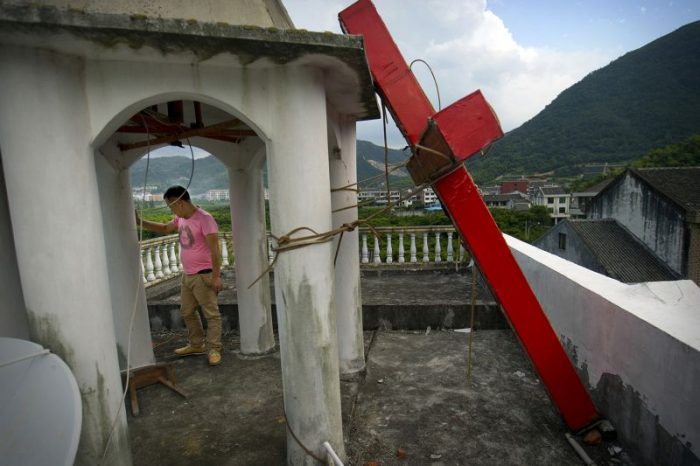
The two men have been prominent in resisting government efforts over the past several years to demolish church property, remove crosses, and replace religious symbols with Chinese Communist Party (CCP) propaganda, including the national flag and copies of the CCP constitution.
Zhejiang Province has long been a focal point of religious tension. Chen Yixin, current director of China’s Ministry of State Security and a native of the province, previously spearheaded a 2014 campaign to demolish crosses and promote the installation of national flags and socialist core values in churches while advancing the “localization” and “politicization” of religious activities.
Residents of Yayang Town have resisted these measures for more than a decade, organizing rallies, demonstrations, and occasionally confronting police.
In the wake of this month’s arrests, authorities staged what ChinaAid called an “Elimination of Six Evils” demonstration, deploying SWAT and riot police in force to “demonstrate power, intimidate local Christians, and create an atmosphere of fear.” Officials framed the church raids as part of an “anti-organized crime campaign.”
Police vehicles have since been stationed outside the homes of known Christians, communications among believers have been disrupted, and officers have conducted door-to-door visits pressuring members to denounce Lin Enzhao and Lin Enci.
State-driven media campaigns have spread rumors portraying the Christians as “unpatriotic” or members of a “cult,” aligning with broader national efforts to criminalize certain religious practices.
ChinaAid founder Bob Fu, who also serves as Senior Fellow for International Religious Liberty at the Family Research Council, condemned the timing of the operation in comments to The Washington Stand.
“The massive pre-Christmas assault on churches in Wenzhou is a chilling reminder that the Chinese Communist Party fears the light of Christ most when it shines brightest,” Fu said. “To raid churches days before Christmas is not only an attack on Christians—it is an assault on human dignity, conscience, and the hope that faith brings to a wounded world.”
Fu added that historical attempts to extinguish faith through persecution have always failed, predicting the raids would only strengthen the resolve of China’s unregistered house churches while exposing the regime’s “moral bankruptcy.”
The crackdown fits a broader pattern documented by international watchdogs. The U.S. Commission on International Religious Freedom (USCIRF) has repeatedly highlighted mass arrests, property destruction, and forced “de-programming” of believers under President Xi Jinping’s “sinicization of religion” policy.
Unregistered religious groups and their leaders frequently face imprisonment for refusing to join state-approved bodies. Earlier this year, USCIRF recommended designating China a “country of particular concern” for systematic violations of religious freedom.
As Christmas arrived, many believers in Yayang Town remained in custody or under heavy surveillance, underscoring the high cost of practicing faith outside official boundaries in China.
- Raju Hasmukh with files from Washington Stand
Related Images:


