






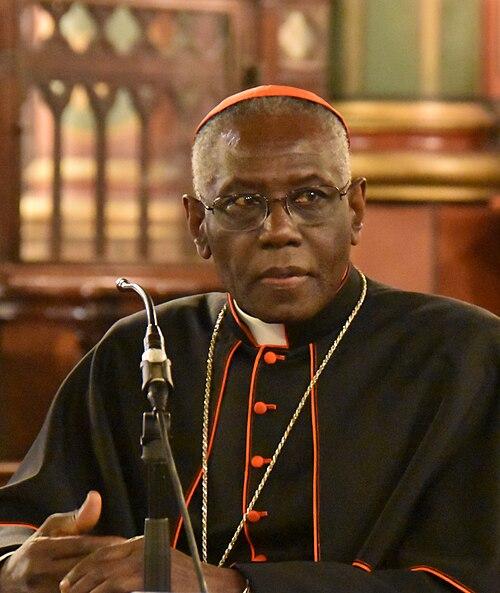
Cardinal Robert Sarah urges wider access to the Traditional Latin Mass and warns synodality, liturgical decline and paganism threaten the Church.
Newsroom (17/07/2026 Gaudium Press ) Cardinal Robert Sarah has issued a strong appeal to bishops throughout the Catholic world, urging them to embrace Pope Leo XIV’s recent call for greater openness toward the Traditional Latin Mass and the faithful attached to the vetus ordo.
In a wide-ranging interview conducted at the Vatican following the second extraordinary Consistory of Cardinals under Pope Leo XIV, the former Prefect of the Congregation for Divine Worship and the Discipline of the Sacraments argued that the Pope’s guidance to French bishops should not be viewed as a local initiative, but as a model for the universal Church.
“What was written to the French Bishops must apply to all Bishops,” Sarah stated.
The Guinean cardinal’s remarks arrive amid continuing debate over the future of the Traditional Latin Mass, five years after Pope Francis issued Traditionis Custodes, the 2021 motu proprio that sharply restricted celebrations of the older Roman rite.
Sarah challenged the rationale behind those restrictions, citing the revelation that a Vatican consultation of bishops reportedly did not support the conclusions used to justify the document.
“We cannot say that what has been done for 1,600 years is no longer valid now,” he said.
The cardinal emphasized that the traditional liturgy had nourished generations of saints and remained an important spiritual resource for many Catholics, particularly younger faithful seeking silence, reverence and contemplation.
Questioning the Legacy of Traditionis Custodes
While expressing respect for papal authority, Sarah questioned whether longstanding liturgical traditions could simply be set aside.
“I don’t know what authority we have to prevent a liturgy that has been celebrated for centuries,” he said.
Rather than seeking a direct reversal of Pope Francis’ restrictions, Sarah proposed a gradual approach under Pope Leo XIV. He suggested that increased pastoral openness from bishops could effectively render Traditionis Custodes obsolete over time.
The cardinal stressed that continuity remains fundamental to the Church’s identity.
“I am not really in favor of one Pope saying one thing and another canceling it,” he said. “The Church is a continuity.”
He went further, saying that texts which seek to break that continuity lack lasting legitimacy because “the Church is a continuity.”
According to Sarah, fostering peace within the Church requires avoiding unnecessary conflicts over the liturgy and respecting legitimate spiritual traditions that continue to nourish the faithful.
Concern Over the Direction of Synodality
Beyond liturgical issues, Sarah devoted considerable attention to concerns about the ongoing Synod on Synodality, a process that has become one of the defining initiatives of recent years within the Church.
The cardinal made clear that he remains unconvinced by the concept itself.
“For my part, I have never understood this change to calling the Church a ‘Synodal Church,'” he said.
Sarah argued that the Church has traditionally understood herself as the Mystical Body of Christ, the Bride of Christ, Mother, and Teacher. He questioned why a new defining label was necessary and maintained that the concept lacks grounding in Scripture, tradition and the Church’s historical self-understanding.
In remarks following the interview, Sarah described synodality as an “abstract term” that cannot easily be translated into many African languages and warned that its meaning remains insufficiently defined.
He called for a clearer explanation of its purpose, limits and authority while insisting that any implementation must leave Catholic doctrine, morality, ecclesial structure and apostolic mission unchanged.
The cardinal also rejected any model of church governance that could imply doctrinal truths are determined through popular consultation or voting.
“The Church is not an assembly of all Christians who must vote,” he said. “The Church must teach.”
Calls for Vatican Scrutiny of Synod Report
Sarah also addressed concerns surrounding Study Group No. 9, one of the synodal study groups examining questions related to homosexuality.
Referencing reports associated with the group’s work, he argued that any document touching on such matters should undergo careful papal review before being distributed throughout dioceses worldwide.
“If we want to be faithful to Revelation, if we want to be faithful to the Catechism of the Catholic Church, this document must be examined by the Holy Father before it is sent out,” he said.
The cardinal warned against allowing what he described as a specifically Western perspective to shape policy for the universal Church without broader scrutiny.
He praised Pope Leo XIV’s prudence and expressed confidence that the Pope would thoroughly review any proposals before approving their wider circulation.
A Church Facing Internal Challenges
Reflecting on the recent Consistory, Sarah welcomed the opportunity for cardinals from diverse regions to meet and exchange perspectives. However, he voiced concern that discussions focused too heavily on social and political issues such as war, violence, drugs and peacebuilding.
While acknowledging the importance of those topics, he argued that the Church’s primary mission must remain centered on evangelization, worship and the relationship between humanity and God.
“The world needs light,” he said. “Not our own light, but God’s light.”
Sarah suggested that many contemporary crises ultimately stem from spiritual causes and that church leaders should devote greater attention to questions of faith, prayer, sacramental life and priestly formation.
He repeatedly returned to the importance of liturgy, describing it as the central point where humanity encounters God.
“God is the Creator, and man must kneel before God, adore Him, thank Him, submit to His will,” he said.
He warned that modern liturgical practices can sometimes drift away from that focus.
“It is urgent,” he said, “because if we do not live the liturgy well, we cannot have a solid faith.”
Criticism of Pagan Influences and Cultural Accommodation
Among the interview’s most striking moments were Sarah’s reflections on what he considers the growing presence of pagan influences within the Church.
In discussing the 2019 Amazon Synod, he criticized the public presence of the Pachamama figure during synodal events held at the Vatican.
“We carried it in procession from the Basilica to the Paul VI Hall, and it remained in front of us the whole time during the Synod,” he said.
Drawing on his own experience in Africa, Sarah contrasted that event with the sacrifices made by converts who renounced traditional idols after embracing Christianity.
He also expressed concern about broader efforts to adapt Catholic worship too extensively to local cultures, arguing that culture should be transformed by the Gospel rather than the other way around.
The cardinal warned that trends toward excessive accommodation risk weakening Catholic identity and undermining the uniqueness of Christ’s message.
Hope for the Church’s Future
Despite his concerns about liturgy, doctrine, secularization, family life and internal confusion, Sarah concluded on a note of confidence.
His newly published French-language book, 2050, examines whether the Church will remain a moral and spiritual beacon a quarter century from now. While identifying numerous challenges, he remains convinced that the Church’s future ultimately rests not on human leaders but on Christ.
“The Church belongs to Christ; it is not ours,” he said.
Asked directly whether the Church would still be a light to the world in 2050, Sarah answered without hesitation.
“Yes,” he said. “Christ will not abandon his Church. He will remain until the end of the world.”
Yet he added that renewal requires conversion on the part of believers themselves.
“We must convert ourselves to Christ; it is not that Christ must convert Himself to us, to our ideas, to our paradigm shift.”
- Raju Hasmukh with filers from Diane Montagna Substack
Related Images:


