






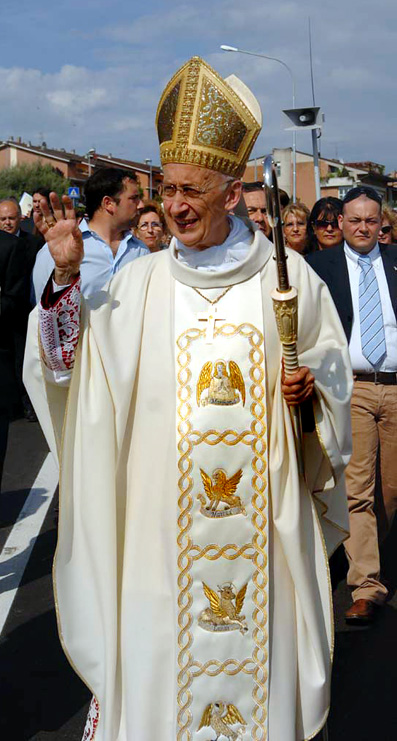
Cardinal Camillo Ruini, chief advisor to John Paul II and influential Italian Church leader, dies at 95, leaving a lasting legacy.
Newsroom (16/06/2026 Gaudium Press ) Cardinal Camillo Ruini, a central figure in the Italian Catholic Church over the past decades and one of St. John Paul II’s most trusted advisors, passed away this week at the age of 95. His death brings to a close an important chapter in contemporary Church history, marked by the Church’s strong presence in public debate and its uncompromising defense of Catholic identity in the face of cultural transformations in the West.
Born in Sassuolo, in the Italian region of Emilia-Romagna, on February 19, 1931, Ruini was ordained a priest in 1954 and built a solid reputation as a theologian before being called to prominent roles within the Church. In 1991, St. John Paul II appointed him Vicar General for the Diocese of Rome and president of the Italian Episcopal Conference (CEI), positions that placed him among the most influential prelates in Europe.
During his sixteen years at the helm of the CEI, Ruini became the public face of the Italian episcopate. Under his leadership, the Church actively participated in discussions on the family, bioethics, education, and the defense of life, during a period of profound cultural and legislative changes in Italy. His actions earned him admiration among defenders of Catholic doctrine and criticism from sectors that desired a Church less involved in political debate.
Created a cardinal by St. John Paul II at the consistory of June 28, 1991, Ruini participated in the 2005 conclave that elected Benedict XVI. Over the years, he established himself as one of the figures closest to the theological and pastoral thought of Joseph Ratzinger.
The “unfiltered” Ruini of recent years
Even after his retirement, the cardinal continued to weigh in on ecclesial debates. In February of this year, upon turning 95, he gave an extensive interview to Corriere della Sera that resonated throughout the Catholic world. The interview was later analyzed by Gaudium Press under the headline “At 95, Cardinal Ruini Speaks Unfiltered: Benedict Was Wrong, I Had Difficulty with Francis.”
On that occasion, Ruini surprised many with his candor. Regarding Benedict XVI, he stated that he considered the 2013 resignation to be a historic mistake, even if motivated by reasons of conscience. The cardinal assessed that the decision created an unprecedented situation in the Church, the consequences of which are still the subject of reflection.
Commenting on Pope Francis’s pontificate, Ruini acknowledged positive aspects, especially the missionary drive and attention to the peripheries, but noted that the Argentine pontiff had paid “little attention to tradition” in certain pastoral and ecclesial choices. Despite his reservations, he rejected polarized interpretations and insisted on the need for ecclesial communion.
The interview drew attention precisely because it did not come from an outside critic, but from one of the most important figures in the post-conciliar Church. At 95 years old, Ruini spoke with the freedom of someone who lived through the pontificates of Paul VI, John Paul II, Benedict XVI, and Francis, and witnessed the beginning of the current pontificate of Leo XIV.
The death of Cardinal Camillo Ruini represents more than just the passing of an influential prelate. It symbolizes the end of a generation of ecclesiastical leaders who shaped the Catholic Church’s public presence in the late 20th and early 21st centuries.
His legacy will remain linked to the defense of the Catholic faith in the public sphere, the promotion of the new evangelization, and the conviction that the Church must not remain silent in the face of the cultural challenges of the contemporary world. For admirers and critics alike, Ruini was a figure impossible to ignore.
With his passing, the Church loses one of the last great figures of the era of John Paul II and Benedict XVI—a cardinal who, until his final days, continued to reflect fearlessly on the direction of Catholicism and the world.
- Gaudium Press Editor
Related Images:


