






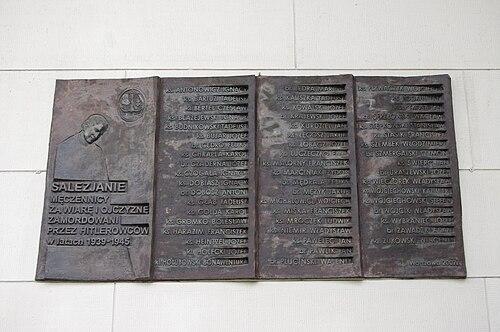
Nine Polish Salesian priests martyred by Nazis were beatified in Kraków, honoring their faith, sacrifice, and dedication to youth.
Newsroom (16/06/2026 Gaudium Press ) Nine Polish Salesian priests who perished in German Nazi concentration camps during World War II were beatified on June 6 at the Sanctuary of St. John Paul II in Kraków. The ceremony honored not only their deaths as martyrs but also their lives as devoted educators, pastors, and mentors to young people in prewar Poland.
Pope Leo XIV, speaking on June 14 after the Angelus prayer, underscored the significance of their witness. “All were beatified as martyrs, as victims of the persecution by totalitarian regimes because of their fidelity to Christ,” he said, situating their sacrifice within the broader history of religious oppression in the 20th century.
The newly beatified priests — Fathers Jan Swierc, Ignacy Antonowicz, Karol Golda, Wlodzimierz Szembek, Franciszek Harazim, Ludwig Mroczek, Ignacy Dobiasz, Kazimierz Wojciechowski, and Franciszek Miska — died between 1941 and 1942 in Auschwitz and Dachau, two of the most notorious Nazi camps, after being arrested during the German occupation of Poland.
Clergy in the Crosshairs of Occupation
While Auschwitz became the largest extermination camp in occupied Europe, Dachau emerged as the principal site for imprisoned Catholic clergy. Nearly 2,800 clergy were held there during the war, including approximately 1,780 Poles, according to Poland’s Institute of National Remembrance.
The nine martyrs came from varied backgrounds, spanning their 30s to 60s. Some served as parish priests; others were educators, seminary professors, school administrators, and youth ministers. All were members of the Salesians of Don Bosco, a congregation founded in the 19th century that is globally recognized for its work with young people.
Before the war, Salesians in Poland operated schools, vocational institutions, youth centers, and seminaries — activities that would ultimately place them in direct conflict with Nazi authorities.
Education as an Act of Resistance
According to Father Dariusz Bartocha, provincial superior of the Salesian Province of Kraków, the very mission that defined these priests made them targets.
“They gave their lives because they educated young people, and because of that they were dangerous to the occupier,” he said. Nazi authorities viewed clergy, educators, and intellectuals as threats to their efforts to dismantle Polish national identity and suppress resistance.
“Anyone who preserved the identity of a nation, anyone who strengthened its spirit and unity, was inconvenient for an occupier,” Father Bartocha explained. “Young people who were given dignity, freedom and a sense of identity are not what an oppressor wanted.”
Courage in the Face of Persecution
Pope Leo XIV formally advanced their cause in October 2025 by approving a decree recognizing that the priests were killed “in hatred of the faith,” clearing the way for their beatification.
Testimonies collected during the canonization process reveal consistent accounts of courage and self-sacrifice. Father Pierluigi Cameroni, postulator general of the Salesians, highlighted that the priests knowingly faced danger yet chose not to flee.
“They were fully aware of the danger and the cruelty being inflicted by German soldiers,” he said. “Nevertheless, the servants of God decided not to flee, not hesitating to hand themselves over to German soldiers in order to save the lives of others.”
One notable example is Father Kazimierz Wojciechowski, who surrendered himself to authorities in place of an elderly pastor. Similarly, Father Wlodzimierz Szembek volunteered to accompany a fellow priest targeted by the occupiers. “That is an expression of love, an expression of brotherhood,” Father Bartocha said, calling it “the truest kind of love.”
Witness Through Faith
Among the group, Father Karol Golda became known as “a martyr of confession.” Despite prohibitions on priestly ministry, he continued administering the sacrament of reconciliation, even hearing confessions of SS soldiers — actions that exposed him to significant risk.
For Father Cameroni, the significance of their martyrdom extends beyond historical remembrance. Drawing on St. John Paul II’s description of modern martyrs as “unknown soldiers in God’s great cause,” he said their witness demonstrates that apparent defeat can conceal a deeper spiritual victory.
“When death seems to have achieved victory, the true victors are those who… adhere to [Christ’s] saving plan,” he said.
A Ceremony Rich in Symbolism
The beatification Mass, celebrated by Cardinal Marcello Semeraro, prefect of the Dicastery for the Causes of Saints, drew thousands of faithful, along with church leaders from Poland and abroad. Among those present were Cardinals Grzegorz Rys, Stanislaw Dziwisz, and Reinhard Marx.
The location carried deep historical resonance. Several of the future blesseds had ministered in a Salesian parish where a young Karol Wojtyła — later Pope John Paul II — prayed and discerned his vocation. He even witnessed the arrest of some of the priests.
Organizers intentionally emphasized the fullness of the martyrs’ lives rather than focusing solely on their deaths. Instead of relics, representatives carried personal items such as diplomas, eyeglasses, letters, and notebooks.
One especially moving moment came when a written testament left by one of the martyrs was placed beside an urn containing ashes from Auschwitz. “People were crying,” Father Bartocha recalled. “For two days afterward, everyone kept talking about what they had experienced.”
A Message for the Present
For church leaders, the beatification holds contemporary relevance. “The beatification is a strong message for the contemporary world,” Father Cameroni said. “It reminds us that faith has a cost, and that education and responsibility toward young people require coherence and courage.”
Ultimately, he added, the nine Salesian martyrs offer a timeless lesson: “The new Salesian blesseds show that true victory is born from fidelity, and that the meaning of life is discovered in the gift of self.”
- Raju Hasmukh with files form OSV News
Related Images:


