








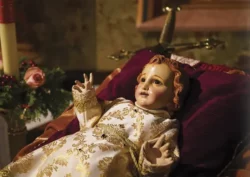
In the midst of the Christmas joys, the prologue of the Gospel of Saint John presents us with an alternative: to be children of light or children of darkness.
Newsroom (26/12/2025 Gaudium Press) Saint Isidore recounts that the eagle received its name because of its keen eyesight: aquila, from acumen oculorum in Latin. He also says that this bird gazes directly at the sun’s rays without closing its eyes and holds its young in such a way that they are exposed to this radiation, deeming worthy those that maintain a steady gaze and rejecting those that blink, as a disgrace to their species.
These picturesque etymological reflections come to mind, by association of ideas, when we read the prologue to the Gospel of Saint John, proclaimed during the liturgy of the Mass on the Nativity of the Lord. The penetrating vision with which this sublime hymn begins allowed Saint Irenaeus of Lyons to attribute the allegory of the eagle to its author.
In fact, at the opening of his Gospel, the Beloved Disciple—as a worthy bearer of the eagle’s symbol—directs his gaze straight toward the divinity of the “Sun of Righteousness” (Mal 4:2), Jesus Christ, our Lord. And he proclaims that this child, the son of Mary contemplated today in his birth, is the divine Word who, pre-existing before the ages of human history, created all things (cf. Jn 1:1-3).
In the following verses, Saint John masterfully synthesizes the themes of his Gospel, among which one stands out, rarely discussed at Christmas. It could be said that, just as the eagle tests its young by exposing them to the sun, he (St John) too desires that all his listeners turn their gaze in wonder to contemplate the divine light.
Indeed, the virgin apostle is the only evangelist who begins his account by narrating that Jesus’ coming into the world provoked a conflict. Yes, around this tender Child, who out of love “became flesh and dwelt among us” (1:14), a radical antagonism was forged: light and darkness (cf. Jn 1:5); Jesus and the world (cf. Jn 1:10); faith and unbelief (cf. Jn 1:7). Whoever believes in Him and welcomes Him receives divine life and heavenly glory, becoming a child of God (cf. Jn 1:12); whoever rejects Him remains in darkness and eternal death. Herein lies the tragic and magnificent choice that Saint John presents in this hymn, a choice from which we cannot turn our gaze.
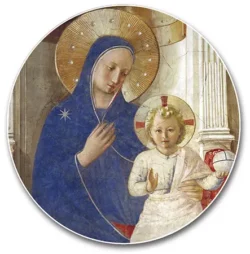
Detail of “Madonna delle Ombre”, by Fra Angelico – National Museum of San Marco, Florence (Italy)
Undoubtedly, these considerations may seem unwelcome during a Christmas celebration. But, given the current religious and moral crisis afflicting the world, and especially the Church, is it possible that we are blind to this reality? Will we be children of light or of darkness? This is a crucial decision for our eternal destiny.
From this perspective, no one has the right to despair or become discouraged, because, with Mary Most Holy as our intercessor, we will receive abundant graces to embrace the ineffable light of the Child Jesus and thus participate in his Kingdom of love forever and ever.
By Fr. Leonardo Miguel Barraza Aranda, EP
(Note published in the Heralds of the Gospel Magazine, December 2025)
_____
Notas
1 Cf. San Isidoro de Sevilla. Etimologías. L. XII, c. 7, n.º 10-11. Madrid: BAC, 2004, p. 939.
2 Cf. San Ireneo de Lyon. Contre les hérésies. L. III, c. 11, n.º 8: SC 211, 165.
The post Una elección decisiva appeared first on Gaudium Press Español.
Related Images:


