









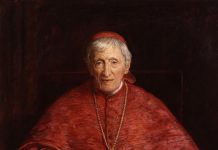

Archbishop Paul Coakley elected USCCB president as expected; Bishop Daniel Flores, the uncategorizable border bishop, storms to vice presidency in Baltimore vote.
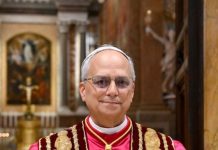
Newsroom (11/11/2025 Gaudium Press ) In a outcome that surprised few but confirmed recent trends, the U.S. Conference of Catholic Bishops on Tuesday elected Archbishop Paul Coakley of Oklahoma City as its new president. The 70-year-old prelate, who has served as USCCB secretary since 2022, secured a clear majority on the third ballot, defeating a field of ten nominees.
Far more unexpected was the persistent strength of Bishop Daniel Flores of Brownsville, Texas, who finished a strong second to Coakley on all three presidential ballots before decisively winning the subsequent vice-presidential election against Bishop Michael Burbidge of Arlington.
The secretary post has effectively become the launching pad for the presidency in recent years, as several recent vice presidents—most recently Archbishop Timothy Broglio—were already over the conference’s age-70 limit for advancing to president. Coakley’s victory had been widely anticipated in ecclesiastical circles for months.
Flores’s performance, however, upended conventional wisdom.
The 64-year-old bishop of the Rio Grande Valley has long occupied a singular position among his brother bishops: intellectually formidable, pastorally direct, and almost impossible to pigeonhole ideologically. Known for quoting Dostoyevsky in casual conversation and drawing theological parallels between Polish and Latin American Marian devotions, Flores has chaired the doctrine committee and served as the conference’s most visible American participant in the Vatican’s multi-year Synod on Synodality—often leavening tense Roman press briefings with dry humor.
Yet many seasoned conference watchers had discounted his chances for high office, largely because he has never been fully “clubbable” in the informal networks that often shape USCCB elections. Neither a card-carrying member of the conference’s progressive wing nor a reliable vote for its self-described conservative bloc, Flores has alternately been labeled “the thinking conservative’s liberal” and “the liberals’ favorite conservative.”
His public interventions have frequently confounded both sides.
It was Flores who, as doctrine committee chairman in 2023, successfully moved to incorporate the conference’s note on the immorality of gender reassignment surgeries into the Ethical and Religious Directives for Catholic Health Care Services. During the synod, he robustly defended the synodal process itself while firmly rejecting attempts to portray thin consultation turnout as a mandate for doctrinal change, telling The Pillar in 2022 that claiming less than 1 percent lay participation represented the sensus fidelium was “not serious.”
On immigration—the issue many bishops believe will dominate the coming three years under a second Trump administration—Flores brings unmatched credibility as bishop of a diocese that straddles the U.S.-Mexico border. His public statements on migration, detention policy, and due process have been characteristically blunt yet nuanced, avoiding both performative outrage and evasive diplomatic phrasing favored by some colleagues.
Perhaps the clearest illustration of Flores’s style came after the 2022 Robb Elementary shooting in Uvalde, located in his diocese. “We sacralize death’s instruments,” he said, “and then act surprised when death uses them.” Rather than let the line stand as a viral soundbite, he followed it with a lengthy, theologically rich reflection on gun policy, the common good, and the limits of what the Church can prudently demand of civil authority.
In an episcopal conference sometimes given to coded language—where, not long ago, the wearing of beards was seriously debated as a proxy for allegiance to or against Pope Francis—Flores has stood out precisely for his lack of subtext.
Tuesday’s vote suggests a majority of his brother bishops have concluded that what you see with Daniel Flores is, in fact, exactly what you get—and that in an increasingly polarized Church and nation, a leader who simply means what he says may be precisely what the moment requires.
The new leadership tandem of Coakley and Flores will take office immediately and guide the conference through what promise to be turbulent years on immigration, religious liberty, and the continuing implementation of the synodal process in the United States.
- Raju Hasmukh with files form The Pillar
Related Images: