






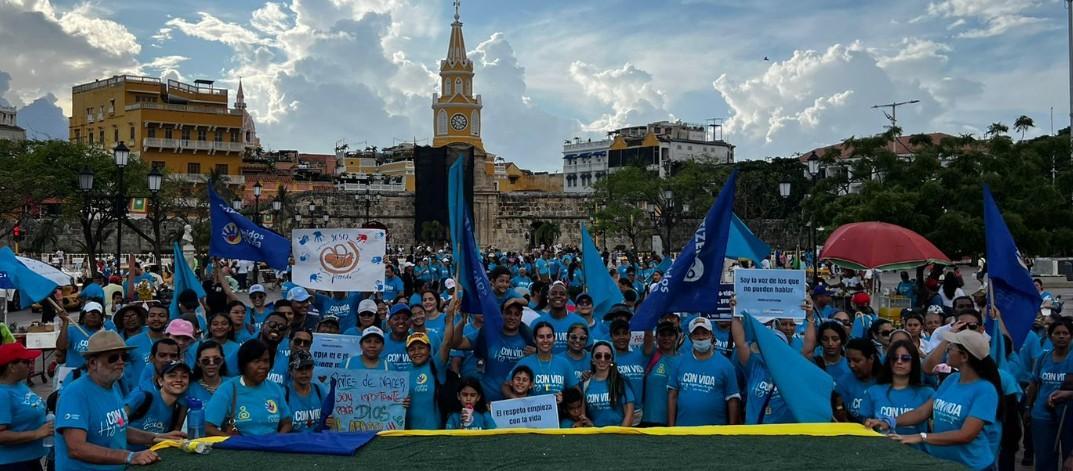
Thousands march across Colombia demanding repeal of abortion laws, defending life from conception and opposing euthanasia policies.
Newsroom (25/05/2026 Gaudium Press) Thousands of Colombians filled the streets on Saturday, May 23, in a coordinated national demonstration calling for the repeal of laws that decriminalized abortion. The mobilization, known as the 20th National March for Life, unfolded simultaneously in approximately 30 cities, underscoring the enduring strength and organization of the country’s pro-life movement.
The marches were organized by the citizen platform Unidos por la Vida (United for Life), alongside a coalition of religious groups, civic organizations, and advocacy networks committed to defending what they describe as “human life in all its stages.” Participants waved light blue flags, a symbol closely associated with pro-life advocacy, and chanted slogans emphasizing the protection of life from conception.
Major cities including Cali, Valledupar, Cartagena, and Bucaramanga saw large turnouts. In the capital, Bogotá, demonstrators began their march at 2 p.m. from National Park, proceeding through the city before concluding at Bolívar Square, where organizers presented an official manifesto outlining their demands and concerns.
Manifesto Calls for Legal Reversal and Cultural Shift
At the heart of the demonstration was a clear political objective: the reversal of key Constitutional Court decisions that have shaped Colombia’s abortion framework over the past two decades.
In its manifesto, Unidos por la Vida expressed gratitude to participants for taking to the streets “to proclaim aloud that human life is inviolable” and must be protected “from the moment of conception until natural death.” The group criticized judicial rulings, particularly Decision C-355 of 2006, which decriminalized abortion under certain circumstances, and Decision C-055 of 2022, which further liberalized access.
According to the organization, these legal shifts have led to what it described as a humanitarian crisis, claiming that approximately 500,000 abortions have taken place in Colombia since the initial ruling. The manifesto characterized this figure as evidence of “a cruel and bloody” practice that must be halted.
In addition to moral arguments, the document linked abortion to broader demographic concerns, asserting that declining birth rates in Colombia are partly attributable to the procedure’s legalization. The group urged the Constitutional Court to overturn its previous rulings, framing the issue as both a legal and societal imperative.
Criticism of Government Policy on Euthanasia
Beyond abortion, demonstrators also voiced opposition to euthanasia policies in Colombia, which has been legal since a 1997 Constitutional Court decision. Unidos por la Vida singled out recent government actions under President Gustavo Petro, particularly Circular 813, as cause for alarm.
The group claims the directive expands access to euthanasia in ways it considers ethically unacceptable, alleging it allows the practice to extend to minors without parental consent and to individuals who are not terminally ill but experiencing emotional or psychological distress.
“The children of Colombia have the right to live,” the manifesto states, reflecting a broader concern among participants about what they view as a normalization of life-ending practices. The critique places euthanasia alongside abortion in what organizers describe as a wider struggle against policies that, in their view, undermine human dignity.
Religious and Civic Support Remains Central
The march also served as a platform to acknowledge longstanding alliances that have sustained the movement over two decades. Unidos por la Vida expressed gratitude to the Catholic Church, Christian denominations, and various faith communities for their continued support and moral guidance.
In addition, the organization highlighted the contributions of NGOs, foundations, and grassroots collectives working with vulnerable populations, particularly women facing crisis pregnancies. These groups, according to the manifesto, play a critical role in providing alternatives to abortion and addressing underlying social challenges such as teenage pregnancy.
Public officials and political figures who have supported pro-life initiatives were also recognized, with organizers praising those who have “raised the banners of human dignity and the defense of life” within Colombia’s institutional framework.
Political Message Ahead of Presidential Elections
The march concluded with a direct appeal to Colombia’s political leadership. With presidential elections scheduled for May 31, Unidos por la Vida called on candidates to adopt what it described as a “serious and firm commitment” to ending abortion and restricting euthanasia practices.
This appeal signals the movement’s intent to influence public policy through electoral engagement, positioning life issues as a central theme in the national political debate.
As Colombia continues to grapple with complex questions surrounding personal autonomy, public health, and human rights, the scale and intensity of the 20th National March for Life demonstrate that these issues remain deeply contested—and far from resolved.
- Raju Hasmukh with files from ACI Digital
Related Images:


