






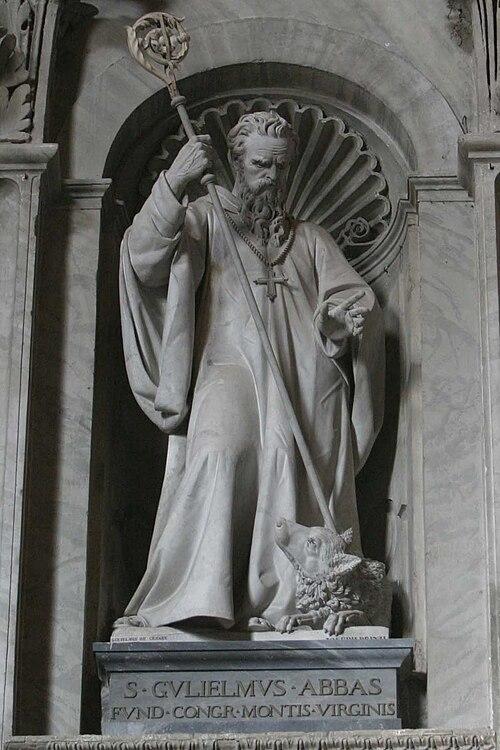
Explore the life of St. William of Vercelli, hermit and founder, whose radical faith shaped Monte Vergine and influenced medieval spirituality.
Newsroom (25/06/2026 Gaudium Press ) Born in 1085 in Vercelli, in Italy’s Piedmont region, St. William entered the world amid privilege. His family was noble and wealthy, positioning him naturally for a future in governance, war, and courtly life. Yet, from a remarkably young age, William chose a radically different path. Renouncing worldly ambition, he resolved to dedicate himself entirely to God, embracing the austere life of a hermit.
His decision was not a retreat born of weakness but rather an act of spiritual conviction. With his parents’ consent, he abandoned all social expectations and embarked on a path of solitude, prayer, and penance—first making a pilgrimage to Santiago de Compostela, and later withdrawing into isolated mountain regions to live in contemplation.
The Hermit Who Drew a Crowd
William’s early hermitage at Monte Solicoli marked the beginning of a paradox that would define his life: the more he sought isolation, the more he attracted followers. Eventually settling on Monte Vergine, a steep and austere mountain, he built a modest hermit’s dwelling and committed himself to prayer and penance, far from human distractions.
Yet his reputation for sanctity and reports of miracles spread quickly. Pilgrims, travelers, and seekers of spiritual counsel ascended the mountain. What began as solitary devotion transformed into a thriving religious community. Disciples gathered, a monastery was formed, and a church dedicated to Our Lady was erected. The mountain itself came to be known as Monte Vergine—the Mount of the Virgin—reflecting the Marian devotion central to William’s spirituality.
A Rule Too Strict
As abbot, William imposed a rigorous and ascetic rule, emphasizing penance, discipline, and simplicity. However, this spiritual rigor ultimately became a source of conflict. Over time, his disciples began to resent the severity of the monastic life he required.
The tension culminated in a dramatic and painful turning point: William was effectively expelled from the very community he had founded. The spiritual father was rejected by his own religious family, a moment described as both tragic and revealing. The monks, seeking a more relaxed way of life, saw him as an obstacle.
Despite this betrayal, William’s response was one of serenity and charity. Rather than condemning his former disciples, he prayed for them, asking divine assistance to restore their fidelity.
A Journey South — and an Unexpected Role
Leaving Monte Vergine behind, William began a journey southward through Italy. He established new hermitages in places such as Monte Laceno, Basilicata, Conza, Guglietto, and Salerno, continuing his mission of spiritual reform and devotion.
His path eventually led him to Naples, a bustling center of culture and political power. There, his reputation reached the ears of King Roger I. The meeting between monarch and hermit marked yet another transformation in William’s life.
From solitary ascetic to influential advisor, William entered the royal court—not as a man of ambition, but as a voice of wisdom and moral authority. His counsel was valued deeply by the king, and he exerted a quiet but profound influence over the kingdom’s governance. In this role, he embodied a rare balance: maintaining the interior life of a hermit while navigating the complexities of political power.
Miracles and Signs of Divine Approval
Tradition attributes extraordinary phenomena to the monastery of Monte Vergine, reflecting a belief in divine endorsement of William’s strict rule. According to accounts, attempts to bring forbidden food—such as meat, eggs, or dairy—into the monastery were met with dramatic consequences. Storm clouds would gather, and lightning would destroy the illicit provisions.
Similar accounts were reported in other monastic communities, such as those influenced by St. Romualdo, where prohibited food would quickly spoil or become infested. These stories were understood as signs that the traditions of penance and austerity established by saints like William were divinely protected and meant to endure.
Death and Legacy
St. William died on June 25, 1142, in Guglietto. Although the original congregation he founded eventually dissolved, his influence did not fade. The monastery of Monte Vergine continued under the care of the Benedictines of Monte Cassino.
In a gesture of respect and continuity, these monks adopted the white habit associated with William, despite their own black Benedictine tradition. This choice symbolized both reverence for the founder and a desire to preserve his spiritual legacy.
A Window into the Medieval Spirit
William’s life offers insight into the broader spiritual and cultural dynamics of the Middle Ages. This era, often characterized by contrasts, saw the flourishing of both intellectual activity and manual labor, bustling urban life alongside profound solitude.
Within this “harmonic contrast,” figures like William played a crucial role. His journey—from nobleman to hermit, from abbot to exile, from pilgrim to royal advisor—illustrates the balance between action and contemplation that defined medieval spirituality.
Three defining images emerge from his life: the hermit alone on the mountain, attracting disciples through holiness; the abbot cast out by his own monks, yet responding with forgiveness; and the humble advisor guiding a king with wisdom and faith. Together, they form a portrait of a man whose strength lay not in power, but in spiritual integrity.
Enduring Lessons
St. William’s story continues to resonate for its themes of perseverance, humility, and trust in divine providence. His life suggests that true influence often arises not from position or authority, but from unwavering commitment to one’s convictions.
Above all, his devotion to the Blessed Virgin Mary shaped both his mission and legacy. Having established his monastery under her protection, it is believed that he died under her care—a fitting end for a life defined by faith.
In the centuries since his passing, the memory of St. William remains a testament to the enduring power of spiritual discipline and the profound impact of a life lived in pursuit of the divine.
- Raju Hasmukh with files from Gaudiumpress.org
Related Images:


