






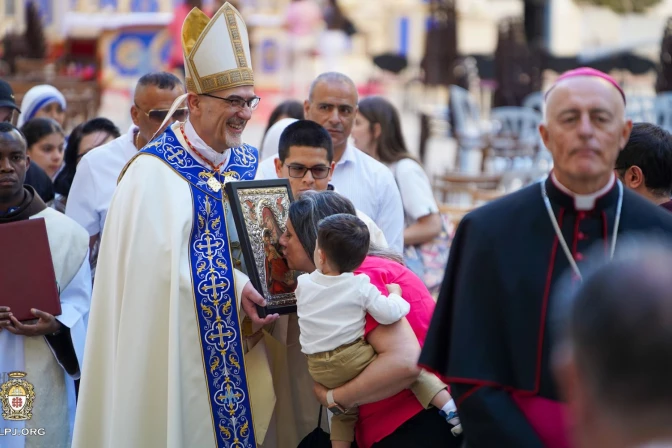
Florence’s Re-Imagine Peace festival closed with Cardinal Pizzaballa’s appeal for dialogue, shared humanity, and reconciliation.
Newsroom (14/07/2026 Gaudium Press ) The “Re-Imagine Peace” festival concluded on Sunday evening, July 12, in Florence, bringing together artists from Israel, Palestine, and Italy in an event dedicated to fostering hope through art, music, and personal testimony. Through performances and reflections on the wounds of the Holy Land, the initiative sought to encourage dialogue and mutual understanding in a time marked by deep divisions and conflict.
The closing concert featured a significant address by the Latin Patriarch of Jerusalem, Cardinal Pierbattista Pizzaballa, whose remarks focused on the moral and human foundations necessary to overcome conflict and build genuine peace.
Beyond Borders and Old Divisions
Opening his reflections, Pizzaballa thanked the participating artists for creating a space for encounter and exchange. He urged audiences to move beyond traditional geopolitical frameworks and entrenched divisions.
“We must also use a little imagination and go beyond our borders,” he said, emphasizing that the cessation of hostilities alone cannot be mistaken for true peace.
According to the patriarch, authentic peace requires creativity, courage, and a willingness to see beyond labels. It demands what he described as the ability to recognize others not as enemies, threats, or categories, but as people. At the center of his message was the need to dismantle the process of mutual dehumanization that accompanies every conflict.
The Revolutionary Power of Listening
Pizzaballa identified deep listening as one of the most essential and transformative acts available to individuals and communities.
“Listening is one of the most revolutionary actions available to us,” he said. “Listening does not mean agreeing, it does not mean renouncing one’s own convictions. It means recognizing that the pain of others exists even when it does not coincide with our own.”
The cardinal argued that acknowledging another person’s suffering does not weaken one’s own identity or convictions. Rather, it affirms the legitimacy of another’s experience and opens the possibility for understanding.
In a world increasingly shaped by polarized narratives and rigid allegiances, he suggested that genuine listening offers a path toward breaking cycles of resentment and mistrust.
Rejecting a Hierarchy of Suffering
Addressing the ongoing tragedy in the Holy Land, Pizzaballa spoke of the pain experienced by both Israelis and Palestinians.
He referred to “the pain of Israeli families” affected by terrorism and “the pain of Palestinian families” living amid destruction and insecurity. For the patriarch, drawing comparisons between these sufferings is both morally wrong and counterproductive.
“Pain should never be a competition,” he stated.
The suffering of a grieving parent or a frightened child transcends political identity, nationality, and religion, he argued. Human dignity remains universal, and no community’s pain diminishes the reality of another’s. This principle, he suggested, reflected the core purpose of the “Re-Imagine Peace” initiative.
The Challenge of Expanding Compassion
Pizzaballa acknowledged that reconciliation is neither simple nor immediate. Forgiveness and coexistence require profound inner strength, including the willingness to move beyond the narratives that offer comfort within one’s own community.
The true challenge, he said, is not deciding who deserves compassion but broadening compassion itself.
“How can I broaden my compassion so that no one is excluded?” he asked.
The patriarch stressed that peaceful coexistence in the Holy Land—and globally—depends on recognizing the value of every individual regardless of nationality, ethnicity, or religious belief. Cultural and spiritual identities, he warned, should never become barriers that isolate people from one another.
Faith as a Force for Healing, Not Division
In one of the strongest moments of his address, Pizzaballa condemned the use of religion to justify violence, describing it as the “gravest sin.”
Rather than serving as instruments of division, religious traditions and leaders should help heal wounded communities, he argued. Their responsibility is to mend hearts, foster understanding, and remind societies that behind statistics, political rhetoric, and national symbols are human beings with hopes, fears, and the right to a future.
Principles for Rebuilding Communities
While acknowledging that he possesses no ready-made political or diplomatic solutions, the cardinal outlined several principles he believes are essential for rebuilding fractured relationships.
Among them were the sacred value of human life, the rejection of violence as an inevitable destiny for nations, and the conviction that the security of one people cannot be built upon the destruction of another.
Within this framework, hope becomes more than an emotion. It becomes a moral responsibility and an active commitment.
“Hope, even when it seems fragile, remains a responsibility,” he said.
In difficult times, communities have an obligation to cultivate dialogue and trust rather than suspicion and fear, working together toward outcomes that may appear impossible.
Choosing Dialogue Over Fear
Concluding his remarks, Pizzaballa expressed the hope that Israelis and Palestinians might increasingly see one another first as human beings rather than adversaries. He called for a culture capable of listening before judging and of recognizing pain without allowing it to evolve into hatred.
“There is something profoundly human in continuing to believe that tomorrow can be better than today,” he said.
At a moment when many voices amplify fear and division, the patriarch urged a different path—one rooted in trust, dialogue, and mutual recognition. Though such transformation will be difficult and gradual, he suggested that all lasting changes begin with the decision to acknowledge the humanity of others.
As “Re-Imagine Peace” drew to a close in Florence, that message stood as the festival’s central legacy: peace is not merely the absence of conflict, but the active choice to recognize shared dignity and nurture hope even in the darkest of times.
- Raju Hasmukh with files from L’Osservatore Romano
Related Images:


