






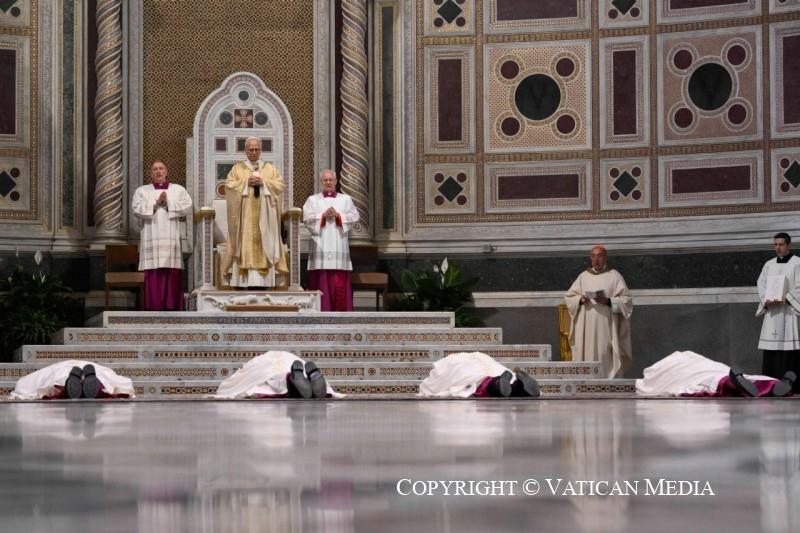
Pope Leo XIV visits Pavia’s Basilica of St. Augustine relics, calling for faith renewal, unity, and Christ-centered mission in a secularized world.
Newsroom (22/06/2026 Gaudium Press ) In a visit rich with historical resonance and spiritual symbolism, Pope Leo XIV traveled Saturday to the Basilica of St. Peter in Ciel d’Oro in Pavia, home to the relics of St. Augustine, in what many viewed as a personal and ecclesial homecoming for the Augustinian pontiff.
The basilica, whose origins date back to the eighth century, has safeguarded the remains of St. Augustine since around 722, when they were brought from Cagliari, Sardinia—having first been transferred there from Hippo in 504. For Pope Leo, the site represents not only a cornerstone of Christian history but also a living source of theological and pastoral inspiration.
A Continuing Augustinian Itinerary
The June 20 visit fits into a broader trajectory of the Pope’s engagement with Augustine’s legacy. Just months earlier, during an April apostolic journey to Algeria, Leo visited Annaba—ancient Hippo—where Augustine served as bishop. The Pavia stop thus offered a complementary moment, linking the saint’s pastoral ministry with the final resting place of his relics.
Upon arrival, the Pope was welcomed by leaders of the Augustinian Order, including Prior General Father Joseph Farrell, Provincial Prior Father Gabriele Pedicino, and Convent Prior Father Gianfranco Casagrande. He met with the Augustinian community and later greeted bishops from the Lombardy Episcopal Conference, underscoring the enduring institutional and spiritual presence of the order within the Church.
A Message Rooted in Love and Unity
Addressing approximately 1,800 faithful gathered in and around the basilica, Pope Leo spoke spontaneously, recalling Augustine’s enduring message: “to live and to love God and our brothers and sisters.” He highlighted fraternal charity as central to Christian witness, saying, “We are signs of love and charity… we know how to live forgiveness, reconciliation and peace.”
In remarks to the Augustinians, the Pope stressed that Augustine’s legacy belongs not to one order but to the entire Church. “St. Augustine is not ours; he belongs to the Church,” he said, urging that the saint’s teachings be shared widely, particularly in a time marked by spiritual searching and societal change.
Re-centering the Church on Christ
In his formal address, Pope Leo praised the Church in Pavia as a resilient community navigating the challenges of secularization and declining religious transmission. He cautioned against discouragement, calling instead for “a gaze animated by the spirit of faith” capable of reading reality with hope rather than pessimism.
“The gaze that is required of us is that of Jesus,” he said.
Central to his message was the call for renewal grounded in Christ. “He is the cornerstone placed as the basis of our ecclesial journey,” the Pope emphasized, warning against becoming distracted by “secondary things” that fail to reach the essential core of Christian life.
He urged communities to prioritize the Gospel, even if it requires relinquishing longstanding structures or forms of security. “The essential thing is to live with Christ,” he said, “and spreading his Gospel is what must be close to our hearts.”
A Living Church in a Secular Age
Pope Leo’s vision of a “living Church” centered on unity, renewal, and active engagement with society. He encouraged priests to return continually to their relationship with Christ, and called on religious communities to renew their charisms in service to the broader Church.
In a secularized world, he said, the primary mission remains the “joyful and liberating proclamation of Jesus Christ,” helping individuals rediscover faith and meaning.
Drawing again on Augustine, Leo highlighted the importance of interiority—the interior life of reflection and conversion—as foundational to Christian witness. At the same time, he emphasized outward engagement, describing the Church as “well rooted in the territory,” attentive to people’s struggles and hopes, and skilled in “the art of listening and accompanying.”
Faith, Culture, and Civic Responsibility
The Pope gave particular attention to the intellectual and cultural life of Pavia, noting the importance of university pastoral ministry and dialogue with academia. Faith, he said, must illuminate humanity’s search for truth, justice, and beauty.
“Study and scientific work challenge believers,” he noted, “to offer a faith capable of illuminating the human search.”
Later, in Piazza Vittoria, addressing thousands gathered in the city center, Pope Leo expanded his message to civic life. He warned against indifference and called for renewed participation in building the common good.
“To be social means to be solidary,” he said, urging citizens to act as “authentic partners” motivated not by self-interest but by shared responsibility.
He encouraged individuals to adopt a simple but profound commitment: “I care about our city… I care about the health of the person next to me.”
A Broader Pastoral Encounter
Earlier in the day, the Pope visited the National Center for Oncological Hadrontherapy (CNAO), a leading Italian facility treating complex tumors with advanced proton and carbon ion therapy. There, he met patients, including children, as well as medical staff.
“God works in our lives also through doctors, nurses and so many people,” he said, thanking the center, which he described as one that “works miracles.”
He also highlighted the vital role of family presence during suffering, affirming that divine accompaniment remains constant even in moments of weakness.
Closing Moments of Prayer and Presence
After leaving the basilica, Pope Leo prayed before the Blessed Sacrament at Pavia Cathedral, venerated the relics of St. Syrus, and blessed a heated cradle intended for abandoned newborns—a gesture symbolizing care for the most vulnerable.
Greeting young people and members of the local Peruvian community, he returned to a theme of personal responsibility in fostering peace. “If we want to change the times… we must begin with ourselves,” he said, calling for an end to hatred, insults, and division.
The visit concluded with a walk through the city despite intense heat, reaffirming the Pope’s pastoral proximity. Before returning to the Vatican, he was scheduled to stop at Sant’Angelo Lodigiano to venerate the relics of St. Frances Xavier Cabrini.
In Pavia, Pope Leo XIV wove together history, theology, and contemporary urgency—offering a vision of a Church rooted in Christ, inspired by Augustine, and engaged in the life of the world.
- Raju Hasmukh with files from NCR Register
Related Images:


