






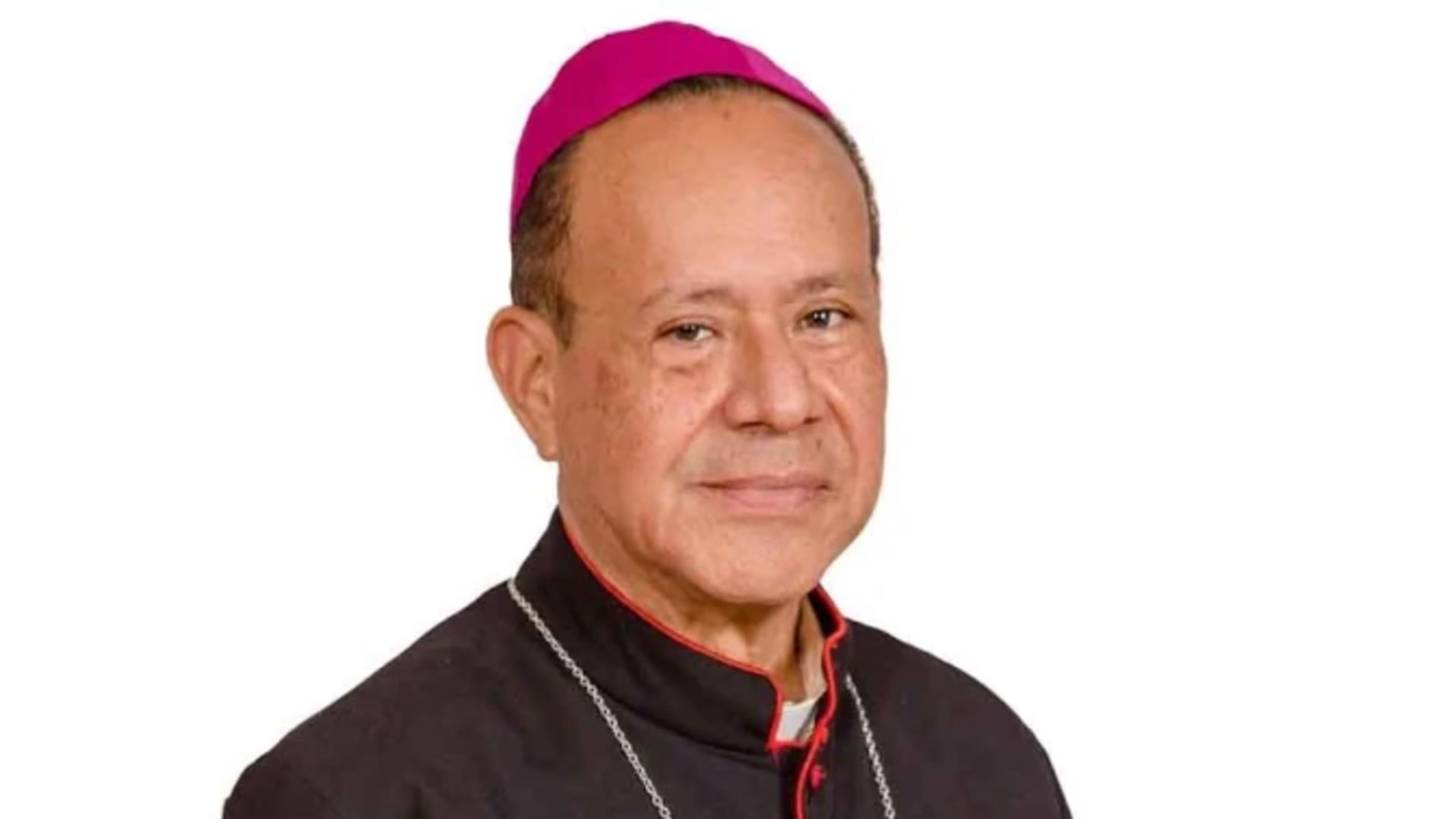
Bishop Abelardo Mata detained in Nicaragua after Mass for persecuted Church, highlighting ongoing repression of clergy.
Newsroom (01/07/2026 Gaudium Press ) Nicaragua’s intensifying crackdown on religious figures drew renewed scrutiny this week after Bishop Emeritus Abelardo Mata of Estelí was detained by police shortly after publicly praying for the country’s persecuted Church.
Mata, who recently turned 80, was held for several hours on June 29, one day after celebrating a Mass in which he called for prayers for exiled and targeted clergy. According to reports from Nicaraguan journalist Arnulfo Peralta Solís, the bishop was taken from a clinic to the Investigations Center at the Evaristo Vásquez Sánchez Police Complex—widely known as “El Nuevo Chipote,” a facility associated with the detention and alleged torture of political dissidents.
The detention underscores a broader pattern of surveillance and restriction imposed on religious leaders in Nicaragua under the government of President Daniel Ortega and Vice President Rosario Murillo. Although Mata was released later that same day and returned to his residence in Tisma, the episode reflects the precarious position of clergy who continue to speak publicly about religious persecution in the country.
According to La Prensa, Mata had traveled to Estelí on June 25 despite reportedly being barred by authorities from visiting the city or celebrating Mass there. On June 28, he presided over a service at Calvary’s Cross Church, where he urged prayers for the persecuted Church and specifically mentioned exiled and restricted clergy, including Bishop Rolando Álvarez and Father Frutos Constantino Valle Salmerón.
Mata’s appearance in Estelí also had a personal dimension. Local media reported that he had visited a clinic for a medical checkup, as he relies on a pacemaker. His presence, however, quickly took on political significance given his longstanding role as a vocal critic of the government.
The broader context reveals a sustained campaign against Catholic figures. Bishop Rolando Álvarez, who succeeded Mata as apostolic administrator of Estelí after Mata’s resignation in 2021, currently lives in exile in Rome. Álvarez was deported in January 2024 after serving approximately 11 months of a 26-year prison sentence, in addition to several months under house arrest. His case became emblematic of the government’s zero-tolerance stance toward dissenting religious voices.
Similarly, Father Frutos Constantino Valle Salmerón, now over 80, remains under house arrest at the Our Lady of Fatima Seminary. As “administrator ad omnia” of Estelí, he is permitted to carry out most pastoral duties but is prohibited from leaving the seminary grounds.
Researchers and observers say Mata’s detention fits into a broader pattern of intimidation. Martha Patricia Molina, author of the report “Nicaragua: A Persecuted Church,” which documents thousands of attacks against Catholics since 2018, emphasized that even mild expressions of concern can provoke retaliation.
“In Nicaragua, anyone who dares to voice an opinion, however obvious it may seem, ends up offending the dictatorship,” Molina said, noting that clergy are frequently kept under surveillance and face threats of imprisonment or exile. She added that many cases of harassment go unreported because public complaints often trigger harsher reprisals.
Accounts from within the country reinforce this assessment. In April, a priest speaking anonymously described a routine of constant monitoring: police photographing him every Sunday, requiring reports on his movements, and scrutinizing his homilies. Addressing social issues from the pulpit, he said, could result in either imprisonment or forced exile.
Despite these risks, Mata has remained a prominent and respected voice. Arturo McFields, Nicaragua’s former ambassador to the Organization of American States, described him as “a strong, courageous voice that has always spoken truth to power.” McFields argued that the government seeks to normalize its actions but that incidents like Mata’s detention reveal a deeper reality of repression.
“The dictatorship tends to want to normalize what is happening in the country,” McFields said, adding that the treatment of Mata demonstrates that “there is nothing normal in Nicaragua.” He further alleged that authorities harbor a longstanding grievance against the bishop and are intent on “settling scores.”
The incident also prompted condemnation from exiled clergy. Bishop Silvio Báez, auxiliary bishop of Managua currently living in Miami, denounced the detention as an act of aggression. Writing publicly, Báez characterized the move as evidence of “the weakness and irrationality of a criminal dictatorship.”
For many observers, the brief detention of an elderly bishop following a prayer for persecuted clergy encapsulates the current climate in Nicaragua—one in which religious expression, particularly when it intersects with calls for justice or solidarity, continues to be met with state pressure and control.
- Raju Hasmukh with files from EWTN News
Related Images:


