






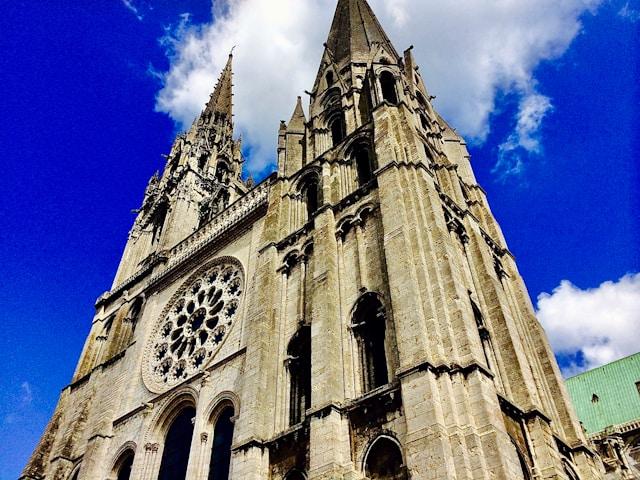
20,000 pilgrims walk to Chartres in 2026, blending youth, tradition, and faith, culminating in Cardinal Burke’s call for perseverance.
Newsroom (26/05/2026 Gaudium Press ) On Pentecost weekend 2026, a vast procession of nearly 20,000 pilgrims set out across the French countryside toward Chartres Cathedral, continuing a tradition now in its forty-fourth year. Their destination: Notre-Dame de Chartres. Their purpose: Christ.
Under searing forty-degree heat, the pilgrims—predominantly young, with an average age of around twenty—pressed forward despite exhaustion, blisters, and sleepless nights. They came from all backgrounds: devout Catholics, traditionalists, families, converts, atheists, Protestants, and international visitors. Some arrived strong; others carried visible and invisible wounds. Yet all shared a common intention—to walk.
The pilgrimage stands in stark contrast to a modern culture oriented toward comfort and distraction. While much of society encourages consumption and entertainment, these pilgrims deliberately chose austerity and sacrifice. They sang, prayed, and walked, often disconnected from digital life as mobile signals faded across the Beauce plains. For many, that disconnection became a form of liberation.
“They confidently accomplish what others before them… have themselves accomplished. With courage,” observes one reflection on the pilgrimage. That enduring continuity—across generations—captures what participants describe as the “mystery of Faith in Chartres.”
A Living Phenomenon Beyond Stereotypes
To those who have never experienced it, the Chartres pilgrimage can appear puzzling, even controversial. Critics often reduce it to surface symbols—scouts, banners, fleur-de-lis—without grasping its deeper reality. Yet participants insist the pilgrimage is not a relic of the past but a living community.
It is, in fact, a microcosm of society: diverse, complex, and unified only by a shared fidelity to faith. For three days, pilgrims commit to a demanding journey where no one is left behind. The strongest support the weakest; the collective matters more than the individual.
Observers who dismiss the event as archaic risk overlooking its essential feature: a people praying together. At its heart, Chartres is neither retreat nor protest—it is an invitation to mercy, unity, and perseverance.
The Silent Climax: A Shared Act of Faith
The pilgrimage culminates in a solemn moment inside Chartres Cathedral. After days of walking, the gathered thousands fall into silence. Then comes the consecration. In a striking expression of unity, 20,000 people kneel together.
For participants, this is the defining moment—the “victory of the Cross,” as it is described. It represents not only personal devotion but collective witness.
Cardinal Burke’s Call to Perseverance
This year’s concluding Mass was celebrated by Cardinal Raymond Leo Burke, serving as a representative of the Holy Father. Delivered according to the traditional Roman rite, his homily underscored themes of fidelity, endurance, and spiritual clarity in a time of crisis.
“We do not yield to discouragement or despair,” Burke told the assembled pilgrims. He framed the Christian life itself as a pilgrimage toward an eternal destination, marked by trials that ultimately serve a greater good.
The cardinal urged the faithful to remain rooted in the Sacred Heart of Jesus, guided by the Immaculate Heart of Mary, and protected by Saint Joseph. In one of the homily’s most resonant passages, he described Saint Joseph as “the guardian of holy tradition, of holy doctrine, of holy liturgy, and of holy discipline,” a statement widely interpreted as an affirmation of traditional Catholic practices.
Burke also emphasized the transformative power of pilgrimage itself. By stepping away from ordinary life, he said, believers rediscover its deeper, “extraordinary” meaning—especially through prayer, penance, and the Eucharist.
A Growing Movement in Modern Europe
The Paris-to-Chartres pilgrimage continues to grow, breaking participation records and attracting increasing numbers of young people and families. Once viewed as a niche traditionalist event, it has evolved into a significant expression of contemporary Catholic life in Europe.
Its expansion comes amid broader tensions within the Church, particularly following restrictions on the traditional Latin Mass. Yet rather than diminishing interest, these challenges appear to have intensified engagement—especially among younger generations seeking clarity, reverence, and continuity.
For many participants, the appeal lies precisely in what sets Chartres apart: its rootedness in tradition, its emphasis on sacrifice, and its unapologetic focus on faith.
The Enduring Mystery of Chartres
Ultimately, the pilgrimage resists simple explanation. For those who walk it, the experience is deeply personal yet profoundly communal. For those who observe it from afar, it remains enigmatic.
But one reality is undeniable: each year, thousands choose the difficult road to Chartres. They walk not for spectacle, but for something unseen—something, as many believe, that will bear fruit.
And so, generation after generation, the procession continues.
- Raju Hasmukh with files from Tribune Chretienne
Related Images:


