






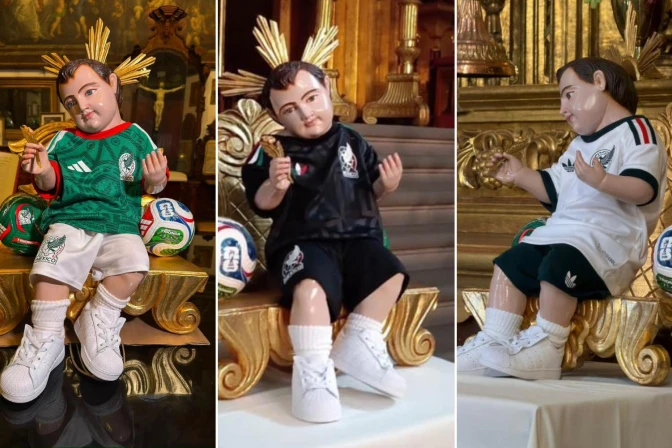
Christ Child dressed in Mexico’s national team jersey returns to cathedral tradition rooted in faith, unity, and World Cup celebration.
Newsroom (25/06/2026 Gaudium Press ) In the heart of Mexico City, where faith and national pride often intersect, a longstanding tradition has quietly returned during the 2026 FIFA World Cup. Inside the Metropolitan Cathedral, one of the most emblematic religious sites in the country, an image of the Christ Child has been dressed in the uniform of the Mexican National Football Team—a practice that dates back to the 1970 World Cup.
The figure now stands on the Altar of the Kings, inviting the faithful to pause and pray amid the excitement of the world’s largest football tournament. Outside the cathedral, the Plaza de la Constitución—widely known as the Zócalo—hosts the FIFA Fan Festival, drawing thousands of visitors daily from across the globe. The juxtaposition underscores a uniquely Mexican blending of devotion and cultural celebration.
Mexico is co-hosting the 2026 FIFA World Cup alongside the United States and Canada, marking the third time the country has hosted the tournament. Matches are being played in Mexico City, Monterrey, and Guadalajara, with a total of 13 games scheduled across the nation. On the field, the Mexican National Team has already made a strong impression, advancing to the round of 16 as group leader.
While football fans celebrate, church leaders emphasize that the cathedral’s gesture is not about sport alone. Speaking on June 24, Fr. Hugo Valdemar, canon of the Mexico City Cathedral, explained that the tradition originated during the 1970 World Cup, when faithful sought to express their joy in a way rooted in spirituality.
“This was not about turning the Christ Child into a good luck charm or asking for a sporting victory,” Valdemar said. Instead, he noted, it was a way of entrusting “the life, the joys, and the hopes of Mexico” to Christ.
Over time, the practice has endured because it resonates deeply with popular religiosity. For many, seeing the Christ Child dressed in the national team’s colors symbolizes the desire to recognize God’s presence even within moments of collective identity and celebration. According to Valdemar, this expression reflects a simple yet profound message: “Lord, even in this that unites us as a country we want to acknowledge your presence.”
This year, the image has been outfitted with three official uniforms, which are changed in sync with the national team’s matches. The complete set—uniforms, balls, and shoes—was donated by a devout family, featuring original Adidas pieces. For the priest, the donation itself is a testament to faith expressed through generosity.
Yet church authorities are careful to ensure that the symbolism remains properly understood. Valdemar stressed that the “focus is not on the jersey” but on “Christ the Child, who reminds us of God’s humility, his tenderness, and his closeness to everyone.”
The Church has also highlighted the importance of guiding such traditions through pastoral care, emphasizing three essential principles: dignity, Christian meaning, and proper orientation. The image, Valdemar said, must always be treated with respect and sobriety, avoiding any trivialization. In this context, the tradition is preserved with decorum, tied to a historical and national moment rather than spectacle.
Equally important is clarifying the theological meaning behind the gesture. The Christ Child is not portrayed as a talisman or symbol of luck, but as a figure who accompanies the people in all dimensions of life—including cultural events like sport. “Christ is near to his people,” Valdemar explained, underscoring the Church’s intention to remain present in everyday experiences.
Pastoral guidance, he added, ensures that the attention drawn by the image ultimately leads to deeper reflection and prayer. While the football jersey may attract visitors or spark curiosity, it serves as an entry point rather than an endpoint. The faithful are encouraged to pray for broader intentions: unity within families, peace in the country, support for young people, and a spirit of integrity among athletes.
At its core, the tradition reflects a broader understanding of popular religiosity—one that sees value in cultural expressions of faith when they are properly guided. Rather than diminishing religious meaning, such practices can open “a beautiful door for many people to look to Christ again with trust and tenderness,” Valdemar concluded.
As Mexico celebrates its role on the global football stage, the scene inside the Metropolitan Cathedral offers a quieter, contemplative counterpoint—one where devotion accompanies the cheers, and where a simple gesture connects a nation’s passion for sport with its enduring spiritual heritage.
- Raju Hasmukh with files from ACi Prensa
Related Images:


