






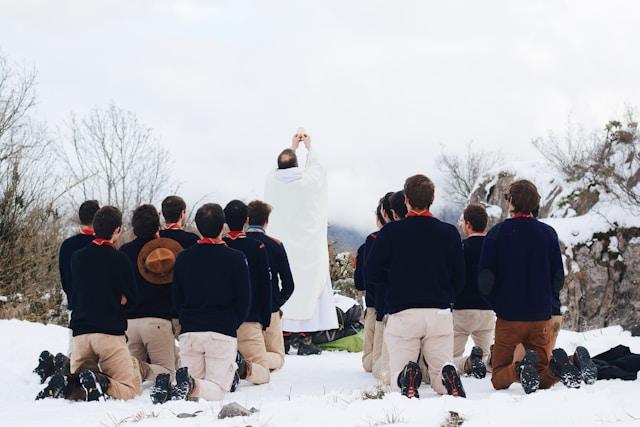
Cardinal Müller explains why the Liturgy of the Word and Eucharist form one act, reaffirming priestly roles and Catholic liturgical doctrine.
Newsroom (25/06/2026 Gaudium Press ) In a theological reflection on the essence of Catholic worship, Cardinal Gerhard Müller underscores the inseparable unity of the Liturgy of the Word and the Eucharistic celebration in the Holy Mass—an understanding firmly rooted in the teaching of the Second Vatican Council and the Church’s constant tradition.
Quoting Sacrosanctum Concilium (56), the Constitution on the Sacred Liturgy, Cardinal Müller reiterates that the two principal parts of the Mass “are so closely linked to each other that they constitute a single act of worship.” For Müller, this teaching points to a deeper theological truth: the unity of worship directed to the Triune God, revealed in Jesus Christ, the incarnate Word.
Christ Present in Word and Sacrament
According to Müller, Christ’s presence in the liturgy is not confined to the Eucharistic species alone. Rather, He is also present in the proclamation of the Word. This dual presence reflects the mystery of the Incarnation, in which the Divine Word became flesh, making both proclamation and sacrament essential to the Church’s worship.
The sacramental nature of the Mass is expressed through what Müller describes as “audible words and visible gestures.” These signs together convey divine grace, forming a unified liturgical action that cannot be divided without distorting its meaning.
The Full Scope of Priestly Ministry
A central concern in Müller’s reflection is the proper understanding of priestly ministry. He emphasizes that the authority conferred through ordination extends to the entire Eucharistic celebration—not only the consecration of bread and wine but also the proclamation and interpretation of Scripture within the Mass.
This holistic vision of priesthood, Müller argues, is consistent with the Church’s doctrinal tradition. The Council of Trent affirmed that priests are instituted by Christ as ministers of both the Word and the sacraments. Likewise, early Christian testimony, such as that of Saint Justin Martyr, describes a liturgical structure in which the presiding minister both expounds Scripture and presides over the Eucharist, assisted by deacons.
The Second Vatican Council reaffirmed this unity in Lumen Gentium (28), teaching that bishops and priests are configured through the sacrament of Holy Orders to Christ as the eternal High Priest, entrusted with preaching, shepherding, and liturgical celebration.
On Lay Participation and Its Limits
While acknowledging that laypersons may validly lead devotions, catechetical gatherings, and celebrations of the Word under episcopal authorization, Müller makes a sharp distinction when it comes to the Holy Mass itself.
He insists that it is not permissible to divide the Mass into separate components led by different ministers—such as assigning the Liturgy of the Word and homily to a layperson while a priest presides over the Eucharistic part. Such a division, he argues, contradicts the essential unity of the Mass.
In line with guidance from the Dicastery for Divine Worship, Müller emphasizes that the homily is an integral part of the Mass and belongs to the ordained minister—whether priest or deacon—by virtue of sacramental ordination.
Historical Errors and Contemporary Risks
Cardinal Müller situates current debates within a broader historical context. He recalls Martin Luther’s criticism that Catholic clergy had reduced their role to ritual performance, neglecting their duty as preachers of the Word. However, Müller notes that the Council of Trent responded by reaffirming, not abandoning, the unity of priestly ministry.
In his assessment, modern attempts to fragment this unity risk repeating past errors. He warns against a “functionalist” approach that divides priestly responsibilities into interchangeable tasks, effectively reducing the sacramental priesthood to a role assigned by the community. Such an approach, he argues, aligns more closely with Protestant theology, which subsumes ordained ministry into the common priesthood of all believers.
A Critique of Selective Appeals to Vatican II
Müller raises particular concern about what he sees as selective interpretations of the Second Vatican Council. He argues that some proponents of expanded lay roles invoke the Council’s authority while simultaneously contradicting its teachings on the nature of the Mass and the priesthood.
In doing so, he contends, they not only depart from the Council of Trent but risk reviving pre-Reformation practices that were themselves a source of conflict and criticism.
A Warning and a Call to Renewal
In a pointed conclusion, Cardinal Müller calls for a renewed fidelity to Catholic doctrine, particularly in contexts where theological and ecclesial tensions are pronounced. He urges a reassessment of attitudes toward the papacy and a deeper engagement with the foundations of Catholic theology.
Without naming individuals, he criticizes what he describes as ideological tendencies that threaten to divide the Church and undermine its sacramental identity. His remarks reflect a broader warning: that attempts to reshape the liturgy or ministry without grounding in tradition risk leading the Church into confusion.
Preserving the Unity of Worship
For Cardinal Müller, the heart of the matter remains clear. The Holy Mass is a single, unified act of worship in which Word and sacrament, proclamation and sacrifice, are inseparably joined. This unity is not a matter of convenience or discipline but a theological necessity grounded in the mystery of Christ Himself.
Any attempt to fragment this unity, he concludes, ultimately obscures the nature of the Church’s worship and its fidelity to the Gospel.
- Raju Hasmukh with files from Infocatholica
Related Images:


