












Underground Catholic priest Fr. Ma Xianshi faces trial in Wenzhou for distributing hymn book, amid harsh repression of diocese. Trial postponed; community seeks Vatican support.
News Desk (14/07/2025, Gaudium Press) The underground Catholic community in the Diocese of Wenzhou, also known as Yongjia by the Holy See, is grappling with intensifying repression from local authorities in Zhejiang province. At the center of this storm is Fr. Ma Xianshi, a priest who until last year served as a “patriotic” priest overseeing the state-sanctioned church, in opposition to Bishop Peter Shao Zhumin, an underground prelate repeatedly arrested in recent years.
Fr. Ma, formerly vice president of the Catholic Affairs Committee for Zhejiang, has been detained since November 2024. Authorities reportedly arrested him for the “public sale in another region” of Tianlu Miaoyin (Heavenly Melodies), a hymn book compiled by the diocese, citing a violation of state regulations. As the diocese’s legal representative, Fr. Ma faces criminal liability for the book’s distribution.
The hymn book, a collection of Chinese hymns used across parishes in Jiangsu, Zhejiang, Shanghai, and Fujian, was edited by priests and seminarians from Sheshan Seminary and published in 2001 by Faith publishing house as part of its liturgical series (no. 119). A high-quality edition with a leather cover and fine paper, it was reprinted eight times until March 2022. Nanjing Amity Printing Co. handled printing starting in 2005, with both editions copyrighted by the Diocese of Wenzhou. The book was distributed wholesale at the Yiwu small goods market by a Catholic company founded by Zhuang Qiantuan, a Wenzhou Catholic arrested alongside Fr. Ma.
Fr. Ma was scheduled to face trial on July 1, 2025, at Yiwu City Court. However, three days prior, after over 300 Wenzhou Catholics requested to attend the proceedings, the court abruptly postponed the trial without announcing a new date. A video posted on Baidu on February 13, 2025, by a lawyer claimed Fr. Ma faces a potential six-and-a-half-year sentence, possibly reducible to three years and three months with cooperation. The lawyer noted that the book’s proceeds, priced at 25–30 yuan, totaled less than 3.5 million yuan, raising questions about the severity of the sentence. Some sources suggest the book had the approval of an official bishop, arguing that financial responsibility should not fall solely on Fr. Ma.
Speculation surrounds the motives for Fr. Ma’s arrest. Some allege the government is attempting to discredit him, with claims—widely doubted by his peers—that he held 200 million yuan (approximately $28 million USD) in a personal account. Others point to his resistance against the imposition of a government-appointed bishop in Wenzhou and his unauthorized meetings with Vatican officials during a pilgrimage as reasons for his targeting. No official priest has publicly defended him, with colleagues in the Catholic Affairs Committee describing the case as “too sensitive.” Some have even called for his removal from duties and the revocation of his priestly status.
Fr. Ma’s detention has been marked by isolation. Neither he nor Zhuang Qiantuan have been allowed to meet with their families during their six-month detention, with only lawyers granted access under pressure to secure a confession. The diocese’s accounts are under intense scrutiny, but no significant personal or financial irregularities have surfaced. A source close to the case described Fr. Ma’s only “mistake” as his steadfast loyalty to the Church.
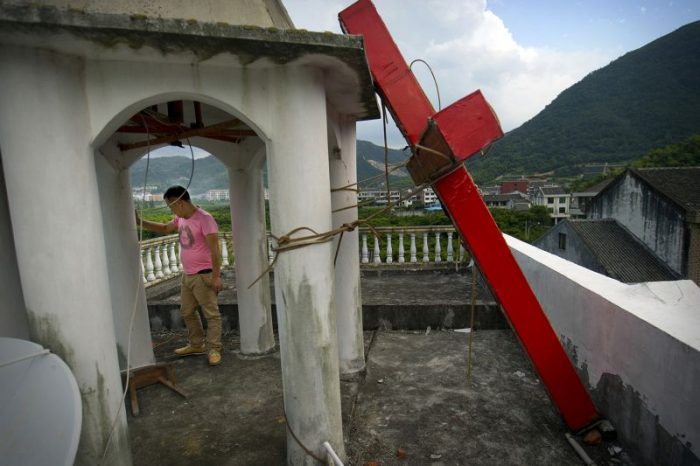
Wenzhou, often called the “Jerusalem of China” for its vibrant Christian community, has faced escalating restrictions. Children are barred from churches, and teachers warn students that attending services could jeopardize their university prospects. Public officials and university students avoid churches, which are now under constant video surveillance. A parishioner lamented, “Since the government-appointed priest founded the Patriotic Association, everything has changed. The priest said, ‘In China, you cannot help but listen to the Communist Party.’”
This is not the first instance of religious persecution in Zhejiang. In 2015, during a campaign to remove crosses from churches, Pastor Joseph Gu of the Evangelical Chongyi Church was arrested on embezzlement charges, spending over two years under house arrest before his acquittal in 2017. Such cases highlight a pattern of targeting religious leaders who resist state control.
Fr. Ma’s last public appearance was on November 2, 2024, during an All Souls’ Day liturgy. If convicted, his priestly certificate will likely be revoked. The case has deeply shaken the Wenzhou diocese, with one source calling it “a shame and a tragedy” that a devoted priest has been “sacrificed,” leaving the community “deeply wounded.”
Amid these challenges, a Wenzhou Catholic expressed hope for the new pope: “The Holy See must prioritize protecting the Church’s faith. If faith is sacrificed for political compromises, we are killing it at its root. A Church that does not bear witness to the truth will split. We hope the Vatican will openly support us, so we do not feel abandoned.”
- Raju Hasmukh with files from Asianews.it
Related Images: