







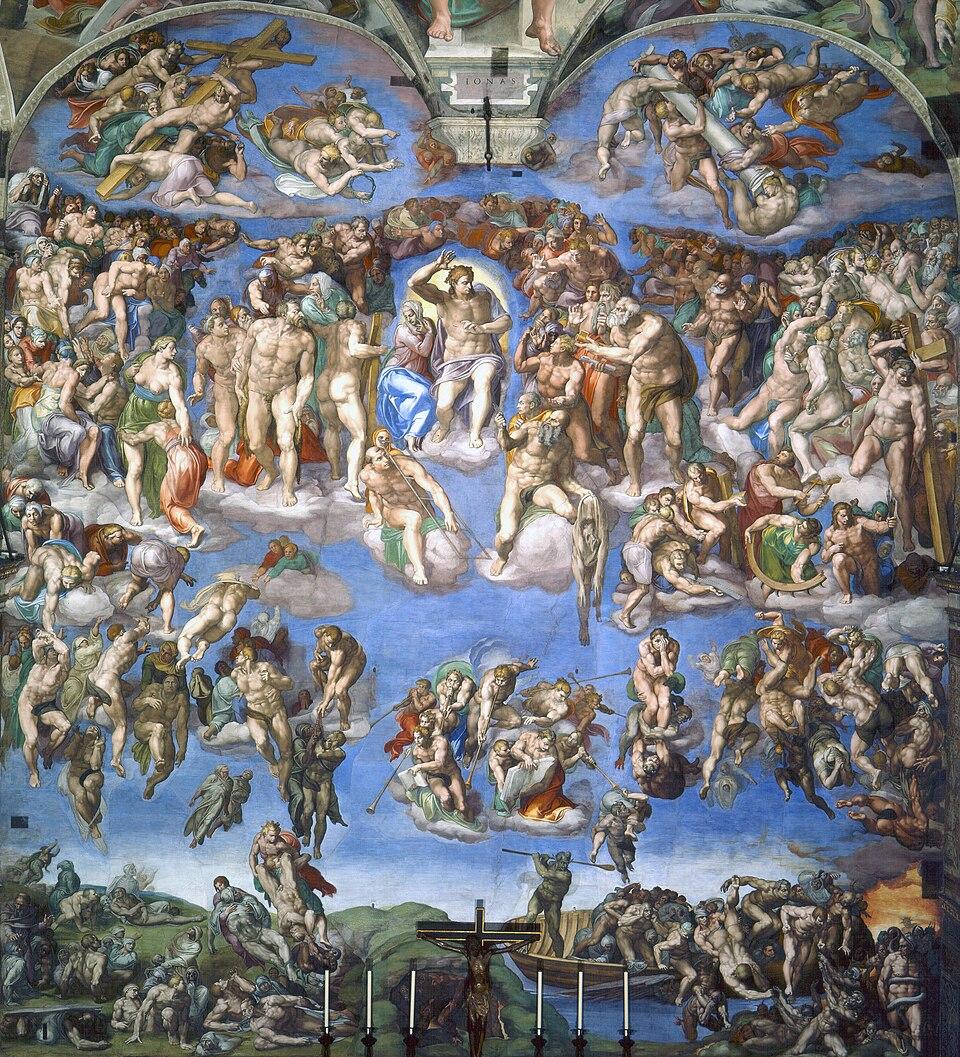
Extraordinary maintenance in the Sistine Chapel begins on Michelangelo’s Last Judgment, a three‑month cleaning that renews color, light and conservation.
Newsroom (24/02/2026 Gaudium Press ) When the scaffolding rose once again along the altar wall of the Sistine Chapel, it marked not a closure but a renewed act of guardianship over one of humanity’s most celebrated images: Michelangelo’s Last Judgment. For approximately three months, the monumental fresco will undergo extraordinary maintenance, a carefully calibrated cleaning that aims to remove a subtle veil accumulated over decades and restore the chromatic brilliance and luminous intensity of the master’s vision. Throughout, the chapel will remain open, its daily rhythm of prayer and visitation uninterrupted, while the technicians of the Vatican Museums work behind a vast printed screen reproducing the very scene they are conserving.
Barbara Jatta, Director of the Vatican Museums, describes a dual commitment: to safeguard Michelangelo’s masterpiece and to honor its uninterrupted role as a living space of worship and encounter. The new intervention comes roughly thirty years after the last major conservation campaign, completed in 1994 under the supervision of then Director General Carlo Pietrangeli and the direction of chief restorer Gianluigi Colalucci. That earlier campaign famously unveiled the unexpected vibrancy of Michelangelo’s palette, overturning long‑held assumptions about his supposed austerity. Now, with this new maintenance, the aim is subtler but no less decisive: to remove a barely perceptible patina and return the fresco’s colors and light to the state intended by the artist, without altering its authentic condition.
Behind the protective canvas that faces visitors, the specialists of the Paintings and Wooden Materials Restoration Laboratory are at work on a scaffold specially conceived and installed in cooperation with the Directorate of Infrastructure and Services of the Governorate of Vatican City State. This large structure, fully screened by the image of the Last Judgment itself, allows restorers to move with millimetric precision across the vast surface while keeping the chapel functioning. The entire operation is made possible through the support of the Florida Chapter of the Patrons of the Arts in the Vatican Museums, whose generosity, acknowledged with gratitude by Jatta, underwrites the sophisticated procedures and the time‑intensive labor required.
Every phase of the intervention is being carefully recorded by the Vatican Museums Photographic Laboratory. This visual documentation, frame by frame, will form a precious testimony not only of the cleaning process but of the state of the fresco at this precise historical moment. By lifting what conservators describe as a “light patina, invisible to the naked eye,” the operation aspires to reveal once more the full intensity of Michelangelo’s chromatic and expressive language, allowing viewers to experience the painting with renewed clarity and immediacy.
The Last Judgment has always stood at the intersection of artistic ambition, papal policy and theological imagination. Commissioned in 1533 by the Medici pope Clement VII, the fresco was not actually begun until 1536, under his successor, Paul III Farnese, and completed in 1541. Fabrizio Biferali, curator in the department devoted to fifteenth‑ and sixteenth‑century art, recalls that, according to Ascanio Condivi’s 1553 “Life of Michelangelo Buonarroti,” Clement VII already had a precise subject in mind for the Tuscan master: the day of the Last Judgment, chosen for the “variety and greatness of the matter,” which he believed would give the artist the widest possible field to test his powers. It is a commission that deliberately sought to match the unprecedented scale and complexity of the fresco with the breadth of Michelangelo’s imagination.
The relationship between the painter and Paul III underscores how highly the work was valued from its inception. So eager was the new pope to see Michelangelo devote himself wholly to the project that, on 17 November 1536, he released him from his contractual obligations for the tomb of Julius II and granted him an annual stipend of 1,200 ducats for life. The anecdote that Paul III, upon first seeing the unveiled fresco, fell to his knees and implored divine forgiveness at the thought of the final judgment captures the shock of encounter that the painting originally provoked. The current maintenance campaign, in its own way, aims to rekindle that same astonishment in contemporary eyes.
Technically, the need for intervention today arises from a pervasive whitish haze across the painted surface, a phenomenon that has progressively softened the fresco’s chiaroscuro and dulled the legibility of its color relationships. Paolo Violini, head restorer of the Paintings and Wooden Materials Restoration Laboratory, explains that the extraordinary maintenance targets this veil, which conservators have identified as an exogenous deposit that subtly alters perception without immediately drawing attention. The cleaning method, refined through extensive testing, uses controlled applications of deionized water brushed onto the surface through a double layer of Japanese paper. This delicate interface allows the water to act on the superficial deposits, fully dissolving unwanted substances while shielding the underlying paint layer.
The emphasis throughout is on reversibility and respect for the fresco’s original condition. Prior to any direct intervention, the team carried out an array of preliminary scientific investigations, detailed photographic recording and meticulous mapping of the artwork’s conservation state. Each step is designed to ensure that the chosen procedures are compatible with the materials and techniques Michelangelo used, and that the cleaning does not disturb the thin, centuries‑old skin of paint that carries his design. In this sense, the operation is closer to a gentle unveiling than to any radical transformation, aiming to “bring to light the original pictorial film in full respect of its authentic state of conservation.”
The current campaign is part of a broader strategy of care that the Vatican Museums have pursued for the Sistine Chapel as a whole. “A Sistine Chapel open to all, in the best possible visiting conditions,” is how Marco Maggi, head of the Conservator’s Office, defines the guiding principle. He speaks of a “daily commitment” toward today’s visitors that is equally a right to be handed on intact to the generations of tomorrow. Since 2010, under the supervision of the Conservator’s Office, the Museums have implemented a comprehensive plan of ordinary maintenance for the chapel. For fifteen years now, on evenings in January and February after closing time, a multidisciplinary team has cycled through the space: restorers of paintings and marbles, diagnostics and conservation experts, logistics operators, museum technicians and staff from the Directorate of Infrastructure and Services.
Their tasks are highly specific: thorough dust removal from the frescoes and decorative elements, rigorous visual and instrumental checks of the surfaces, and verification of the performance of the air‑conditioning and lighting systems installed in 2014. These systems are crucial for stabilizing the microclimate and ensuring optimal viewing conditions, particularly in a space that welcomes millions of visitors each year. The extraordinary maintenance of the Last Judgment thus builds on, rather than replaces, an ongoing regime of preventive care.
In 2024, the same spirit of vigilance—rooted in a Vatican tradition dating back to 1543, under Paul III, with the creation of the office of the mundator, responsible for cleaning—led the Museums to undertake a systematic survey of the Last Judgment within the framework of their maintenance plans, three decades after the previous restoration. It was during this comprehensive assessment that experts detected a thin white film of foreign material on the surface, capable over time of distorting the perceived balance of the colors. A year and a half of studies and analyses followed, culminating in the current installation of a special scaffold against the altar wall: an engineering solution that allows restorers to operate safely across the entire painted expanse while the chapel remains open to the faithful.
The planned removal—one might say lifting—of this white veil serves several purposes. It will restore the richness of Michelangelo’s chromatic range to full view, while also generating valuable data about the origin of the deposits and the mechanisms by which they form. This information will be essential to devising strategies to prevent or mitigate similar phenomena in the future, in an environment increasingly stressed by visitor numbers and environmental fluctuations.
Scientific analysis lies at the heart of this intervention. Fabio Morresi, head of the Scientific Research Cabinet, frames the current work as the latest stage in a long‑term, global approach to conservation that relies on the collective expertise of multiple professional profiles serving the Holy See. Nearly thirty years after the last restoration, he notes, the team has returned to “touch and observe” Michelangelo’s work at close range. Continuous monitoring of the paint layer in recent decades had already revealed slight accumulations of particulate matter and localized whitening in certain zones.
These anomalies became the focus of targeted investigation. A sequence of in‑depth scientific tests ultimately established the molecular identity of the whitish substance: calcium lactate. This salt, Morresi explains, is stratified only on the outermost surface of the paint and is highly soluble in water—a chemical and physical property that makes its removal relatively straightforward while minimizing interaction with the pigments below. Thus, the same quality that allowed the deposits to form as a fragile surface layer now permits their careful dissolution without invasive measures.
Throughout the maintenance operations, the Scientific Research Cabinet will maintain constant oversight, performing an articulated series of chemical and physical measurements to support the work of the restorers. The data collected during this phase will be crucial for tracking the fresco’s health over time, providing a baseline against which future changes can be measured. In this way, the cleaning of the Last Judgment becomes not only an act of restoration but also an investment in knowledge, enabling more informed decisions in the decades to come.
Financially, the extraordinary maintenance is once again supported by the Florida Chapter of the Patrons of the Arts in the Vatican Museums, whose contribution embodies a model of international collaboration in the stewardship of cultural heritage. Their backing, acknowledged with particular thanks by Vatican officials, underscores the global stake in the preservation of the Sistine Chapel and its masterpieces. The partnership aligns private generosity with institutional expertise and spiritual responsibility.
For visitors who enter the Sistine Chapel during these months, the sight of a great image temporarily covered by its own likeness may carry a quiet symbolism. Behind the vast printed cloth, invisible to the gaze below, Michelangelo’s teeming universe of saints, martyrs and resurrected bodies is being gently reclarified, its contours and colors sharpened by the removal of a film no tourist would ever have suspected. When the scaffold finally comes down, ideally before Holy Week, those who look up will encounter a familiar scene that appears, almost imperceptibly yet unmistakably, renewed.
In that moment, the intention of the entire project will be fulfilled: to let the Last Judgment speak again with the full force of its original vision, its chromatic depth and dramatic light restored, while honoring the intricate layers of history and care that have sustained it. Between the day Paul III reportedly dropped to his knees before the newly revealed fresco and the day a modern visitor raises a smartphone to capture its newly refreshed blues, a common thread runs: the awe of confronting an image that refuses to belong entirely to the past, because each act of responsible maintenance returns it to the present.
- Raju Hasmukh with files from Vatican News
Related Images:


