












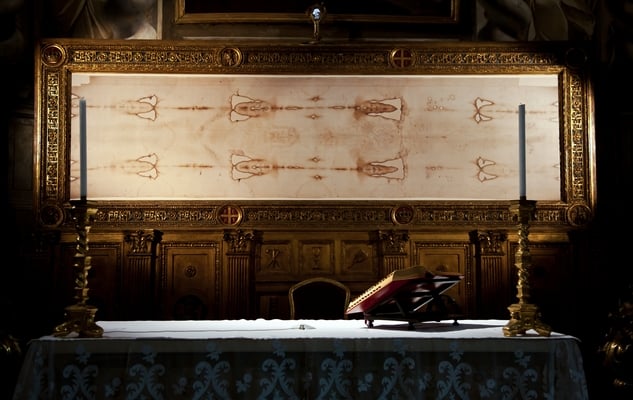
The guardians of the famed Shroud of Turin are disputing the results of a recent study that purports to disprove the cloth’s origins as the burial shroud of Jesus Christ.
Newsroom (05/08/2025 Gaudium Press ) The custodians of the Shroud of Turin, a revered Christian relic believed to be the burial cloth of Jesus Christ, have sharply contested a recent study claiming the shroud’s image was created using a low-relief model, such as a statue, rather than a human body.
In a study published last month in the scholarly journal Archaeometry, Brazilian 3D artist Cicero Moraes argued that the shroud’s depiction of Christ’s body aligns more closely with an artistic representation than a direct imprint of a human body. “The imagery on the shroud is more consistent with an artistic low-relief representation than with the direct imprint of a real human body, supporting hypotheses of its origin as a medieval work of art,” Moraes wrote.
The International Center of Sindonology, a Turin-based organization dedicated to studying and promoting the shroud as an object of Christian devotion, dismissed the study’s findings as unoriginal in an Aug. 4 press release. The center noted that the concept of the shroud’s image as an orthogonal projection—where the image appears as if projected flat from a three-dimensional object—has been recognized since 1902. “There is nothing new in this conclusion of the article,” the center stated.
The center further cited research from the Shroud of Turin Research Project, initiated in the 1970s, which ruled out image formation through painting, rubbing with a bas-relief, or contact with a heated statue. It also highlighted the “Agamemnon Mask effect,” a known phenomenon where an imprinted image distorts when wrapped around a three-dimensional subject, a factor it claims Moraes’ study overlooks.
Critics of the study also questioned the reliability of Moraes’ methodology. The center argued that the digital modeling software used in the study “is not specifically designed for scientific purposes” and lacks a realistic physical context, such as a support plane, undermining the study’s conclusions.
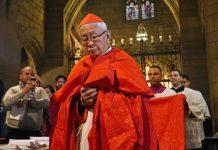
Cardinal Roberto Repole, the Turin archbishop and pontifical custodian of the shroud, expressed skepticism about the study’s credibility. In a statement, he voiced concern over “the superficiality of certain conclusions” that fail to withstand rigorous scrutiny, declining to comment further on what he described as “hypotheses freely formulated by scientists of varying degrees of credibility.”
Quoting renowned physicist Richard Feynman, the International Center of Sindonology emphasized the importance of scientific rigor: “The first principle is that you must not fool yourself — and you are the easiest person to fool.” The center urged researchers to report all potential invalidating factors in their experiments, a standard it claims Moraes’ study does not meet.
The Shroud of Turin, housed in Turin’s Cathedral of St. John the Baptist, remains one of Christianity’s most debated artifacts, with ongoing studies seeking to unravel its origins and authenticity.
- Raju Hasmukh with files form CNA
Related Images: