






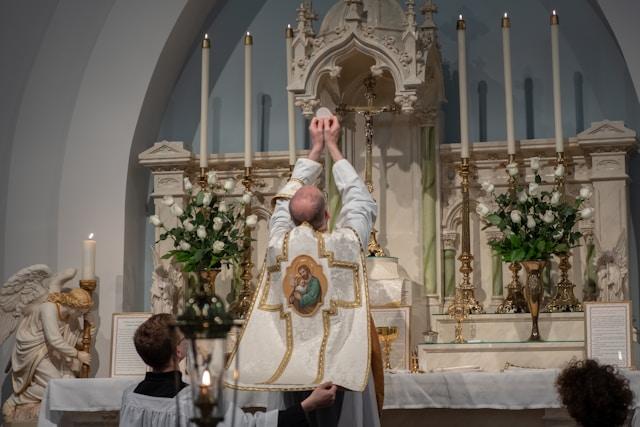
French priest Father Louis-Marie de Blignières calls for dedicated jurisdiction for traditional Latin Mass ahead of Pope Leo XIV’s extraordinary consistory.
Newsroom (06/01/2026 Gaudium Press ) A leading figure in France’s traditionalist Catholic movement has circulated a detailed proposal to over a hundred cardinals calling for the establishment of a dedicated ecclesiastical jurisdiction for communities devoted to the ancient Roman liturgy, marking a significant intervention ahead of Pope Leo XIV’s extraordinary consistory this week.
Father Louis-Marie de Blignières, 76, founder of the Fraternity of Saint Vincent Ferrer, sent the letter dated December 24 to fifteen cardinals known for their concern for traditional liturgy in hard copy, with an additional hundred receiving it by email. The proposal arrives at a crucial moment, as liturgical matters feature prominently on the consistory agenda.
The letter proposes creating an ecclesiastical jurisdiction—modeled on the structure of Military Ordinariates—that would provide canonical framework for faithful attached to the traditional Latin Mass while maintaining full communion with Rome. This approach would offer a stable pastoral solution to tensions that have persisted since Pope Francis issued Traditionis Custodes in 2021, which imposed severe restrictions on celebration of the pre-Vatican II liturgy.
Historical Context and Authority
Father de Blignières brings considerable credibility to this intervention. In 1988, following Archbishop Marcel Lefebvre’s illicit episcopal consecrations, he participated in dialogue with Pope John Paul II that ultimately led to creation of the Pontifical Commission Ecclesia Dei. That commission was established specifically to reconcile groups attached to traditional liturgical forms with the broader Church.
He led the Fraternity of Saint Vincent Ferrer as prior from its 1979 founding until 2011, then again from 2017 to 2023, accumulating more than three decades of leadership experience. His position as an Ecclesia Dei Institute founder gives him unique perspective on the entire history of efforts to accommodate traditionalist Catholics within Church structures.
The concept of dedicated jurisdictions for the traditional rite has circulated within French traditionalist communities for the past decade, though such discussions largely ceased after Traditionis Custodes. Father de Blignières’s letter represents a renewed effort to advance this idea at the highest levels of Church governance.
Precedents and Prior Proposals
The letter documents several historical precedents for such arrangements. In 1988, founders of Ecclesia Dei Institutes first suggested this formula. Two years later, Dom Gérard Calvet, Abbot of Le Barroux, proposed creating apostolic vicariates for the ancient Latin rite during a private audience with John Paul II. A 1991 petition from Una Voce United States advocated for traditional ordinariates, and in 2001, superiors of traditional communities presented a formal supplication requesting apostolic vicariates to the Ecclesia Dei Commission president.
The Holy See actually implemented this solution once before. In 2002, it established the Personal Apostolic Administration of Saint John Mary Vianney within Brazil’s Diocese of Campos. The decree explicitly granted faculty to celebrate Mass, other sacraments, and liturgical actions according to the Roman Rite and liturgical discipline from Pope Pius V through Blessed John XXIII.
Pope Benedict XVI opened a different path in 2007 with Summorum Pontificum, which liberalized access to the traditional Mass by declaring it never abrogated and establishing a framework of “two forms” of the Roman Rite. That approach ended with Traditionis Custodes, which Pope Francis issued to restrict traditional liturgy celebration and reject the “two forms” framework.
The Proposed Solution
Father de Blignières argues that lay faithful and priests strongly attached to the ancient Latin rite and in full communion with Rome constitute a sufficiently numerous and distinctive group to warrant dedicated jurisdiction. He notes that in 1988, the Holy See acknowledged this group possesses genuine “identity” that merits protection.
The letter quotes extensively from Ecclesia Dei, where John Paul II described this identity through references to liturgy, spirituality, apostolate, and discipline—vocabulary comparable to that used for ritual Churches. John Paul II later observed that celebration of sacraments according to pre-reform rites presents characteristics comparable to Eastern rites, further supporting the case for specific jurisdictional arrangements.
Father de Blignières quotes Cardinal Darío Castrillón Hoyos, who led the Ecclesia Dei Commission from 2000 to 2009, characterizing the traditionalist phenomenon as encompassing “a Christian vision of the life of faith and devotion” with particular features including strong sense of belonging to the Mystical Body of Christ, desire to maintain ties with the past in continuity rather than opposition, and deep desire for spirituality and sacredness.
Practical Implementation
The proposal envisions dedicated ecclesiastical jurisdictions under bishops with episcopal character drawn from the communities they would lead. These bishops would be accountable to the Holy See and other ordinaries, facilitating use of the 1962 Pontifical and Ritual for ordinations, confirmations, consecrations, and other ceremonies.
This arrangement would relieve diocesan bishops less familiar with traditional liturgical books and concerned about presbyterate tensions from managing these matters directly. Bishops devoted to the ancient Latin rite would regulate worship sites in concert with other ordinaries while taking primary responsibility for their administration.
The proposal emphasizes cumulative jurisdiction similar to military ordinariates. Faithful would remain members of their residential dioceses while also belonging to the dedicated jurisdiction, maintaining contact with local ordinaries and able to receive sacraments in their dioceses. This avoids creating separate ecclesial communities cut off from diocesan structures.
Father de Blignières suggests this framework would foster acceptance of Vatican II among traditionalist priests and faithful in accordance with Catholic doctrine on assent owed to the Magisterium, removing contentious tensions from the equation.
Theological and Canonical Foundations
The letter invokes Vatican II’s Decree Unitatis Redintegratio, which acknowledges the Church’s historical capacity to find pragmatic solutions promoting unity while safeguarding fundamental elements of ecclesial communion. Father de Blignières argues the situation of Catholics legitimately attached to earlier liturgical and disciplinary forms has lacked stable resolution for over sixty years.
He cites a 2023 analysis by Father Réginald-Marie Rivoire suggesting that by abandoning “two forms of the Roman rite” vocabulary, Traditionis Custodes could paradoxically enable canonical recognition of two distinct Latin rites—the Roman rite and the modern rite. If fully acknowledged by the legislator, this reality should logically lead to erecting personal ecclesiastical jurisdictions with faculty to celebrate all liturgical actions according to the 1962 Roman rite, given that Sacrosanctum Concilium declares all legitimately recognized rites equal in law and dignity.
Father de Blignières presents his proposal as promoting stability, peace, and unity through sound pastoral practice. He frames it as an offering from devoted sons of the Church, submitted in an ecclesial spirit to emerge from the situation blocked since 2021 with justice and mercy.
The letter’s timing—arriving as cardinals gather to discuss liturgical matters—positions it to potentially influence high-level deliberations on one of the most contested issues in contemporary Catholicism. Whether it gains traction among members of the Sacred College remains to be seen, but it represents the most detailed and formally presented proposal for resolving traditionalist tensions to emerge since Traditionis Custodes reshaped the landscape three years ago.
- Raju Hasmukh with files from Diane Montagna’s Substack
Related Images:


