






“Fearing family affections as enemies of the apostolic spirit,” he thanked him, saying that he would see his relatives in Heaven.
Newsdesk (19/01/2026 11:58 Gaudium Press) A descendant of the Kings of Navarre, Saint Francis Xavier was born in 1506 and, from an early age, stood out for his intelligence at the schools he attended. At the age of 18, he went to study at the University of Paris and took up residence at Santa Barbara College, together with Pedro Fabro, a disciple of Saint Ignatius of Loyola.
After a few years, his parents, eager for him to come to Castle Xavier during the holidays, consulted their daughter Madalena, Abbess of the Monastery of Santa Clara, in the Province of Valencia, who was renowned for her holiness and possessed prophetic gifts.
Madalena replied: “Leave him in Paris to study philosophy and theology. God has revealed to me that Francis was the chosen vessel destined to carry the torch of faith to the Indies.” Hearing this, his parents thanked God and agreed that he should remain in the French capital. [1]
Francis met Saint Ignatius, who always said to him, “What good is it for a man to gain the whole world if he loses his soul?” However, very proud of his progress in his university studies, he did not give this counsel any importance.
Nonetheless, moved by Divine Grace, he went on a retreat to meditate on the Spiritual Exercises, causing him to convert completely, and he then joined the group of the Saint’s disciples.
On August 15th, 1534, in a chapel of the current Basilica of the Sacred Heart of Montmartre in Paris (where, in the third century, Saint Denis and his companions were martyred) together with Saint Ignatius and other disciples, he took vows of poverty, chastity, and obedience to the Pope. Three years later, he was ordained a priest in Venice.

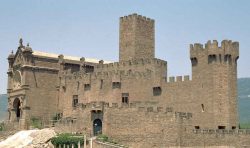
Castle of the family of St. Francis Xavier
Appointed Apostolic Nuncio
King John III of Portugal asked Pope Paul III for missionaries to evangelize Portuguese India. The pontiff contacted Saint Ignatius, who appointed two Jesuit priests for this heroic mission: Simão Rodrigues and Francis Xavier.
As soon as he received the order to travel to Portugal, Xavier remembered his sister Madalena’s prophecy and the dreams he had had confirming this mission.
Together with the Portuguese ambassador to the Holy See, he left Rome on March 15th, 1540, taking with him only his Breviary. Passing through Spain, the diplomat asked him if he would like to visit his family at Castle Xavier. “Fearing family affections as enemies of the apostolic spirit,”[2] he thanked him, saying that he would see his relatives in Heaven.
After three months of travel, they arrived in Lisbon, and the two Jesuits were received by the monarch, who offered them rooms in the Royal Palace, but they preferred to reside in a hospital in the capital.
The king wanted both of them to remain in Portugal, but Saint Ignatius decided that Simão would stay there and Francis would travel to the Indies.
Shortly before leaving, Xavier received papal briefs appointing him Apostolic Nuncio and recommending him to the rulers of Africa and India.
The King wished for both of them to remain in Portugal, but Saint Ignatius decided that Simão would stay there and Francisco would travel to the Indies.
Afonso de Albuquerque, Lion of the Seas
In April 1541, he boarded a ship on which was the governor of Portuguese India, Martim Afonso de Souza – who had been the first grantee of the Captaincy of São Vicente, in Brazil – as well as some vigorous men of business.
But Francis was “Imbued with a longing far greater than that of the most audacious merchants of the time, he went in search of souls for Our Lord Jesus Christ.” He traveled with a heart torn apart by pain at the devastation that the Pseudo-Reformation was wreaking on European Christianity, and perhaps he thought: ‘I am going to India, Japan, and China to invite new peoples and souls not yet evangelized to respond to grace, and thus bring them to the Catholic Faith, which is now shaken in the West.’ [3]
The main warrior who had conquered the Portuguese Indies was Afonso de Albuquerque (1462-1515), nicknamed the “Lion of the Seas’. A descendant of the Portuguese Royal family, his epic deeds were celebrated by Camões in his work “Os Lusíadas”, Canto X (stanzas 40 to 49).
After five months of sailing, they arrived in Mozambique, where they remained for a few days, during which Francis carried out his apostolate.
In May 1542, thirteen months after leaving Lisbon, he landed in Goa, the capital of Portuguese India, which had been conquered by Albuquerque in 1510 after terrible battles in which 6,000 of the 9,000 Muslim occupants of the city died.
The Portuguese had catechized the inhabitants, but when Francisco arrived there was a great moral decay and even monstrous idols were worshipped. Through his presence and preaching, he converted countless Portuguese and Indians.
He also preached in Travancore and Cochin. Speaking in Portuguese, the Indians understood his words, for he had received the gift of tongues. He performed several miracles, including the resurrection of the dead.
In April 1545, he visited São Tomé de Meliapor (St. Thomas of Mylapore), where he prayed at the tomb of the Apostle Saint Thomas, who had evangelized India.
In a letter from 1545 to the Jesuits in Rome, he says: In India, “in one month I baptized more than ten thousand people. (…) After baptizing them, I order the houses where they had their idols to be torn down and the images of the idols to be broken into small pieces.”[4]
A crab carries his crucifix
He was in the Moluccas—an archipelago in Indonesia—where he converted almost the entire population, and in Malacca, Malaysia, which had been conquered in 1511 by the heroic Albuquerque, but had fallen into moral corruption.
Walking through the streets of Malacca with a bell in his hand, he invited people to attend his sermons. He performed many conversions and the resurrection of two dead people. He wrote a Catechism in the Malay language.
During one of his sea voyages, there was a terrible storm near Malacca. While he was praying on the deck of the ship, his crucifix fell into the water.
The next day, he disembarked on an island and, walking along the beach, saw a crab carrying the crucifix toward him. When the man of God knelt down, the crustacean dropped the crucifix before him and disappeared into the sea.
It is common to find crabs marked with a cross on their shells in the Strait of Malacca, known as “St. Francis Xavier crabs.”
Eager to fight sin and save souls, he then set sail for Japan.
By Paulo Francisco Martos
Noções de História da Igreja
[1] DARRAS, Joseph Epiphane. Histoire Génerale de l’Église. Paris: Louis Vivès. 1884, v. 34, p. 27.
[2] Idem, ibidem, p. 225.
[3] CORRÊA DE OLIVEIRA, Plinio. São Francisco Xavier e o autêntico idealismo. In Dr. Plinio. São Paulo, ano X, n. 117 (dezembro 2007), p. 25.
[4] MORAZZANI, Pedro. EP. Para a maior glória de Deus. In Heralds of the Gospel Magazine. November 2005
Compiled by Roberta MacEwan
The post Saint Francis Xavier, Apostle of the East appeared first on Gaudium Press.
Related Images:


