






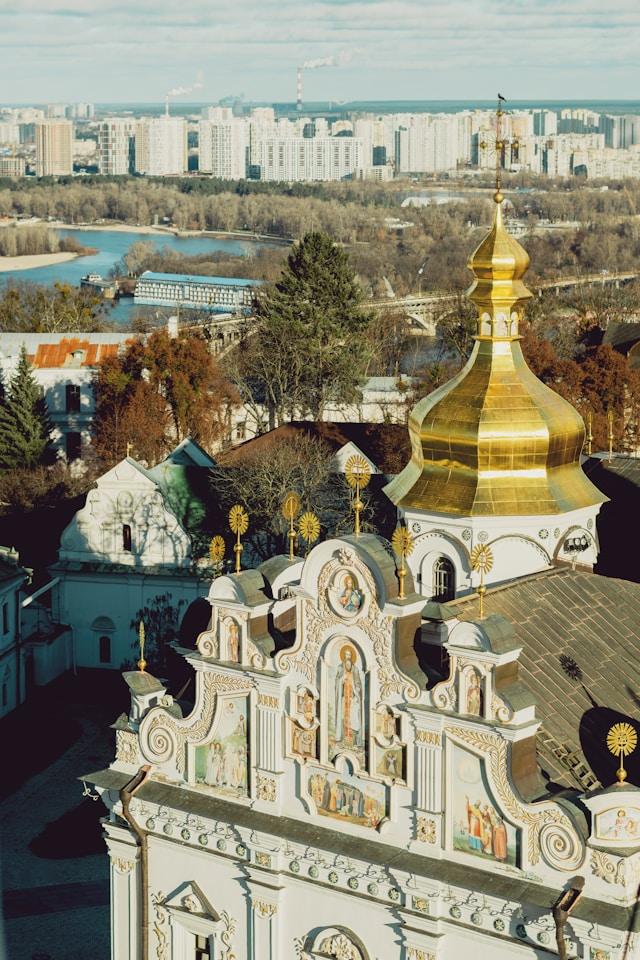
Russian drone strike damages Kyiv-Pechersk Lavra cathedral, sparking outrage from Catholic and Orthodox leaders over attack on sacred site.
Newsroom (16/06/2026 Gaudium Press) A Russian drone strike has inflicted severe damage on one of the most revered religious sites in Eastern Christianity, drawing sharp condemnation from both Catholic and Orthodox leaders worldwide. The attack, which occurred during a broader wave of Russian missile and drone assaults across Ukraine on June 14–15, set ablaze the Dormition (Assumption) Cathedral at the Kyiv-Pechersk Lavra, a UNESCO World Heritage site and a cornerstone of православной (Orthodox) spiritual heritage.
The Kyiv-Pechersk Lavra, an 11th-century monastery complex founded by the monks Anthony and Theodosius, is widely regarded as one of the most sacred sites in the Orthodox world. Metropolitan Archbishop Borys A. Gudziak of the Ukrainian Catholic Archeparchy of Philadelphia described it as “one of the most holy sites in the Orthodox world,” emphasizing its deep historical and spiritual significance. The term “Lavra,” derived from Greek, denotes a monastery of particular importance, underscoring the site’s status as “the first and the most ancient monastery on the territory of contemporary Ukraine.”
According to Ukrainian officials, the cathedral sustained a direct hit during the attack. Ukrainian President Volodymyr Zelenskyy confirmed that two Russian drones deliberately targeted the area encompassing both the Lavra and the Mystetskyi Arsenal, a nearby cultural institution. Zelenskyy personally inspected the damage, climbing onto the cathedral roof where more than 8,600 square feet had been scorched by fire.
The human toll of the attacks across Ukraine was also significant. At least 11 people were killed and 53 injured, including two young children, ages five and six, wounded in Kyiv. Among the deceased were five first responders in Kharkiv, Ukraine’s second-largest city, highlighting the widespread impact of the coordinated strikes.
Religious leaders responded swiftly and forcefully. Bishop Vitalii Kryvytskyi of the Roman Catholic Diocese of Kyiv-Zhytomyr condemned the strike as another example of inhumane aggression. “The Russian occupiers have once again attacked our capital in an inhumane manner,” he said, noting the bitter irony that “’Orthodox’ Russia is destroying Orthodox shrines.”
Kryvytskyi rejected any suggestion that Ukrainian air defenses were responsible for the damage, countering that such measures would be unnecessary without the initial attack. He expressed gratitude to Ukrainian defenders while offering condolences to victims, including “Orthodox brothers and sisters” and all those affected. He also urged resilience, praying that Ukrainians would not succumb to hatred or a desire for destruction in response to the ongoing violence.
Russia has denied responsibility for targeting the Lavra, but Ukrainian authorities maintain that evidence confirms deliberate strikes on the area. The broader assault damaged multiple cultural and residential structures, further intensifying concerns about the protection of civilian and heritage sites during the war.
Metropolitan Epiphanius of Kyiv and All Ukraine, primate of the Orthodox Church of Ukraine, described the attack in stark moral terms. In a public statement, he called it “another Russian crime against humanity, against history, against Christianity.” He went further, questioning the global response: “What more must the Kremlin Antichrist do for the world to realize that decisive action must be taken so that the Russian terror against Ukraine and the very principles of peace comes to an end?”
Invoking a traditional Eastern Christian title for Mary, he added a poignant plea: “Most Holy Theotokos, stop Herod!” The statement underscored both the religious symbolism of the site and the profound emotional impact of its destruction.
Archbishop Gudziak also framed the attack as a broader moral challenge, calling it “a summons to all Orthodox to speak out.” His remarks suggest that the targeting of such a significant religious landmark carries implications beyond Ukraine, resonating across global Christian communities.
The Dormition Cathedral itself has endured a turbulent history. In 1941, retreating Red Army forces detonated mines within the building, after which it was looted during Nazi occupation from 1941 to 1943. The cathedral was eventually restored, with reconstruction completed in 2000. Its recent damage thus marks yet another chapter in a long history of destruction and renewal.
The latest attack also forms part of a broader pattern. Monitoring groups report that well over 700 religious sites in Ukraine have been damaged or destroyed since the onset of Russia’s war, which began with attacks in 2014. Multiple reports, including those by the New Lines Institute for Strategy and Policy and The Raoul Wallenberg Centre for Human Rights, have classified the ongoing conflict as a genocide.
As Ukraine continues to assess the damage and mourn the victims, religious leaders are amplifying their calls for accountability and protection of cultural heritage. The destruction at the Kyiv-Pechersk Lavra stands not only as a physical loss but also as a symbolic blow to spiritual identity, history, and shared human heritage.
- Raju Hasmukh with files form UCA News
Related Images:


