





Pope Leo XIV joins 300 faith leaders at Colosseum for Nostra Aetate 60th; prays for peace, reconciliation, end to wars in historic interfaith vigil.
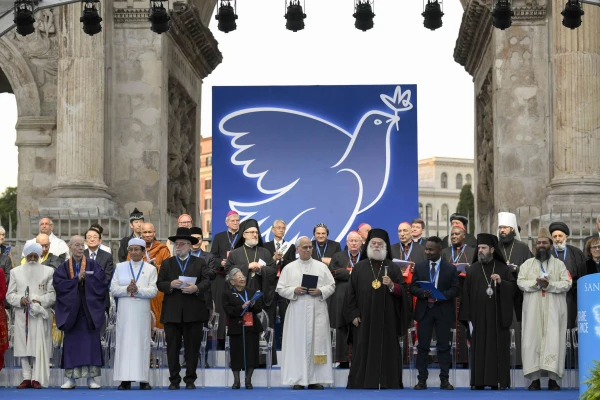
Newsroom (29/10/2025, Gaudium Press ) Pope Leo XIV on Tuesday evening led an unprecedented interfaith prayer vigil at the ancient Colosseum, joined by approximately 300 religious leaders from Christianity, Judaism, Islam, Hinduism, Buddhism, Sikhism, and indigenous traditions to mark the 60th anniversary of Nostra Aetate, the Second Vatican Council’s landmark declaration on relations with non-Christian religions.
The solemn gathering, titled “Peace Is Always Possible,” was organized by the Community of Sant’Egidio and held beneath floodlit arches of the 1st-century amphitheater—a site once synonymous with martyrdom and now a global symbol of reconciliation.
“Peace is a constant journey of reconciliation,” the pontiff declared in his address, delivered from a wooden platform adorned with olive branches and candles. “This is our witness: offering the immense treasures of ancient spiritualities to contemporary humanity.”
Standing alongside Rome’s Chief Rabbi Riccardo Di Segni, Grand Mufti of Egypt Shawki Allam, Buddhist monk Shoten Minegishi, and Sant’Egidio founder Andrea Riccardi, Leo XIV thanked the delegates for traveling to Rome. “Your presence expresses our shared conviction that prayer is a powerful force for reconciliation,” he said.
A Cry Against War and Indifference
The pope issued a searing indictment of global conflicts, particularly in Ukraine, the Middle East, and Africa. “We need a true and sound era of reconciliation that puts an end to the abuse of power, displays of force, and indifference to the rule of law,” he said. “Enough of war, with all the pain it causes through death, destruction, and exile!”
He urged the assembly not to ignore “the cry of the poor and the cry of the earth,” linking social injustice with environmental degradation. “In the power of prayer, with hands raised to heaven and open to others, we must ensure that this period of history, marked by war and the arrogance of power, soon comes to an end, giving rise to a new era,” he said.
“We cannot allow this period to continue,” he warned. “It shapes the minds of people who grow accustomed to war as a normal part of human history.”
As dusk fell, participants—many in traditional vestments—lit candles and raised small blue banners reading “Peace” in over 20 languages. Children from war-torn regions presented olive saplings to each leader, symbolizing hope planted amid ruin.
Vatican Celebration Follows
Following the Colosseum vigil, Pope Leo XIV proceeded to the Vatican’s Paul VI Audience Hall for a vibrant two-hour celebration co-hosted by the Dicastery for Interreligious Dialogue and the Dicastery for Promoting Christian Unity.
The program featured multicultural performances: a Hindu Bharatanatyam dance invoking harmony, a Jewish klezmer ensemble, an Islamic nasheed choir from Indonesia, and a Gregorian chant fused with African drumming. A digital timeline highlighted six decades of papal interfaith milestones—from Paul VI’s 1964 visit to Jerusalem to Leo XIV’s 2024 signing of the Abu Dhabi Declaration on Human Fraternity.
In his closing address, the pope reaffirmed Nostra Aetate’s core insight: “We belong to one human family, one in origin, and one also in our final goal. Religions everywhere try to respond to the restlessness of the human heart.”
“Each in its own way offers teachings, ways of life, and sacred rites that help guide their followers to peace and meaning,” he continued, urging religious leaders to “reawaken the sense of the sacred” in a secular age and “keep love alive.”
“We have come together in this place bearing the great responsibility as religious leaders to bring hope to a humanity that is often tempted by despair,” Leo XIV said. “Let us remember that prayer has the power to transform our hearts, our words, our actions, and our world.”
Historic Convergence
The twin events—prayer at the Colosseum and celebration in the Vatican—represent the most extensive interfaith commemoration of Nostra Aetate since its 50th anniversary in 2015. Vatican officials described Tuesday’s gatherings as a “living testament” to the declaration’s enduring impact.
The anniversary observances continue Wednesday with Pope Leo XIV’s General Audience in St. Peter’s Square, where he is expected to deliver a major catechesis on the theological and practical implications of Nostra Aetate for the 21st century.
- Raju Hasmukh with files from CNA
Related Images: