






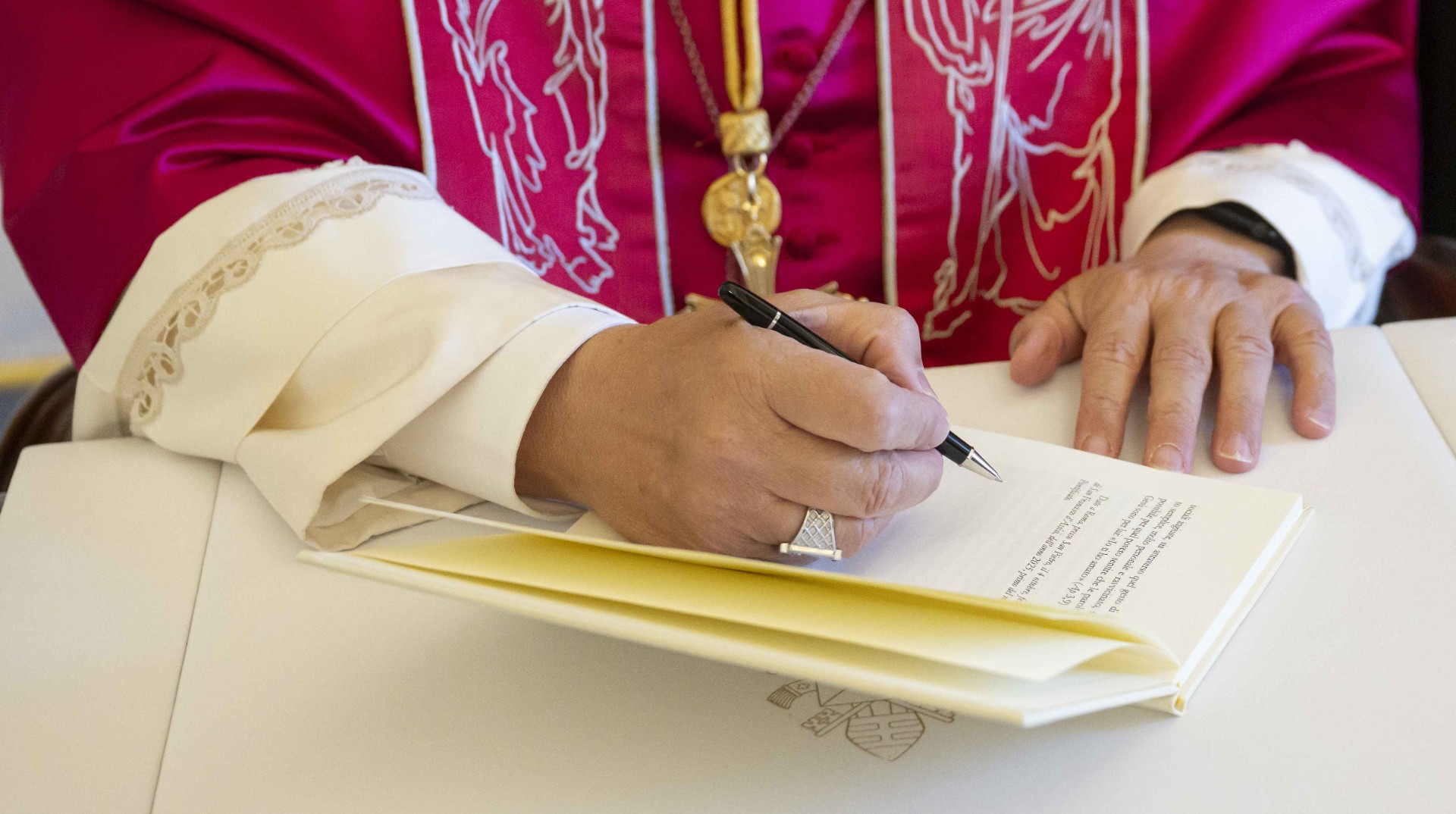
Pope Leo XIV releases “In Unitate Fidei” on Nicaea’s 1700th anniversary, urging renewed faith in Christ’s divinity and stronger Christian unity.
Newsroom (23/11/2025 Gaudium Press ) The Holy Father Pope Leo XIV published the Apostolic Letter In Unitate Fidei on Sunday, 23 November 2025, the Solemnity of Christ the King, to commemorate the 1,700th anniversary of the First Ecumenical Council of Nicaea (325), the assembly that defined Jesus Christ as “consubstantial with the Father” and gave the Church the core of the Creed still recited at every Sunday Mass.
Issued on the eve of the Pope’s planned Apostolic Journey to Türkiye — site of ancient Nicaea (present-day İznik) — the 12-page document calls the 325 council “the enduring confession of faith” that remains the common heritage of all Christians and a source of hope amid today’s wars, disasters, injustices and spiritual confusion.
“Nicaea proclaimed the heart of the Christian faith,” Leo XIV writes. “Even today, during every Sunday Eucharistic celebration, we recite the Nicene-Constantinopolitan Creed, the profession of faith that unites all Christians.”
The letter offers a detailed historical and theological reflection on the crisis provoked by the Alexandrian priest Arius, who taught that the Son was a created being and “there was [a time] when the Son did not exist.” Against this, the 318 bishops gathered by Emperor Constantine affirmed that Jesus Christ is “begotten, not made, consubstantial (homoousios) with the Father” — a formula the Pope insists was not a capitulation to Greek philosophy but a defence of biblical monotheism and the authenticity of the Incarnation.
Pope Leo XIV strongly rejects the still-common charge that Nicaea “Hellenized” Christianity. “The accusation of Hellenization,” he writes, “should be directed at the false doctrine of Arius and his followers, not the Fathers of Nicaea,” who employed extra-biblical terms precisely to safeguard Scripture’s meaning against a Hellenism-inspired subordinationism.
The Pope highlights the soteriological heart of the Nicene definition, quoting St Athanasius: only if the Son is truly God can he deify human beings by becoming man. “No mortal being can defeat death and save us; only God can do so,” the letter states, echoing the classic patristic argument that divinization (theosis) requires divinity in the Redeemer.
Attention is also given to later developments: the completion of Trinitarian doctrine by the Cappadocian Fathers, the full Creed of Constantinople I (381), and its definitive reception at Chalcedon (451). Leo XIV notes that the Nicene-Constantinopolitan Creed is today the only creed shared by Catholics, Orthodox, Anglicans, and most Protestant communities born of the Reformation.
In a passage clearly directed at contemporary culture, the Pope warns that many today live as if “God and the question of God have almost no meaning.” He cites Vatican II’s acknowledgment that Christians bear part of the blame when faith appears irrelevant or is invoked to justify violence rather than mercy, and calls for self-examination on issues of idolatry, care for creation, and solidarity with the poor.
The letter’s longest section addresses ecumenism, describing full visible unity among Christians as a “great objective” of Vatican II and praising St John Paul II’s 1995 encyclical Ut Unum Sint. “What unites us is much greater than what divides us,” the Pope insists, and proposes the common profession of the Nicene-Constantinopolitan Creed and baptism as the foundation for “spiritual ecumenism of prayer, praise and adoration.”
The document closes with a solemn invocation of the Holy Spirit to “gather us into the one flock of Christ” so that the world may believe.
The International Theological Commission’s new study Jesus Christ, Son of God, Saviour: 1700th Anniversary of the First Ecumenical Council of Nicaea is commended as a companion text for deeper exploration of Nicaea’s theological, ecclesial, cultural and social relevance.
The full text of In Unitate Fidei is available in multiple languages on the Holy See website. Pope Leo XIV is scheduled to visit İznik during his upcoming journey to Türkiye, where he is expected to pray at the ruins of the church of Hagia Sophia of Nicaea, traditional site of the 325 council and the proclamation of the Creed.
- Raju Hasmukh with files from Vatican.va
Related Images: