





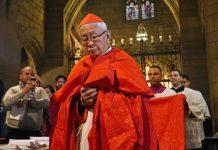

Pope Leo XIV prays with 27 Christian leaders in Nicaea on 1,700th anniversary of First Council, urging unity and rejection of violence in Christ’s name.
Newsroom (28/11/2025 Gaudium Press ) On the shores of Lake Iznik, in the very place where the bishops of the early Church gathered in 325, Pope Leo XIV stood alongside Ecumenical Patriarch Bartholomew I and leaders from nearly thirty Christian Churches and World Communions to mark the 1,700th anniversary of the First Ecumenical Council of Nicaea.
The ecumenical prayer service, held on the second day of the Pope’s Apostolic Journey to Türkiye, culminated with all present jointly professing the Nicene-Constantinopolitan Creed – deliberately omitting the Filioque clause – in a powerful symbol of what still unites Christians across centuries of division.
In his address, Pope Leo XIV warmly thanked Patriarch Bartholomew for his “great wisdom and foresight” in convening the commemoration and expressed gratitude to every Church leader and representative who accepted the invitation.
Returning to the heart of the 4th-century debate, the Pope recalled how the Council of Nicaea was convoked to confront the teaching of the Alexandrian priest Arius, who denied the full divinity of Christ and presented him merely as an intermediary between God and humanity.
“But if God did not become man,” Pope Leo asked, “how can mortal creatures participate in His immortal life?” He stressed that what was at stake then – and remains at stake today – is nothing less than faith in the God who, in Jesus Christ, “became like us to make us partakers of the divine nature.”
The Council’s response, the Nicene Creed, remains the Christological confession shared by virtually all Christian traditions. Quoting its solemn words – “one Lord Jesus Christ, the Only Begotten Son of God… consubstantial with the Father” – the Pope described this common profession as “a profound bond already uniting all Christians” and “of fundamental importance in the journey that Christians are making towards full communion.”
Building on that existing unity, Pope Leo invited believers everywhere to deepen “adherence to the Word of God revealed in Jesus Christ, under the guidance of the Holy Spirit, in mutual love and dialogue.” Overcoming divisions and reconciling with one another, he said, would enable Christians to bear “more credible witness” to Christ and to his message of hope.
The Pope then broadened the horizon to the world’s present conflicts. “Christian unity is greatly needed in our world filled with violence and conflict,” he declared. The desire for full communion among Christ’s followers, he continued, must go hand in hand with the pursuit of fraternity among all human beings and resolute respect for the rights and dignity of every person, regardless of ethnicity, nationality, religion, or personal convictions.
In a firm rejection of religious extremism, Pope Leo insisted: “We must strongly reject the use of religion for justifying war, violence, or any form of fundamentalism or fanaticism.” Religions, he said, are called instead to serve truth and to encourage “fraternal encounter, dialogue and cooperation.”
Concluding his address, the Pope prayed that the 1,700th anniversary commemoration might bear “the abundant fruits of reconciliation, unity and peace” through the grace of God the Father.
As the service ended the assembled leaders rose together and, in a single voice, proclaimed the Creed that first rang out in that same place seventeen centuries ago (omitting the Filioque) – a living reminder that the path to full visible unity begins with the faith Christians already share
- Raju Hasmukh with files from Vatican News
Related Images: