






Pope Leo XIV welcomed participants of the symposium “Nicaea and the Church of the Third Millennium: Towards Catholic-Orthodox Unity,” held at the Pontifical University of Saint Thomas Aquinas from June 4-7.
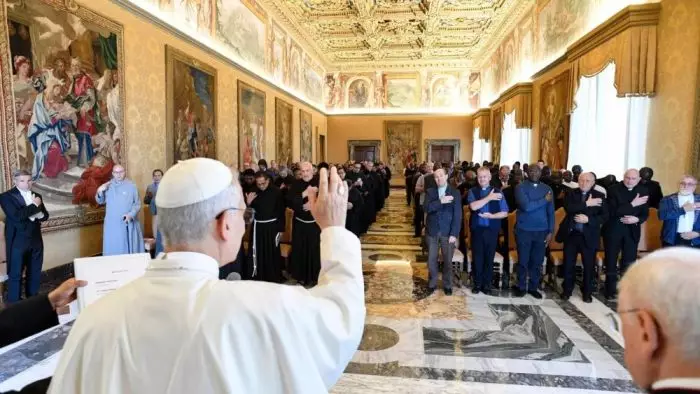
Newsroom (07/06/2025 10:30 , Gaudium Press) In a profound address at the Clementine Hall, Pope Leo XIV welcomed participants of the symposium “Nicaea and the Church of the Third Millennium: Towards Catholic-Orthodox Unity,” held at the Pontifical University of Saint Thomas Aquinas from June 4-7. Organized by Œcumenicum, the Angelicum’s Institute for Ecumenical Studies, and the International Orthodox Theological Association, the event gathered scholars, clergy, and representatives from Orthodox and Oriental Orthodox Churches to reflect on the legacy of the Council of Nicaea and its implications for Christian unity.
Opening with a warm greeting and a light-hearted apology for his slight delay—citing his recent assumption of the papacy—Pope Leo XIV emphasized the symposium’s forward-looking approach. “The Council of Nicaea is not merely an event of the past but a compass that must continue to guide us towards the full visible unity of Christians,” he said, underscoring its foundational role in the shared Catholic-Orthodox journey since the Second Vatican Council.
The Pope highlighted the symposium’s three key themes: the faith of Nicaea, synodality, and the common celebration of Easter.

Addressing synodality, Pope Leo XIV praised the contributions of Eastern and Western delegates to the recent Synod on Synodality, which emphasized ecumenical dialogue as vital to understanding the Church’s synodal nature. He expressed hope that the upcoming commemoration of Nicaea’s anniversary would foster “ecumenical synodal practices,” including joint consultation and discernment on shared concerns, as outlined in the Synod’s Final Document.
The Pope also tackled the issue of Easter’s date, a point of division due to differing calendars. Noting that all Christians celebrated Easter on the same day in 2025, he reaffirmed the Catholic Church’s commitment to finding an ecumenical solution to unify the celebration, enhancing the Church’s missionary witness. “Differences in calendars no longer allow Christians to celebrate together the most important feast of the liturgical year, causing pastoral problems within communities, dividing families, and weakening the credibility of our witness to the Gospel,” he observed.
Concluding on the eve of Pentecost, Pope Leo XIV invited attendees to pray for unity, reciting a prayer from the Eastern tradition:
“O Heavenly King, the Comforter, the Spirit of Truth,
Who art everywhere and fillest all things;
Treasury of Blessings, and Giver of Life,
Come and abide in us, and cleanse us from every impurity,
and save our souls, O Good One.” Amen.
He stressed that Christian unity is a gift of the Holy Spirit, not merely a human achievement, and bestowed a blessing upon the gathering.
The symposium, attended by distinguished professors and ecumenical representatives, marks a significant step in the ongoing dialogue between Catholic and Orthodox traditions, with the 1700th anniversary of Nicaea in 2025 poised to be a milestone in their shared journey.
Raju Hasmukh with files from
-
Address of the Holy Father to Participants in the Symposium “Nicaea and the Church of the Third Millennium: Towards Catholic-Orthodox Unity,” Vatican, June 7, 2025
-
International Theological Commission, Jesus Christ, Son of God, Savior, 2025.
-
Synod on Synodality, For a Synodal Church: Communion, Participation, Mission, Final Document, 2024.
-
Address to Pontifical Mission Societies, May 22, 2025.
Related Images:


