





Cardinal Pizzaballa urges Holy Land pilgrims to reclaim joy and hope amid conflict at Our Lady of Palestine feast in Deir Rafat.
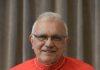
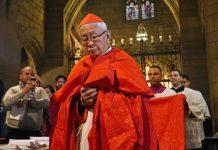
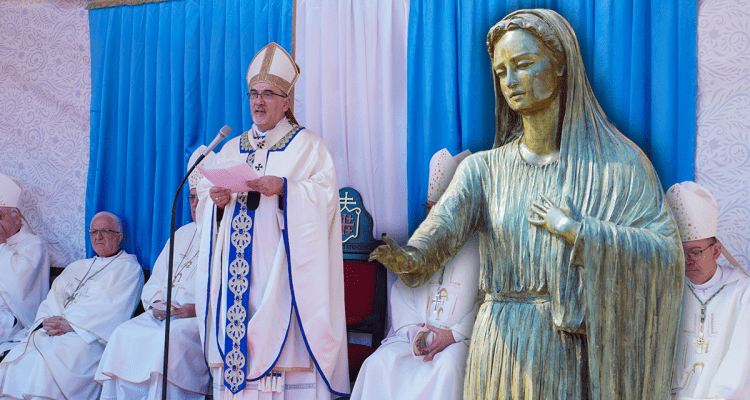
Newsroom (28/10/2025, Gaudium Press ) Cardinal Pierbattista Pizzaballa, Latin Patriarch of Jerusalem, delivered a pointed and pastoral homily on October 25, 2025, during the Solemnity of Our Lady Queen of Palestine, weaving biblical exegesis with the raw realities of life in a war-torn Holy Land. Speaking to a packed shrine and an assembly of pilgrims who had traveled from Gaza, the West Bank, Galilee, and Jerusalem itself, the cardinal refused to sugarcoat the region’s anguish while insisting that despair must not have the final word.
The Disciples’ Return: A Template for Today
Opening with Acts 1:12—“They returned to Jerusalem from the mount called Olivet, which is near Jerusalem”—Pizzaballa lingered on the verb returned. After the crucifixion, he reminded listeners, the apostles had scattered; hope had died inside them. The Emmaus disciples’ confession—“We had hoped…”—became a mirror for contemporary disappointment. Yet the Risen Christ’s appearances reversed the spiral. “It took time for them to understand,” the cardinal acknowledged, “but eventually they returned to the fullness of life. The hope that had seemed like disappointment gradually became a firm and living faith.”
He pressed the parallel: “War has disrupted our lives for too long.” Families remain fractured by displacement, bereavement, and economic collapse. “Political difficulties and their consequences continue to weigh heavily on each of our families,” he said, his voice measured but unflinching. Mistrust festers; prejudice calcifies. “This has increased in us the same feelings… that the disciples felt.”
The Dragon That Must Not Paralyze
Drawing from Revelation’s second reading, Pizzaballa named the “Dragon of the Apocalypse” as the symbol of systemic evil now embedded in daily existence. “We must no longer allow the Dragon to paralyze us—within or around us—as happened to the disciples.” Crucially, he rejected any temptation to treat the conflict as a mere interlude. “I do not know if the war is truly over, but we know the conflict will continue,” he stated plainly. “The complex political and religious dynamics, and the inevitable consequences of mutual prejudice and fear have now become an integral part of our ecclesial identity.”
This is the ground zero of mission, he argued. “They are not simply obstacles to be overcome in order to live; rather, they constitute the very place where the life of the Church is called to express itself.” The question is not whether to inhabit this context, but how: “We are called to choose… whether to let it shape our thinking and our perspective, or to decide for ourselves how to live it as a Christian community.”
A Deliberate Return to Joyful Ordinary Life
Luke’s Gospel supplied the emotional crescendo: the disciples “returned to Jerusalem… with great joy” (Lk 24:52). Pizzaballa seized the phrase. “We too need to return to life with that same great joy,” he insisted, even while conceding that “many of our problems will remain, that we will not see true peace anytime soon.” The early Church received the Spirit not on a mountaintop but “in the midst of ordinary life.” Thus the mandate: “We too must return to ordinary life; we must allow life to flow again among us.”
He enumerated concrete blocks—fear, bitterness, tunnel vision—and prescribed prayer as the antidote. Quoting Acts 1:14, he called the assembly to be “constantly devoting themselves to prayer” in order to “turn the page and rebuild our lives from scratch, drawing the strength and perseverance we need from our encounter with the Risen One.”
Mary’s Faith in the Ordinary
Turning to the Visitation, the cardinal lingered on Elizabeth’s benediction: “Blessed is she who believed…” (Lk 1:45). Two commonplace pregnancies sheltered the extraordinary. “That extraordinary work was possible because they believed,” he repeated. The takeaway was blunt: “Blessed are we when we believe that even in our ordinary lives, God can do extraordinary things.”
He exhorted the faithful to “throw off the works of darkness and put on the armor of light” (Rom 13:12), moving from lamentation to agency. “Cease merely lamenting the death that surrounds us and begin again to create spaces of life and hope.”
Glimmers Already Present
Lest the call sound abstract, Pizzaballa catalogued existing lights piercing the night:
- Medical teams serving under bombardment in Gaza and beyond.
- Prison visitors offering dignity to detainees of every background.
- Interfaith networks distributing food and medicine across checkpoints.
- Global parishes—some “very poor”—sending both prayers and tangible aid “not only in Gaza but throughout the Holy Land.”
- Children in Italy, Brazil, and the Philippines who “gave up what little they had to share with their peers” here.
“The Dragon… has also awakened a response in many people toward goodness, solidarity, communion, and sharing,” he observed. “The Devil is powerless where there is love. And that is where we want to be.”
Final Charge and Entrustment
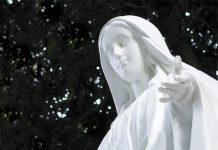
“Take courage, then!” the patriarch concluded, voice rising. “God has not abandoned us, and He will not leave us alone.” He entrusted the entire Patriarchal Diocese to Our Lady of Palestine, petitioning her to “open our hearts to hope… not only to our own problems but also to the presence of God among us: among our poor, in our families, in our religious and parish communities, and in our civil society.” The feast closed with the statue of Mary processed through olive groves, pilgrims’ candles flickering like the small lights the cardinal had just named.
- Raju Hasmukh with files from Latin Patriarchate of Jerusalem
Related Images: