







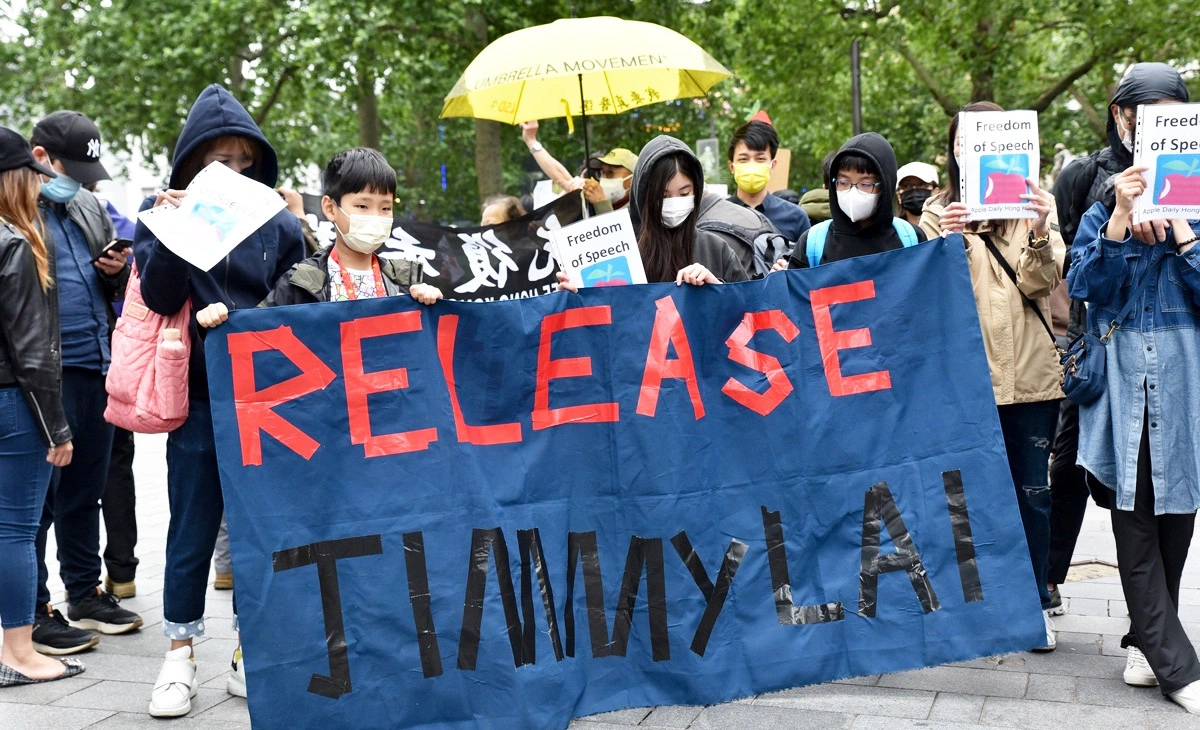
The defense team for Jimmy Lai Chee-ying has urged Hong Kong judges to dismiss critical testimony from a prosecution witness described as an “admitted serial liar.”
Newsroom (27/08/2025, Gaudium Press ) In a closely watched national security trial, the defense team for Catholic media tycoon Jimmy Lai Chee-ying has urged Hong Kong judges to dismiss critical testimony from a prosecution witness described as an “admitted serial liar.” The defense’s closing arguments, delivered on Wednesday at West Kowloon Court, sought to dismantle the prosecution’s narrative that Lai orchestrated an anti-China lobbying campaign through his now-defunct Apple Daily newspaper and related activism.
Lai, 77, a devout Catholic and founder of the pro-democracy tabloid, faces charges of conspiracy to publish seditious articles and collude with foreign forces, allegations tied to his activities between April 2019 and June 2021. Detained since December 2020, Lai is accused of using his media platform and social media presence to provoke foreign sanctions against China and incite public unrest against Hong Kong authorities. Central to the prosecution’s case is Lai’s alleged funding and direction of the “Fight for Freedom, Stand with Hong Kong” (SWHK) lobbying group, which prosecutors claim sought to destabilize China through Western intervention.
The defense, led by barrister Marc Corlett, focused its closing arguments on discrediting Wayland Chan Tsz-wah, a former defendant turned prosecution witness. Chan, described by prosecutors as a liaison between Lai and SWHK, testified that Lai outlined a four-step international lobbying strategy during a January 2020 meeting in Taiwan, allegedly aimed at triggering China’s “implosion.” Corlett countered that Chan, who pleaded guilty to conspiracy to collude with foreign forces and admitted to lying repeatedly to police, lacks credibility. “Chan is a convicted criminal and an admitted serial liar,” Corlett argued, noting that another prosecution witness, former SWHK member Andy Li Yu-hin, failed to corroborate Chan’s account of the Taiwan meeting.
Madam Justice Susana D’Almada Remedios, one of the three presiding High Court judges, suggested that Li’s omission of details might reflect a lapse in memory rather than a contradiction. She also questioned the defense’s call for “empathy” in evaluating Lai’s testimony, to which Corlett clarified that the request stemmed from Lai’s advanced age and declining memory, not a plea for leniency.
Lai has denied directing SWHK to pursue foreign sanctions, attributing the group’s anti-China strategy to UK-based activist Finn Lau Cho-dik. The defense further argued that Lai’s post-June 2020 interactions with U.S. political figures, including appearances on his “Live Chat with Jimmy Lai” talk show, were benign discussions of foreign policy, not evidence of collusion. “Merely talking about foreign policy matters with those who are not co-conspirators does not demonstrate what the prosecution needs to prove,” Corlett asserted.
The defense also challenged hearsay evidence suggesting that Lai’s associate, Mark Simon, a former U.S. naval intelligence officer, encouraged Chan to continue lobbying efforts after the national security law took effect in June 2020. Madam Justice Esther Toh Lye-ping, however, noted “strong evidence” that Lai intended Simon to act as a conduit to activists.
In a separate argument, Jon Wong Kwok-ho, representing three Next Digital companies also on trial, urged the court not to attribute the alleged actions of Apple Daily’s senior management to the corporate entities. He acknowledged, however, that if the court finds Lai to be the “directing mind and will” of the companies, their fates are intertwined with his.
From a Catholic perspective, Lai’s trial raises profound questions about justice, truth, and the role of conscience in public life. As a Catholic, Lai has long framed his advocacy for democracy and free speech as a moral imperative, rooted in the Church’s teachings on human dignity and freedom. His supporters argue that his prosecution reflects a broader clampdown on dissent, challenging the principles of justice and fairness that are central to Catholic social teaching. Critics of the trial, including international Catholic organizations, have called for greater scrutiny of Hong Kong’s application of the national security law, citing concerns about due process and the erosion of civil liberties.
The trial, now in its final stages, was adjourned until Thursday for the judges to consider a defense application to admit certain statements as facts. As the court prepares to conclude, the outcome will likely resonate beyond Hong Kong, raising questions about the balance between national security and the fundamental rights of individuals to speak truth to power—a balance that Lai, guided by his faith, has sought to uphold.
- Raju Hasmukh with files from South China Morning Post
Related Images: