






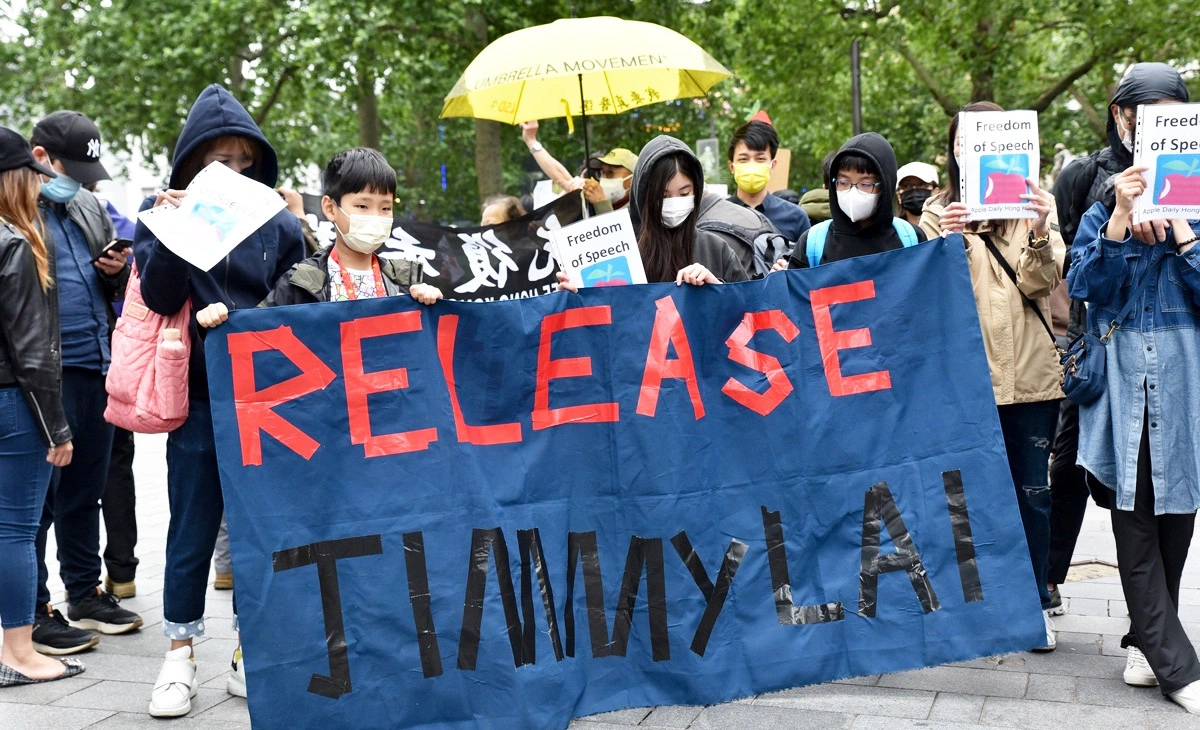
After an exhaustive 156-day trial, the legal proceedings against Jimmy Lai concluded on Thursday at West Kowloon Court in Hong Kong
Newsroom (28/08/2025, Gaudium Press )After an exhaustive 156-day trial, the marathon legal proceedings against Jimmy Lai Chee-ying, the former Hong Kong media tycoon and founder of the now-defunct Apple Daily tabloid, concluded on Thursday at West Kowloon Court. The three presiding High Court judges, led by Madam Justice Esther Toh Lye-ping, have yet to announce a verdict, expected before mid-November. Lai, a devout Catholic, faces life imprisonment if convicted on charges of conspiring to collude with foreign forces and publishing seditious articles. This case raises profound questions about justice, freedom of conscience, and the moral responsibility to stand for truth in the face of oppression.
Lai, 77, has been detained since December 2020, accused of using his media platform to incite foreign sanctions against China and stir public disaffection against Hong Kong authorities between April 2019 and June 2021. Prosecutors allege that Lai’s actions—particularly his meetings with U.S. officials, including then-Vice President Mike Pence and Secretary of State Mike Pompeo in 2019—sought to provoke Western intervention in Hong Kong’s affairs. They claim he radicalized Apple Daily, transforming it into an anti-China outlet that fueled the 2019 protests and promoted “sinophobic” sentiments abroad. Additionally, Lai is accused of financing the “Fight for Freedom, Stand with Hong Kong” (SWHK) group to lobby for hostile actions against China, even after the national security law took effect in June 2020.
The prosecution’s case paints Lai as a deliberate agitator, resolute in his pursuit of foreign sanctions to destabilize China. They point to his public statements, social media posts, and financial support for SWHK as evidence of a calculated effort to undermine the state. Yet, Lai’s actions can be seen as a courageous defense of human dignity and freedom—values deeply rooted in Catholic social teaching. The Church has long upheld the right to free expression and the press as essential to a just society, as articulated in Gaudium et Spes, which emphasizes the importance of truth and the common good. Lai’s outspoken criticism of authoritarian measures, particularly those stifling Hong Kong’s autonomy, aligns with the Church’s call to resist systems that suppress human rights.
Lai’s defense team argued that his conduct was a legitimate exercise of free speech, protected as a fundamental right. They noted that the 161 allegedly seditious Apple Daily articles cited by prosecutors represent a tiny fraction of the outlet’s output during the period in question. Lai himself, testifying for 52 days, admitted to advocating for U.S. sanctions before the national security law’s enactment but insisted he ceased any criminal acts once it took effect. His acknowledgment of misjudging the law’s implications reflects a humility consistent with Catholic virtues, yet his resolve to continue supporting Hong Kong’s freedoms—such as endorsing Britain’s citizenship offer to Hongkongers—demonstrates a commitment to justice that resonates with the Church’s call to solidarity.
The trial’s conclusion, marked by Lai’s wave to supporters and folded hands as he left the dock, underscores his resilience. Lai’s faith has been a cornerstone of his public life, and his steadfastness recalls the Church’s teaching in Lumen Gentium that the faithful are called to bear witness to Christ, even at great personal cost.
As the judges deliberate, the Catholics must reflect on the balance between obedience to lawful authority and the moral imperative to resist injustice. The Catechism of the Catholic Church (CCC 2242) affirms that citizens are not bound to obey laws that violate the moral order or fundamental rights. Lai’s case challenges the faithful to consider whether his actions constitute a prophetic stand against an encroaching authoritarianism that threatens Hong Kong’s freedoms.
The verdict, when delivered, will not only determine Lai’s fate but also signal the trajectory of justice in Hong Kong. For Catholics, it is a moment to pray for discernment, for Lai, and for a society yearning for truth and liberty. As St. John Paul II wrote in Centesimus Annus, “Freedom is not simply the absence of tyranny… but above all the pursuit of the good.” Lai’s trial, viewed through the lens of faith, is a testament to one man’s pursuit of that good, whatever the cost.
- Raju Hasmukh with files from South China Morning Post
Related Images: