






A humble religious who performed thousands of healings and conversions through the intercession of Saint Joseph and who built the largest church in the world in his honour.
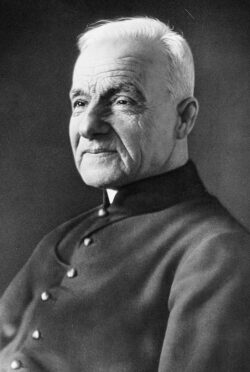

Newsdesk (16/12/2025 15:15, Gaudium Press) Alfred—his baptismal name—was born into a poor and large family on August 9, 1845, in the village of Saint-Grégoire d’Iberville, near Montreal. In poor health, pain accompanied him from an early age.
According to some biographers, his remarkable devotion to St. Joseph may have originated from the fact that his father was a carpenter. But in any case, Alfred’s life was marked from childhood by a special relationship between the Patriarch of the Church and that pious boy, who would build the largest church in the world dedicated to him.
First, however, he had to travel a long and winding road. He tried his hand at various professions, without success, due to his poor health. At the age of twenty, he left for the United States, seeking work in the textile factories of Connecticut, but returned some time later when it became clear that he did not have the strength for such work.
It was the parish priest of his native village who, recognizing the virtue, righteousness, and constancy of this young man, identified in him an authentic religious vocation and sent him to the college that the Congregation of Holy Cross—recently founded in France by Blessed Basile Moreau—already had in Montreal. “I am sending you a saint,” declared the parish priest in the letter recommending this simple and illiterate candidate.
The Congregation’s best “calling card”
Alfred did not disappoint those expectations. He quickly learned to read and, with his exemplary behavior, helped raise the standard of the novitiate. Meditation on the sufferings of Christ had always been one of the pillars of his spirituality. “If we remembered that sin crucifies Our Lord again, our prayers would be more appropriate,” he said. However, he tried to keep his companions cheerful, repeating to them: “Try not to be sad! It’s good to smile a little…”
As the end of his novitiate approached, Alfred Bessette feared that he would be denied permission to take his religious vows because of his poor health. But after asking for the intercession of Bishop Ignace Bourget, he finally took his vows on August 22, 1872, changing his baptismal name to Brother André.
The superior entrusted him with the gatekeeper’s duties at the college, and he performed his task with perfection: he kept the premises in excellent order, served as postman, and performed various other services. Speaking English and French, he revealed a special talent for welcoming people and making them feel at ease. He ended up becoming the Congregation’s best “calling card.”
At the end of his life, he used to say wittily: “When I joined this community, the superiors showed me the door, and I stayed there for forty years.”
Numerous and well-documented cures

About five years after entering the religious order, he began to manifest the gift of healing. One day, he approached the bed where a student lay with a high fever and told him to go play, saying that he was in perfect health. To the astonishment of the doctor on duty, the boy got out of bed healthy.
On another occasion, the father of a student arrived at the gate with a worried look on his face, and the good brother asked him what his problem was. The poor man explained that his wife had become paralyzed. “Perhaps she is not as sick as she seems,” said the saint. At that moment, on the other side of town, the woman got up and began to walk normally.
Brother André took advantage of these healings, always performed discreetly and with an appearance of normality, to carry out a continuous apostolate: he recommended persevering prayer, suggested novenas, “prescribed” the application of oil from a lamp that burned before the image of St. Joseph, or advised people to carry a small medal of St. Joseph with them, because, he said, “all these are acts of love and faith, of trust and humility.”
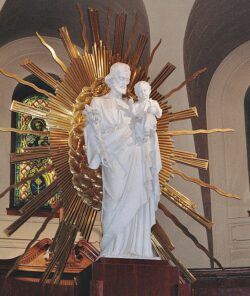
He also made a point of clarifying the true cause of the healings attributed to him, affirming that it is the good Lord who performs miracles and St. Joseph who obtains them. “I am only St. Joseph’s little dog,” he said humbly.
One day, while washing the central corridor of the school, a woman suffering from rheumatism appeared before him, supported by two people, unable to walk on her own. Brother André, looking at her with perplexity, said to her:
“I believe you could walk on your own.” Why don’t you try walking to the chapel by yourself? She did so, and returned home walking without difficulty and crying with gratitude.
When the influx of sick people began to disrupt the school’s routine, Brother André transferred his apostolic activities to a nearby bus station.
Upon learning of this, the Archbishop asked his superiors what he would do if they forced him to stop performing miracles. Upon learning that he would obey blindly, he replied, “Then leave him alone. If this work is of God, it will flourish; if not, it will fall apart.”
The healing of souls and bodies continued in abundance. More than four thousand pages documenting them were collected during the beatification process.
One of the most impressive cases is that of a young man, victim of a terrible industrial accident. With his face burned and at risk of going blind, he ran to find Brother André, but he was attending to an unfortunate cancer patient, and there were many others waiting. Without even seeing him arrive, the religious appeared and asked him:
“Who said you will lose your sight? Do you have confidence in the intercession of St. Joseph?”
When he answered in the affirmative, he recommended:
“Go to church, attend Mass, and receive Communion in honor of St. Joseph. Continue with your medication, but add to it a drop of oil from the lamp of the glorious Patriarch, praying this ejaculatory prayer: ‘St. Joseph, pray for us!’. Have confidence, everything will be fine!”
The accident victim did exactly as he was told, and the next day, the cauterized tissue on his face fell off like “sheets of cellophane.” Fully recovered, he returned as a sign of gratitude.
“Thank St. Joseph and don’t stop praying!” was all the miracle-working saint said.
The owner of a nearby snack bar, who a few days earlier had seen the young man with his disfigured face, could not believe it was the same man. He began to spread the word about the impressive miracle he had witnessed.
A church for Saint Joseph
However, a holy desire burned in the soul of the humble porter. He longed to build a church in honor of his protector near the college on Mont-Royal. But the goal was very daring…
One day, a religious from his community told him that the image of Saint Joseph in his cell seemed to be turning by itself toward that hill. Exultant, Brother André recognized in this fact the long-awaited sign from Providence to begin the realization of his desire, and he covered the desired place with medals.
In 1896, the Congregation of the Holy Cross acquired that land, with the aim of preventing a bad neighborhood from developing around the college. Brother André obtained permission to place an image of St. Joseph in a grotto there, and pilgrimages soon began. Thousands and thousands of people visited it.

After saving two hundred dollars from cutting the hair of high school students at five cents each, it was possible to build a small chapel. They also began to collect alms in the “offering plate” placed at the feet of the Saint, and donations were even received from the United States.
In 1904, a small Oratory of St. Joseph was erected, consisting of a slightly larger chapel and an office, where Brother André took up residence. Thirteen years later, the building was enlarged to accommodate a thousand people seated, but this too soon became too small for the large influx of faithful.
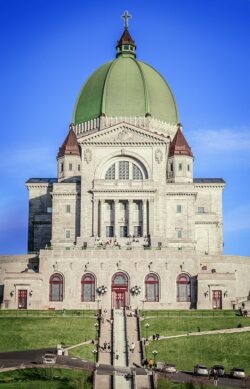
Construction of the current basilica—the largest church in Canada—began in 1924. Eight years later, it had to be halted due to lack of funds as a result of the great economic crisis the country was going through. Without despairing, Brother André placed an image of St. Joseph inside the unfinished building, saying:
“If he wants a roof over his head, the roof will come.”
Two months later, work resumed…
It should be noted that, although he considered it his duty to carry on with this construction, Brother André devoted to it only the time allowed by obedience, without neglecting his other duties.
Ministry of loving sacrifice
The daily life of that humble doorman was entirely devoted to a ministry of loving sacrifice. He began his day by assisting at two Masses, and at eight o’clock in the morning he opened the door to visitors. In his small office, which also served as his cell, he received between 200 and 400 people every day, sometimes as many as 700.
Those who came to see Brother André in search of sensationalism left disappointed. His advice was simple and sensible, aimed at healing souls rather than relieving physical ailments.
Sometimes he limited himself to helping people accept God’s will. “God will have an eternity to console you for your sufferings here,” he would tell them. He also encouraged frequent Confession and daily Communion, assuring them that Jesus refuses nothing to those who welcome Him into their hearts. And he would comment: “It’s curious: I receive numerous requests for healing, but rarely does anyone ask for the virtue of humility or the spirit of faith.”
He showed boundless compassion to people who had strayed from religious practice due to weakness or ignorance. He would tell them the parable of the Prodigal Son in a moving way and conclude: “Comme le bon Dieu est bon – How good God is!”
But he nipped attitudes of rebellion and bad faith in the bud: “Does God owe you anything? If you think so, you can make your own arrangements with Him.”
The price he paid for the relief and conversion of these souls was very high. At the end of the day, even when consumed by indisposition and fatigue, he would still make a slow Way of the Cross in the chapel and then kneel for hours praying with his arms outstretched in the shape of a cross. His bed often remained untouched throughout the night. And when a brother in habit begged him to sleep, offering his sleep as a prayer, he replied gravely, “If you knew the state of those who ask for my prayers, you would not make such a suggestion.”
First posthumous fruits
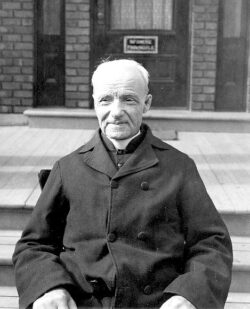

The faithful loved that kind old man with white hair and begged him not to leave them. But at the age of 92, death was approaching, and he kindly consoled them, saying that if someone can do good on Earth, they can do even more from Heaven.
On January 6, 1937, the sad news was prominently reported in Montreal’s most important newspapers: “Brother André has died.”
Brother André did not live to see the completion of the great Shrine, which was only finished in the late 1960s, nor did he see the fulfillment of another of his wishes: to place a large Way of the Cross outside the church to encourage devotion to the Passion of the Redeemer.
A large image of St. Joseph, carved in stone, welcomes visitors on the central staircase. At its base, a three-word inscription welcomes them, evoking the simple and pious wisdom of that little brother who lies in the crypt: “Ite ad Joseph – Go to Joseph.”
Text adapted from Heralds of the Gospel Magazine, October 2010. By Sr. Elizabeth MacDonald, EP
The post He Sought to Honour the Father of Jesus appeared first on Gaudium Press.
Compiled by Roberta MacEwan
Related Images:


