









Empty adoration chapels in the majority-Catholic country and lack of belief in the Real Presence lead to innovative solution in the Philippines.
Newsroom (27/05/2025 11:24, Gaudium Press) As the National Eucharistic Revival in the United States draws to a close this year, the need for a worldwide renewal of Eucharistic devotion becomes increasingly evident—particularly in the Philippines, a nation of deep Catholic roots. Despite being the largest Catholic country in Asia and the third largest in the world, the Philippines faces a troubling reality: empty adoration chapels and a weakening belief in the Real Presence of Christ in the Eucharist.
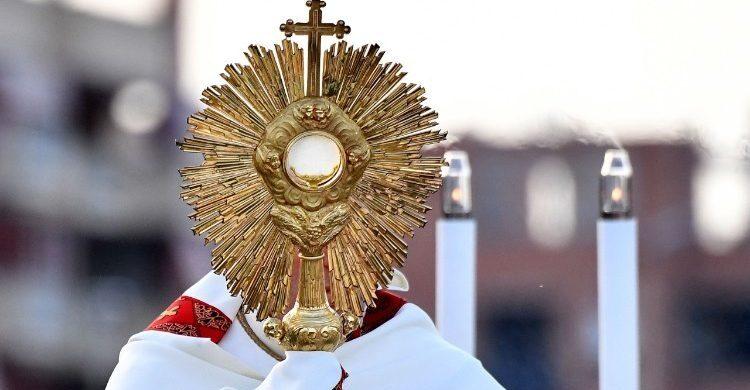
Father James Cervantes, a Filipino-American priest of the Marians of the Immaculate Conception (MIC), expressed his sorrow upon witnessing the neglect of Eucharistic adoration in Manila. “I visited multiple churches across different cities, only to find exposed Blessed Sacraments in deserted chapels,” he told Catholic News Agency (CNA). “In the U.S. and Poland, such a situation would be unthinkable.” The problem reached a shocking low when thieves stole a monstrance containing the consecrated Host from an unattended chapel—an unthinkable sacrilege in a nation that prides itself on Catholic devotion.
A Crisis of Catechesis and Faith Formation
The emptiness of adoration chapels is symptomatic of a deeper issue: a lack of catechesis and authentic faith formation. Many Filipino Catholics, while devout in external practices, lack a profound understanding of the Eucharist as the true Body and Blood of Christ. This deficiency is not unique to the Philippines; across Latin America, millions of Catholics have left the Church for evangelical communities, drawn by vibrant preaching, Bible studies, and a sense of personal encounter with Christ—elements often perceived as lacking in Catholic parishes.
A returning Catholic in the Philippines, who wished to remain anonymous, shared his journey: “I felt spiritually starved in the Church, so I sought nourishment in evangelical circles. But despite their dynamic worship, I realized something was missing—the Eucharist.” His reversion underscores a pivotal truth: No preaching, no matter how charismatic, can replace the Real Presence of Christ in the Blessed Sacrament.
A Simple Yet Powerful Solution: The Holy Hour Pledge
In response to this crisis, parishes across the Philippines have adopted a straightforward but transformative initiative: the Holy Hour Pledge. At St. John Bosco Parish in Santa Rosa, Laguna, parishioners sign pledge cards committing to one hour of Eucharistic adoration per week. The results have been striking—chapels once empty are now steadily frequented by the faithful.
“The pledge works because it is made directly to the Lord, not to any person,” explained Johanna Adaza of the Archdiocesan Shrine of Divine Mercy in El Salvador. However, she noted that most adorers are elderly, highlighting an urgent need for better catechesis among the youth.
A young Mass-goer in Manila echoed this concern: “We crave reverence, substance, and depth. Some homilies feel more like performances than teachings. The homily may be short, but if it’s well-prepared, it can be our only weekly catechesis.”
The Path Forward: Reverence, Formation, and Encounter
Father Cervantes emphasized that the solution lies in returning to the essentials: reverent liturgies, strong preaching, and consistent catechesis on the Real Presence. “The Mass is the most powerful act of worship on Earth,” he said. “When celebrated with devotion, it transforms parishes into vibrant communities of faith.”
Kent, a 25-year-old adorer at St. John Bosco Parish, testified to the life-changing power of Eucharistic devotion: “I started with 15 minutes a day out of desperation. Now, I can’t live without it. St. John Bosco was right—frequent adoration turns ordinary men into saints.”
A Revival for the Whole Church
The Philippine experience serves as both a warning and an inspiration. A nation’s Catholic identity cannot be taken for granted; without ongoing catechesis and Eucharistic devotion, even the most devout cultures risk spiritual erosion. As the U.S. concludes its Eucharistic Revival, the call for a global renewal grows louder. The solution is neither complex nor novel—it begins with a simple act of love: spending time with Jesus in the Blessed Sacrament.
The Holy Hour Pledge is a small step with eternal repercussions. If embraced worldwide, it could rekindle the fire of faith in every corner of the Church. For as the saints remind us: Where the Eucharist is, there is the Church—and where the Church is, there is Christ.
Let us not leave Him waiting alone.
- Raju Hasmukh with files from CNA
Related Images: