






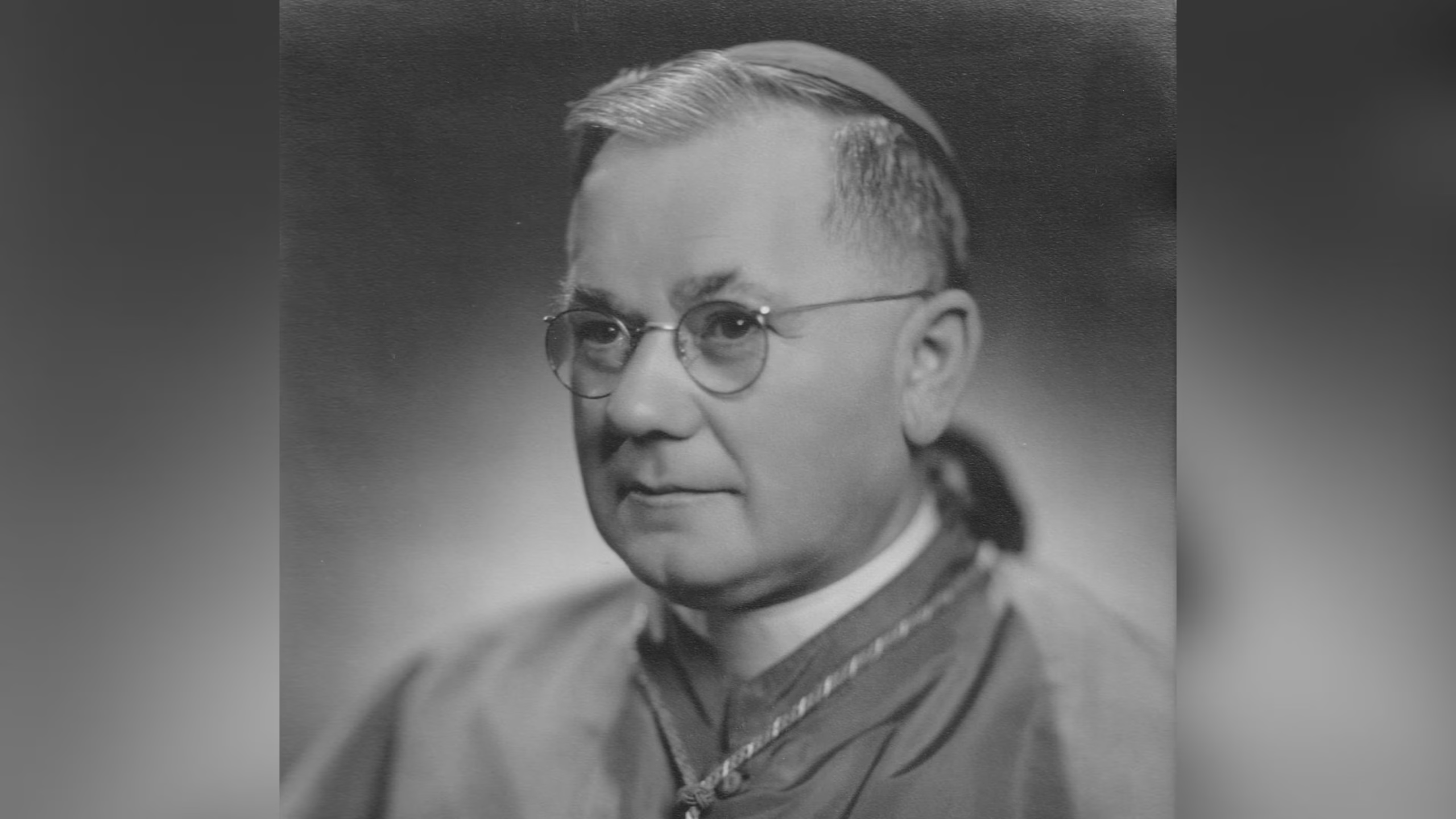
Czech court rehabilitates Archbishop Josef Karel Matocha, ruling his communist-era internment unlawful over six decades after his death.
Newsroom (15/06/2026 Gaudium Press ) More than sixty years after his death under forced isolation, Archbishop Josef Karel Matocha has been formally rehabilitated by a Czech court, marking a significant acknowledgment of injustice during the communist era in former Czechoslovakia.
The district court in Olomouc ruled that Matocha, who served as the city’s archbishop, was unlawfully deprived of his liberty in the 1950s. Although never formally convicted, he was confined under constant surveillance within the archbishop’s palace by the State Security apparatus. The court determined that this form of state-imposed restriction amounted to imprisonment.
The decision, issued under the Judicial Rehabilitation Act, provides long-awaited legal recognition of Matocha’s suffering and reflects a broader reassessment of the communist regime’s treatment of religious figures.
A Long-Overdue Legal Recognition
Archbishop Josef Nuzík, the current head of the Olomouc archdiocese and president of the Czech Bishops’ Conference, welcomed the ruling as a milestone in restoring justice.
“I am very happy that after so many years we have managed to complete this procedural step and achieve justice,” Nuzík said, emphasizing the importance of civil-law recognition alongside moral and historical acknowledgment.
He also reflected on Matocha’s enduring presence, noting that visitors to the archbishop’s residence often express deep emotion upon learning that its elegant surroundings once served as a place of confinement. “These beautiful spaces were his prison,” Nuzík remarked, underscoring the stark contrast between the setting and the suffering endured within its walls.
According to Nuzík, the rehabilitation carries significance beyond the individual case. It serves as a reminder to society that the resilience and sacrifices of those who resisted oppression must not fade into obscurity.
Decades of Isolation Under Surveillance
Matocha’s ordeal began in 1950, just two years after his appointment as archbishop by Pope Pius XII. A scholar holding doctorates in philosophy and theology, he was known for his pastoral dedication and his efforts to advance the beatification process of Archbishop Antonín Stojan.
Despite his religious leadership, Matocha became a target of the communist government’s campaign against the Church. He was effectively placed under house arrest in the archbishop’s palace, cut off from the outside world. He was barred from reading newspapers or listening to the radio, and even access to the palace garden was limited and intermittent.
The isolation persisted until his death in 1961. The circumstances of his passing highlight the harshness of his confinement: he died of a heart attack, exacerbated by the denial of adequate medical care.
Even under such conditions, Matocha’s influence endured. During his internment, he secretly ordained František Tomášek as a bishop—an act of quiet defiance. Tomášek would later rise to become a cardinal and archbishop of Prague, playing a prominent role in the Church’s life during and after communist rule.
Efforts to Preserve Memory and Seek Justice
The push for Matocha’s legal rehabilitation originated from historian and researcher Ladislav Müller, acting on behalf of Jan Kratochvil, director of the Museum of Czech, Slovak, and Ruthenian Exile of the 20th Century in Brno. Their initiative underscores the role of academic and cultural institutions in revisiting historical injustices.
Although the archdiocese has not announced any immediate commemorative events, church officials noted ongoing efforts to rehabilitate other victims of similar persecution. Among them is Cardinal Štěpán Trochta, who also endured internment during his tenure as bishop of Litoměřice and has strong ties to the Olomouc region.
A Broader Reckoning with the Past
Matocha’s case is part of a wider pattern of judicial and societal reassessment in the Czech Republic. In recent years, courts have recognized the unjust treatment of other clergy who suffered under the communist regime.
Earlier this year, the District Court of Prague rehabilitated Cardinal Josef Beran, the former archbishop of Prague, who had been detained in multiple locations. In 2024, the regional court in Hradec Králové rehabilitated priest Josef Toufar, who died after being illegally arrested and tortured.
These rulings collectively highlight a growing determination to confront the legacy of political repression and to formally acknowledge those who endured it.
Legacy of Faith and Resistance
Archbishop Matocha’s life and posthumous recognition illustrate the enduring intersection of faith, resistance, and state power in 20th-century Central Europe. His earlier recognition in 1999 by then-President Václav Havel, who awarded him the Order of Tomáš Garrigue Masaryk for contributions to democracy and human rights, signaled his importance in the national narrative.
The recent court decision builds on that legacy, offering not only a legal correction but also a public reaffirmation of historical truth.
As Archbishop Nuzík emphasized, the rehabilitation serves as a societal reminder: the courage of those who stood firm in the face of oppression must remain part of collective memory—both as a warning and as an inspiration for future generations.
- Raju Hasmukh with files from CNA
Related Images:


