






















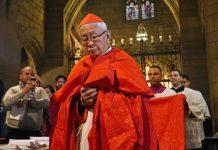


A proposed bill would mandate the disclosure of any sexual abuse, including information revealed in confessionals.
Editorial Staff (20/05/2025 10:26, Gaudium Press) A new threat looms over the seal of confession, this time in the United Kingdom. The Crime and Policing Bill, currently under consideration in the UK, is at the report stage in the House of Commons.
In a statement to the National Secular Society (NSS), the Minister for Safeguarding, Jess Phillips, assured that the inviolability of the Sacrament of Confession would not be protected under this bill.
In the statement, the Labour minister affirmed that the government “is not considering any kind of exception to the mandatory reporting duty for religious institutions,” and that this absence of exception includes “confessionals,” as reported by The Catholic Herald.
Minister Phillips’s declaration was made in response to a request from the NSS, known as an anti-religion campaign group. The NSS asked the government to follow the recommendations of the Final Report of the Independent Inquiry into Child Sexual Abuse (IICSA) of 2022, which called for “legislation that would place certain individuals—the ‘mandatory reporters’—under the obligation to report child sexual abuse.” The reporting obligation “should not be subject to exceptions based on religious relationships, confidentiality, or others,” the report stated.
At the time, Cardinal Vincent Nichols, president of the episcopate of England and Wales, explained to the IICSA that the sacramental seal was non-negotiable, as it was “an essential part of the exercise of the priesthood.”
Furthermore, Canon Law firmly establishes the inviolability of the sacramental seal (c. 983) and defines the penalty of latae sententiae excommunication for anyone who directly violates this seal (c. 1388).
Finally, it is false to claim that the supposed provision would benefit minors, as, if established, it would simply lead hypothetical abusers to avoid the Sacrament of Confession, thereby losing even the possibility of improvement offered by the Sacraments of the Catholic Church, through the action of grace and the good counsel of the confessor.
Compiled by Gustavo Kralj
Related Images: