






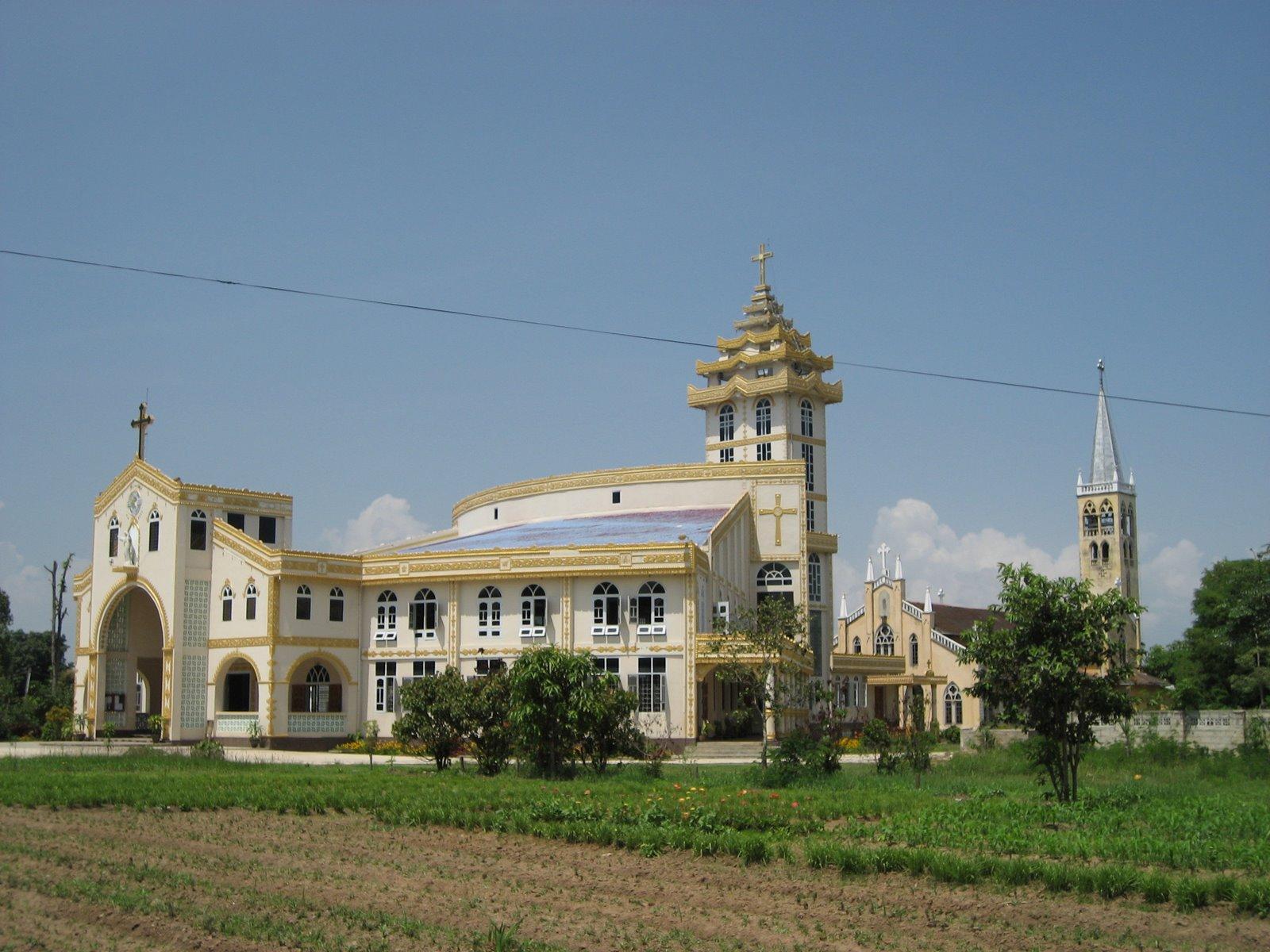
Return of Loikaw Cathedral offers hope as Myanmar conflict displaces 300,000; Church rebuilds amid damage, scarcity, and ongoing unrest.
Newsroom (15/06/2026 Gaudium Press ) The return of the Cathedral of Christ the King in Loikaw marks a rare sign of hope in Myanmar’s conflict-ravaged Kayah State, where years of fighting and displacement have left communities fractured and struggling to survive.
“It is a great joy that the army has returned the Cathedral of Christ the King and the pastoral centre of the Diocese of Loikaw to us,” said Bishop Celso Ba Shwe, speaking about the long-occupied religious complex in the state capital. The cathedral had been seized by military forces in November 2023 and converted into a base, reflecting the broader devastation that has engulfed the region since the military coup of February 2021.
Kayah State remains one of the areas most heavily affected by the conflict between government forces and local resistance groups. The violence has triggered a severe humanitarian crisis, displacing hundreds of thousands of people. Entire villages, schools, and places of worship have been damaged or destroyed, while instability continues to grip large portions of the territory.
Against this backdrop, the Catholic Church has emerged as a constant presence, providing both spiritual support and humanitarian assistance—especially to internally displaced persons scattered across camps and remote regions.
A Damaged Sanctuary
Despite its return, the cathedral is far from restored. Bishop Ba Shwe noted that he has not yet returned to reside there permanently, with two priests currently overseeing parish activities. The building itself suffered significant damage, particularly to its roof, requiring partial repairs to allow the resumption of religious services.
The adjacent pastoral centre remains in worse condition, with extensive restoration work needed. “We still have no electricity or water, so it is not fully accessible,” the bishop explained. Efforts are underway, but progress is gradual. “We are proceeding in small steps.”
Even so, the reopening has prompted the return of some parishioners. Their presence has encouraged the diocese to begin reorganizing pastoral care and community support structures.
A Dispersed Faithful
While the cathedral stands again, much of the diocese remains empty. The majority of parishioners have yet to return home, instead living in displacement.
“The majority of the faithful in the diocese still live scattered across remote areas, in camps for displaced persons or in the forests,” Bishop Ba Shwe said. “Many parishes are empty and closed.”
Choosing to remain close to those most affected, the bishop currently resides in Shansu, at the Church of the Mother of God, near large concentrations of displaced people. From there, he visits parishes and numerous refugee camps spread across the region.
The scale of displacement is staggering. The diocese counts hundreds of camps, with the total number of displaced persons exceeding 300,000. While some areas have seen relative calm, others remain active conflict zones.
A Changing Mission
The crisis has fundamentally reshaped the Church’s mission. Priests and religious workers no longer serve primarily within parish boundaries but instead accompany communities wherever they have taken refuge.
“I visit the refugee camps regularly, and all the priests in the diocese do the same,” the bishop said. Many clergy members now live permanently in these camps. “It is a different kind of mission, a different way of being a priest.”
Pastoral ministry has adapted accordingly—focused less on fixed institutions and more on mobile, community-based care. Sacraments such as Baptism, First Communion, and Confirmation continue to be administered, even in the most precarious conditions.
Faith Amid Hardship
Life in displacement camps is marked by constant uncertainty, but also by resilience and solidarity. According to Bishop Ba Shwe, mutual support among displaced families has become essential for survival.
“We face the difficulties of the refugee camps together, helping one another,” he said, noting that external donors provide critical assistance, often seen by the community as a sign of providence.
Faith remains a central source of strength. “We do not know when God will allow us to return to our homes and our churches,” the bishop reflected. “But wherever we are… we maintain a deep faith in God.” This belief sustains hope that eventual return and peace remain possible.
The demand for spiritual guidance has, if anything, grown stronger in the camps. Families seek out clergy, bringing children for sacraments and community support, underscoring the role of religious life even in crisis.
A Call for Peace and the Future
Beyond immediate needs, Bishop Ba Shwe emphasized the importance of national reconciliation. He called on political leaders, armed groups, and authorities to engage in a process aimed at unity and peace.
“Without reconciliation, there will be no peace,” he said, stressing that the well-being of the population—especially the poorest—must take priority.
The future of younger generations is another pressing concern. With formal education systems disrupted, the Church, often supported by religious sisters, has established informal schools and learning initiatives with limited resources.
“We are very concerned about young people,” the bishop noted. “They need a good education, and we try to do everything we can.”
Holding On to Hope
Despite the immense challenges, Bishop Ba Shwe remains steadfast in his mission, underscoring that even small acts—presence, encouragement, and solidarity—carry profound importance.
“We cannot do much,” he concluded, “but our presence… is very important. Our hope is in God alone.”
In Loikaw, the return of a damaged cathedral stands as both a symbol of resilience and a reminder of the long road ahead. While the building begins its slow restoration, the people it serves continue to wait—displaced, hopeful, and determined to endure.
- Raju Hasmukh with files from Fides News
Related Images:


