










Bishop Strickland challenges Fr. James Martin at USCCB over a confirmation involving a same-sex couple, sparking debate on doctrine.
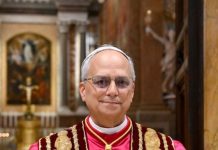
Newsroom (13/11/2025 Gaudium Press ) The U.S. Conference of Catholic Bishops (USCCB) experienced a moment of tension this week when Bishop Joseph Strickland, the former bishop of Tyler, Texas, interrupted a doctrinal discussion to address a controversial confirmation liturgy involving an openly “married” homosexual couple. The exchange, which took place during the Committee on Doctrine’s review of Action Item #03—updated Ethical and Religious Directives for Catholic Health Care Services—centered on the participation of Fr. James Martin, SJ, in a widely publicized Mass celebrating the confirmation of ABC News anchor Gio Benitez.
Strickland, known for his outspoken conservative stance, seized the opportunity to highlight images circulating on social media depicting the liturgy, which occurred on November 8, 2025. “Since we’re in the area of doctrine,” Strickland began, “I don’t know how many of us have seen on social media, priests and others gathered celebrating the confirmation of a man living with a man openly. And it just needs to be addressed.” He explicitly referenced Fr. Martin’s involvement, noting, “Father James Martin once again involved. Great pictures of all of them smiling. Here we are talking about doctrine. I just thought I need to raise that issue.”
The liturgy in question saw Benitez, who is in a civil same-sex marriage, confirmed into the Catholic Church. His “husband” served as his sponsor during the Mass, and both received Holy Communion. Fr. Martin, a Jesuit priest known for his advocacy for greater inclusion of LGBTQ individuals within the Church, concelebrated the Mass and was publicly thanked by Benitez for guiding him into the faith. The event drew significant attention online, with images of the smiling participants amplifying the controversy.
Strickland’s intervention was pointed but brief. He acknowledged that the issue was not on the formal agenda but urged the assembly to confront it, stating, “This body gathered, we need to address it.” However, his appeal was met with silence. According to Michael Haynes, a regular contributor to the Catholic Herald, the panel offered “no response,” and the session promptly moved forward without engaging the matter further. The lack of dialogue underscored the sensitivity of the topic within the USCCB, particularly during a meeting focused on doctrinal clarity.
The Catholic Church’s teachings on sexuality and sacramental life provide the backdrop for the controversy. The Church holds that all individuals must be treated with respect and dignity, but it maintains that sexual relations are reserved exclusively for marriage between a man and a woman. The reception of Holy Communion, a central act of Catholic worship, requires the recipient to be in a state of grace, free from unconfessed mortal sin. Publicly recognized same-sex unions, such as civil marriages, raise significant pastoral and doctrinal questions, as they are seen to conflict with the Church’s understanding of marriage and sexual morality.
Strickland, 67, has long been a polarizing figure in the American Catholic hierarchy. Ordained a priest in 1985, he served in various pastoral and administrative roles in the Diocese of Tyler before his appointment as bishop by Pope Benedict XVI in 2012. His tenure was marked by a deep commitment to Eucharistic devotion and a willingness to challenge perceived deviations from traditional Catholic teaching. Strickland gained national prominence for his directness, often using social media to critique trends within the Church and broader society. In 2023, he publicly accused Pope Francis of “undermining the Deposit of Faith,” a rare and bold rebuke from a sitting bishop.
His outspokenness, however, led to his removal from the Diocese of Tyler in November 2023. Following an apostolic visitation ordered by Pope Francis, two senior bishops investigated concerns about Strickland’s governance, diocesan finances, and pastoral leadership. The Vatican provided no detailed public explanation for his dismissal, consistent with its practice in such cases, but the decision was among the most high-profile episcopal removals in the U.S. in recent decades. Since then, Strickland has remained a prominent voice among conservative Catholics, frequently speaking at conferences and contributing to Catholic media.
The silence that followed Strickland’s remarks at the USCCB meeting reflects the broader challenges facing the American bishops as they navigate issues of doctrine, pastoral care, and cultural polarization. Fr. Martin’s ministry, which emphasizes outreach to LGBTQ Catholics, has long been a flashpoint, with supporters praising his compassion and critics arguing that his approach risks diluting Church teaching. The confirmation liturgy involving Benitez, coupled with Strickland’s public challenge, highlights the ongoing tension between inclusion and fidelity to traditional doctrine.
As the USCCB continues its work, the unresolved questions raised by Strickland’s intervention are likely to persist, both within the conference and in the wider Catholic community. For now, the bishops’ silence speaks as loudly as the concerns voiced in Baltimore.
- Raju Hasmukh with files from Catholic Herald
Related Images: