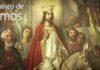


















Why Is St. Roch Represented with a Dog or as a Pilgrim Wearing a Cloak, Hat, Boots, and Sometimes Holding a Staff?
Newsroom (08/16/2025, Gaudium Press) – St. Roch was born in Montpellier, France, between 1346 and 1350, during the Hundred Years’ War and the devastating Black Plague that lasted two years and wiped out one-third of the Western population.
His father, Jean Roch de La Croix, a city dignitary, was the first consul in 1363. His mother, Dame Libéria, was from Lombardy and persistently prayed to Our Lady for the grace of having a child. Roch was raised in a deeply Christian environment.
Orphaned at the age of 17, wealthy and educated, he decided to leave for Rome. But first, he distributed his fortune to the poor, abandoning honors and riches, joined the Third Order of St. Francis, donned the pilgrim’s habit, received the blessing of the Bishop of Maguelone, and set out on his journey.
He most likely followed the Via Francigena toward Rome. He arrived in the city of Acquapendente, just two days’ walk from Rome. Exhausted from a long journey completed under a scorching sun, he asked for directions to the hospital, a shelter for the sick and travelers. Humbly, he requested hospitality and offered to care for the sick the next day. At that time, a deadly malaria outbreak was sweeping through the Apennine mountains, and the hospital was full of plague victims. St. Roch remained there for three months, aiding both physical healing and spiritual renewal. He combined his medical training with the sign of the cross and prayer, obtaining countless cures. His gift for ministering to the sick became clear.
He resumed his journey to Rome, but when he learned that the plague had spread to Cesena, in the opposite direction, he went there instead, doing what God expected of him and once again performing miraculous healings. He finally arrived in Rome in early 1368 and departed in 1370 to return to his homeland. In July 1371, he was in Piacenza, at the Hospital of Our Lady of Bethlehem near the Church of St. Anne, where he assisted, healed, and consoled the sick.
Day and night, Roch tirelessly cared for the ill, oversaw burials, comforted the dying, tended to blackened wounds with his bare hands, and protected children from harm. Then one day, he himself contracted the plague. He withdrew into a forest to avoid infecting others and awaited death. But a miracle occurred. A spring flowed forth, and a dog brought him bread each day. This is why St. Roch is the patron of the sick and of pets and is often depicted with a faithful dog.
Once healed, Roch set out again, traveling through Lombardy toward Milan, which was embroiled in a war between the Duke of Milan, Bernabò Visconti, his brother Galeazzo II, and a league formed by Pope Urban V and led by Amedeo VI of Savoy. This conflict lasted from 1371 to 1375, and Roch was arrested.
Why was he imprisoned? Modern biographers suggest he was mistaken for an envoy of the Holy See—thus, considered an enemy or a spy. It’s certain that Roch did not resist this unjust arrest. He made no appeal for defense and sent no message to the governor, who, according to tradition, was a relative. He offered only perfect silence, following Christ’s example during the Passion.
His imprisonment lasted five years. Tradition says that he revealed his identity to a priest on the eve of his death, which occurred on August 16, in a year between 1376 and 1379—believed to be Tuesday, August 16, 1379. Witnesses said the dungeon lit up, and Roch’s final request to the angel who came to assist him was to intercede for the suffering people. He was only identified thanks to a birthmark in the shape of a cross on his chest.
Compiled by Gustavo Kralj
Related Images: