












Newsroom (11/21/2025 12:11, Gaudium Press) One hundred years after its first public exhibition, Duke Borso d’Este’s Bible returns to the Chapter House of the Italian Senate Library in Rome, where, in 1923, Giovanni Treccani decided to rescue it from exile.
The exhibition takes its name from Genesis: “‘Et vidit Deus quod esset bonum’: ‘And God saw that it was good’ – The Bible of Borso d’Este – A masterpiece for the Jubilee.”
It is a return steeped in history, almost like a reunion: it was there that Treccani met Giovanni Gentile. Impressed by the beauty of the manuscript, he decided to buy it, “it moved me to tears”. Today, the exhibition offers an opportunity to see a work exhibited to the public on rare occasions.
The inauguration, promoted by the President of the Italian Senate, Ignazio La Russa, was attended by, among others, the Vice President, Mariolina Castellone, the Deputy Secretary of Culture, Gianmarco Mazzi, and Special Commissioner for the Jubilee, Roberto Gualtieri, as well as the three main speakers: Monsignor Rino Fisichella, Pro-Prefect of the Dicastery for Evangelization, Carlo Ossola, President of the Treccani Italian Encyclopedia Institute, and Alessandra Necci, Director of the Gallerie d’Este and organizer of the exhibition.
A beauty that challenges
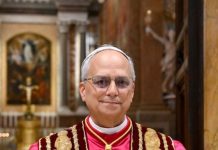
Archbishop Rino Fisichella drew the attention of those present to the profound nature of the manuscript: “The Bible is not just a book, but the Word that continues to speak to all generations. In the exhibition with miniatures commissioned by Duke Borso d’Este, beauty is not a simple adornment, but a visual prayer, a memory that spans the centuries.”
The pages decorated with gold and precious pigments become an invitation to contemplation, an invitation to rediscover the sacred text in its most authentic value; it is the Word itself, which we continue to find in editions accessible to all, which we keep at home or simply ask to be reopened to allow its essential content to emerge.
Alessandra Necci reconstructs the context in which the manuscript was created: the court of Borso and Escole d’Este, a laboratory of art, politics, and splendor, where Taddeo Crivelli, Franco de’ Russi, Girolamo de Cremona, and Guglielmo Giraldi worked. It was there that the language that Roberto Longhi defined as “capable of dialoguing, on an equal footing, with monumental painting” took shape.
After recalling that Duke Borso took the Bible to Rome in 1471 to show it to the Pope, the exhibition director concluded: “This is a work of the court, which became the heritage of all, guiding visitors through more than six hundred manuscripts with miniatures, fantastic animals, and scenes that echo the style of Donatello.”
“Harmony between beauty and sacredness”
Carlo Ossola, president of the Italian Encyclopedia Institute, highlighted the civic significance of Treccani’s gesture: “A noble example of modern patronage. His generosity allowed Italy to regain possession of a treasure that was in danger of being lost internationally.”
In this exhibition, the history of the work and that of the Institute are once again intertwined, as Ossola also states: “The entire panorama of Italian culture is concentrated in just two volumes. A century after its donation, the Bible also remains one of the symbols of the idea of culture as a common good.”
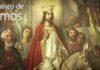
Borso d’Este’s Bible is not a simple book, but a visual microcosm where the sacred, politics, art, fantastic zoology, and the pride of the dynasty coexist. The Afghan ultramarine blue of the precious lapis lazuli, the golden background, the coats of arms, the centaurs, and the emblems of the d’Este family: each page vibrates with a “harmony between beauty and sacredness,” as evoked by Monsignor Fisichella, a pilgrim symbol of the Jubilee.
In Modena, where it is preserved, the book represents the precious jewel of the d’Este Galleries. In Rome, where it will be on display for a period, it will be a pinnacle of memory, recalling what culture can achieve when institutions, scholars, citizens, and history come together. This book continues to be, as the title of the exhibition suggests, something good and wonderful.
With information from Vatican News. Translation by Gaudium Press.
Compiled by Dominic Joseph
Related Images: