

















A controversial court ruling over the ownership of the ancient monastery at the foot of Mount Sinai has caused outcry. We dive into this situation and its background.
Newsroom (05/06/2025 02:05 , Gaudium Press) The road to St. Catherine’s Monastery winds through a stark and silent Mount Sinai landscape, where jagged peaks rise like ancient sentinels over the desert. For pilgrims , the sight of its towering walls—built in the 6th century by the Byzantine Emperor Justinian—is both awe-inspiring and humbling. This is one of the oldest continuously inhabited Christian monasteries in the world. A place where history, faith, and legend intertwine.

Today, this UNESCO World Heritage Site is embroiled in a modern struggle. One that pits centuries of religious tradition against the legal machinery of the Egyptian state. A recent court ruling has thrown the monastery’s future into uncertainty, raising urgent questions about ownership, autonomy, and the preservation of a sacred legacy that transcends borders.
A Living Relic of Early Christianity
St. Catherine’s Monastery, officially known as the Sacred Autonomous Royal Monastery of St. Catherine of the Holy and God-Trodden Mount Sinai, is not merely a historical monument—it is a living spiritual community. Its origins trace back to the 4th century, when hermits began settling near Mount Sinai, drawn by its biblical significance. By AD 527, Emperor Justinian ordered the construction of a fortified monastery to protect these monks from Bedouin raids.

At its heart lies what tradition holds to be the Burning Bush. The miraculous shrub from which God spoke to Moses, commanding him to lead the Israelites out of Egypt (Exodus 3). The bush, a rare species of bramble (Rubus sanctus), still grows within the monastery’s walls, its green leaves a striking contrast against the surrounding stone. Nearby is the Well of Moses, where, according to scripture, Moses met his future wife, Zipporah.

The monastery’s spiritual importance extends beyond its biblical connections. It is the final resting place of St. Catherine of Alexandria, the early Christian martyr, whose defiance of Roman persecution made her one of the most venerated saints in Christendom. According to tradition, angels carried her body to Mount Sinai after her execution, where monks discovered her remains centuries later.
A Treasure Trove of Ancient Knowledge
Beyond its sacred relics, St. Catherine’s is home to one of the world’s most significant collections of early Christian manuscripts. Its library, the oldest continuously operating in existence, contains over 3,300 manuscripts, including some of the earliest surviving biblical texts. Among its most famous holdings was the Codex Sinaiticus, a 4th-century Greek Bible that is now dispersed across museums in Europe.
The library also houses the Syriac Sinaiticus, the oldest known copy of the Gospels in Syriac, and countless other theological, historical, and scientific works in Greek, Arabic, and other languages. Many of these texts were painstakingly preserved by generations of monks, even as wars and invasions ravaged the surrounding region.
The monastery’s icon collection is equally extraordinary. Its walls are adorned with some of the finest examples of Byzantine iconography, including the renowned Christ Pantocrator (6th century), one of the oldest surviving icons of Christ. These artworks have not only spiritual but immense cultural value, offering a window into the early Christian world.
The Covenant of Protection: Muhammad’s Promise to the Monks
One of the most remarkable aspects of St. Catherine’s survival is its relationship with Islam. According to tradition, the Prophet Muhammad himself granted the monastery protection in a document known as the Ashtiname of Muhammad. This 7th-century charter, kept in the monastery’s archives, exempts the monks from taxes and military service and commands Muslims to defend them.
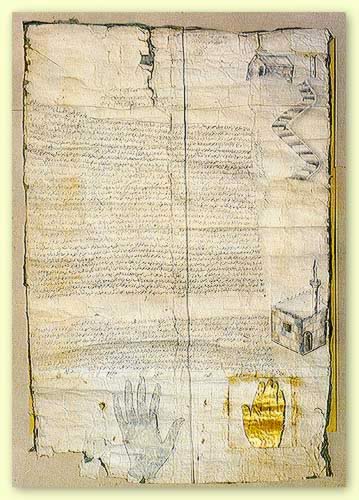
Historians debate the exact authenticity of the document, but its symbolic power is undeniable. For centuries, Muslim rulers—from the Fatimids to the Ottomans—honored its spirit, allowing the monastery to flourish even as Christian influence waned in the region. This delicate balance of coexistence is a testament to the monastery’s unique place in interfaith history.
The Modern Legal Battle: Who Owns the Holy Mountain?
The current crisis began in 2015, when the South Sinai Governorate—the regional administrative body—initiated legal action to assert state control over the monastery’s lands. The dispute stems from a 1980 Egyptian law requiring landowners to formally register their properties. The monastery submitted claims for 71 plots, including its churches, gardens, and surrounding terrain.
For years, negotiations between the monastery, the Egyptian government, and Greek officials (due to the site’s ties to the Greek Orthodox Church) seemed to be progressing. A draft agreement reportedly recognized the monastery’s ownership of its core properties. But according to Archbishop Damianos, the current abbot, Egyptian authorities altered the terms at the last moment.
“Though we agreed on a text, they changed it and presented something entirely different,” he said.
On May 28, 2025, an Egyptian Court of Appeals issued a ruling that many interpreted as transferring ownership of the monastery’s lands to the state while allowing monks to continue their religious activities. The 160-page decision was so dense that legal experts struggled to fully decipher it.
The Greek government, still reviewing the ruling days later, called it “extremely complex,” citing dense legal reasoning in Arabic. Meanwhile, Egypt’s State Information Service sought to clarify the decision, insisting it “represents the first instance in which the legal status of the monastery has been regulated” while affirming its sacred status.
Yet the fine print raised concerns. While the court acknowledged the monks’ right to use the land, it suggested that uninhabited areas beyond the monastery’s immediate vicinity could be considered state property.
Egypt’s State Information Service (SIS) quickly moved to clarify, insisting the ruling “affirms the sacred status of the monastery” and merely regulates its legal standing. Key points included:
-
Recognition of the monks’ right to use the monastery and its immediate surroundings.
-
Acknowledgment that some uninhabited, distant areas lack proper ownership records and thus fall under state control.
-
A commitment to protect the monastery’s religious and historical character.
But critics argue the ruling sets a dangerous precedent. If the state can claim uninhabited lands, what stops future expansions of that definition? Could access to water sources, pilgrimage routes, or even parts of the monastery itself be contested?
Church Leaders Sound the Alarm
The ruling sent shockwaves through Orthodox Christian communities. Archbishop Elpidophoros of America called it a violation of religious freedom, warning that it “endangers a site of immense historical and cultural importance.”
The Ecumenical Patriarchate of Constantinople, the spiritual center of the Orthodox world, expressed dismay, arguing that the ruling undermined centuries of established ownership. “Islam itself has respected and safeguarded this arrangement for centuries,” it noted, urging Egypt to honor past agreements.
Even the Greek Orthodox Patriarchate of Jerusalem, which maintains close ties with Egyptian authorities, vowed to “condemn and act upon any encroachment” on the monastery.
Monks Protest, Diplomats Scramble
In response to the ruling, the monastery’s roughly 20 monks reportedly closed its doors to visitors, retreating into prayerful protest. The decision also risks straining Egypt’s relations with Greece, a key European ally.
On May 30, Greek Prime Minister Kyriakos Mitsotakis spoke with Egyptian President Abdel Fattah El-Sisi, who assured him of Egypt’s commitment to preserving the monastery’s sacred status. Egyptian Foreign Minister Badr Abdelatty echoed this stance in meetings with European ambassadors, pledging further negotiations.
But Greek commentators remain skeptical. Nikos Meletis of Proto Thema accused Egypt of stalling until the court ruling could be used as leverage. “They waited for the decision, and now they can present it as a fait accompli,” he wrote.
With Greece’s foreign minister set to visit Cairo on June 4, the stage is set for high-stakes diplomacy. The question now is whether a compromise can be reached—one that preserves both Egypt’s legal claims and the monastery’s ancient legacy.
A Test of History and Faith
For St. Catherine’s, this is more than a property dispute. It is a test of whether a 1,500-year-old institution can maintain its autonomy in a rapidly changing world. The monastery has survived Roman persecutions, Islamic conquests, and colonial intrigues. Now, it faces a battle not with swords, but with legal documents.
As monks continue their vigil within the monastery’s ancient walls, the world watches—waiting to see if this sacred sanctuary, a bridge between faiths and civilizations, will endure for centuries to come.
- Raju Hasmukh with files form The Pillar
Related Images: