




















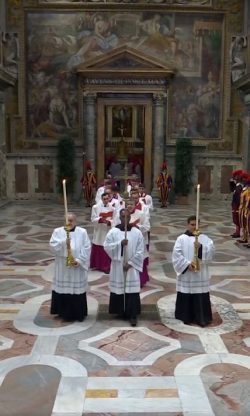
The vision of candlelit altars, Gregorian chant and sophisticated iconography are synonymous with transcendence, offer a privileged path to God and attract younger generations.
Newsdesk (18/05/2025 16:55, Gaudium Press) There are images that do not fade. The chant of the traditional antiphon In Paradisum echoed over St. Peter’s square, as the church prayed for the soul of Pope Francis at the funeral of the Argentine pope on April 26.
The long procession of cardinals dressed in red followed in silence, with the weight of centuries on their shoulders; the solemn procession of the 133 cardinal electors, slowly going from the Pauline Chapel to the Sistine Chapel, while the hymn was sung Veni Creator Spiritusinvoking the Holy Spirit as the conclave was about to begin on May 7.
Then, after the Latin order “Extra omnes” (All out), the large bronze doors of the iconic Sistine Chapel closed, isolating the world. All of these moments have captivated believers and non-believers around the world, arousing a renewed admiration for the beauty inherent in Catholicism.
Antidote to human finitude
Publications and comments proliferated on social media network X and Instagram, paying tribute to the spectacle generated by the secular traditions of the Church. A growing number of voices made bolder claims.
“Catholic aesthetics are beautiful because religion is true”, said an account on the social network X — a phrase that resonated beyond the usual Catholic circles. In an online ecosystem saturated with immediate gratification and fleeting fads, the idea that beauty can mean unchanging truth seems not only invigorating, but quietly revolutionary.
At the heart of this renewed fascination is the instinct that Catholic beauty is not merely incidental or decorative, but objectively revealing. This recent online movement is not driven by ecclesiastical authorities, but by grassroots figures like Julia James Davis, creator of War on Beauty whose presence in the YouTube, X and Instagram has become a point of convergence for this sensitivity.
Davis says the abandonment of beauty by modern culture in architecture, art, apparel and even customs reflects a deeper rejection of truth itself. Catholicism, on the other hand, holds a form of beauty still ordered, transcendent, and unapologetically turned to the soul.
Davis’ criticism resonates with younger generations navigating a cultural landscape of sterile minimalism and aggressive utilitarianism. For them, the vision of candlelit altars, Gregorian chant and sophisticated iconography are synonymous with transcendence and offer a privileged path to God.
Other recent trends have confirmed this social phenomenon, starting with the extraordinary success of the traditional pilgrimage from Paris to Chartres, which needs to refuse thousands of entries every year due to the large number of faithful.
In France, about 10 thousand adults — a record number — were baptized at Easter this year, an increase of 45% compared to the previous year. In the UK and Belgium, similar increases are being recorded. And in all three countries, as in the U. S., the most common new converts are not middle-aged or elderly, but young adults in their 20s. In his testimonies, beauty is repeatedly mentioned: the beauty of the liturgy, of sacred music, of ancient rites.
Catholic Genius
This intuition — that beauty speaks of truth — is not new.
After the French Revolution two centuries ago, French writer Francois-Rene de Chateaubriand, in his masterpiece The Genius of Christianity, formulated what many people online are now instinctively discovering. At a time when the Enlightenment had reduced religion to ethical principles, Chateaubriand saw beauty as the most complete form of apologetics to reaffirm the reality of the Incarnation. The veracity of a religion, he says, is judged by the beauty it spreads and the sophistication of its dogmas, areas in which Christianity has stood out like no other over the centuries. One should look, he said, not only at the saints and theologians, but also at the material heritage that faith has produced.
“Attached to the steps of the Christian religion”, he wrote about the arts, “they recognized her as their mother as soon as she appeared in the world. Music recorded her songs, painting represented her sorrows, sculpture dreamed of her next to the tombs, and architecture built for her temples as sublime and mysterious as her thought”.
For Chateaubriand, beauty was not optional, but essential.Music, for example, was not only to provide pleasure, but to purify the soul and elevate it to virtue.
“The most beautiful music”, he said, “is the one that most perfectly mimics the belo”. When religion takes hold of music, Chateaubriand said, it combines two conditions indispensable to harmony: beauty and mystery.
But nowhere is this more impressive than in architecture. For Chateaubriand, the Christian temple — especially in its Gothic form — was the embodiment of the divine presence.
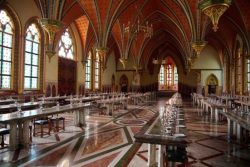
“That is why there is nothing more religious than the vaults of our ancient Gothic churches. One cannot enter such a church without feeling a shiver of devotion and a vague sense of the divine”, he wrote.
Sistine Chapel
It is difficult to imagine a more perfect parallel with the Sistine Chapel, where the recent conclave that led to the election of Pope Leo XIV took place. When the cardinals presented themselves under the painting of Michelangelo’s Last Judgment, they were not in a neutral meeting hall, but in a space full of theological pretensions. Its frescoed walls and heavenly ceiling are, in fact, mere proclamations of faith.
What Chateaubriand named with the lyricism of romantic literature, a new generation is rediscovering it through algorithms, reels and screenshots. The platforms have changed, but the message remains unchanged: the beauty of Catholicism is the outward form of a living reality; it is the visible echo of a truth too vast to be absorbed at once.
Cultural Hunger
Many thinkers of our time believe that the postmodern world, which emerged from the Second World War, is facing an unprecedented “beauty crisis” and that this does not spare the Church.
“Catholic artists and writers feel isolated and alienated from both society and the Church. The Catholic Church had lost its traditional connection to beauty”, poet Dana Gioia said in 2019. Post-conciliar apologetics, which focused on reason, ethics and social justice, tended, according to observers, to marginalize beauty as, at best, a peripheral tool in the evangelizing mission of the Church and, at worst, a vehicle for pride and greed.
Hans Urs von Balthasar, one of the greatest Catholic theologians of the XX century, warned in his book The Glory of the Lord: Seeing the Form (The Glory of the Lord: Seeing the Form, in free translation), published in 1982, that abandoning beauty means falsifying one’s faith.
“We no longer dare to believe in beauty”, he wrote, saying that “beauty demands for itself at least as much courage and decision as truth and kindness, and she will not let herself be separated and banished from her two sisters without taking them with her in an act of mysterious revenge”.
For von Balthasar, beauty was not a luxury but a necessity, the brilliance of truth made visible.
Philosopher Simone Weil, drawn to the mystery of the Church without ever formally entering it, came to a similar conclusion: “Beauty is the experimental proof that the Incarnation is possible”, she wrote. Beauty, for her, was not feeling, but metaphysics. It was the moment when the soul is pierced by something that transcends it and recognizes a presence.
The spontaneous rebirth of Catholic aesthetics online — at a time when new conversions abound unexpectedly — is therefore particularly significant, especially since it arises not from an ecclesial strategy but from popular cultural hunger. These passionate young people, in search of meaning, are discovering, as Chateaubriand discovered in his day, that Catholicism has not only beauty. He reveals it — because it is true.
Article written by Solene Tadie, European correspondent of the National Catholic Register, published in Acidigital.
The post A beleza da Igreja está cativando uma nova geração appeared first on Gaudium Press.
Related Images: