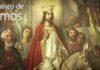







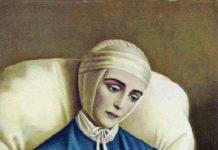








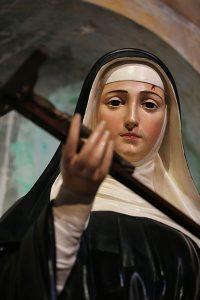
Saint Rita of Cascia is the patron saint of causes considered impossible. She obtained the conversion of her husband and her children. After their deaths, she entered the monastery of the Order of Saint Augustine, where her incorrupt body rests to this day.
Newdesk (18/11/2025 14:09, Gaudium Press) Although already advanced in age, Antonio Mancini and his wife, Amanta, never ceased to pray to God, confidently and insistently, for the blessing of having a child to bring joy to their home. They lived in the small village of Rocca Porena, in Cascia, Umbria.
To answer the prayers of this pious couple, God performed the first “impossible” miracle in the life of Saint Rita: her birth in 1381.
She was a charming girl. And from an early age, Divine Providence began to manifest special designs for her. According to tradition, while she slept in the basket that served as her cradle, rare white bees often appeared, fluttering around her and gently depositing honey on her lips without hurting or waking her. One of the neighboring peasants, witnessing the scene for the first time, tried to chase the insects away with his crippled hand. At that very moment, his hand was healed.
After Saint Rita’s death, these same white bees began to appear annually at the Augustinian monastery, where she spent the last years of her life. They arrived during Holy Week and remained until May 22nd. Then they would leave, only to return the following Holy Week. To this day, pilgrims can still see the small holes they made in the monastery walls.
A childhood marked by piety and obedience
From an early age, Rita showed a great inclination toward piety. Her parents, although they could neither read nor write, taught her the Catechism and the stories of Jesus. She devoted herself with great joy to prayer, always meditating on the Passion of Our Lord. She could neither read nor write. However, she continually “read” the most magnificent of all books: the Crucifix.
In addition to being especially devoted to Our Lady, she chose St. John the Baptist, St. Augustine, and St. Nicholas of Tolentino as her patron saints. She tried to abstain from toys and the mischief typical of childhood as a mortification to console Jesus Crucified.
The greatest desire of her soul was to be a religious. At this very point, Providence demanded of her an enormous act of obedience, accepting a state of life opposite to the religious calling she felt in her soul. At only 12 years of age, she was forced by her parents to marry a fiancé of their choosing, named Paulo Ferdinando.
Suffering in the family
Her husband soon revealed himself to be an aggressive man, bad-tempered, a heavy drinker, and dissolute, which caused Rita tremendous suffering. However, she not only remained faithful to him, but also endured all of this with extreme patience for 18 years, always praying and offering this kind of martyrdom for the conversion of sinners, especially her detestable husband.
And then at last, the “impossible” came true in the life of this exemplary woman. She finally had the joy of seeing her husband convert and ask her forgiveness for all the mistreatment and the dissolute life he had led. How timely this conversion was! Shortly after reconciling with God through the Sacrament of Confession, Paulo Ferdinando was murdered by some of the bad companions he had had.
The couple’s children, twins then aged 14, swore to avenge their father’s death. Seeing how much her children had inherited their father’s evil tendencies, and fearing for their eternal destiny, Saint Rita addressed a plea to God: she would rather see her children physically dead than follow the path of eternal perdition. Soon the Father of Mercy showed His pleasure with this plea from a truly Catholic mother. In less than a year, the two fell ill and died, having forgiven Paulo Ferdinando’s murderers.
Entry into religious life
A widow, childless, free from everything that could tie her to the world, Rita longed to become a nun. She asked to be accepted into the monastery of the Augustinian nuns of Cascia, where she had always desired to be. But—oh, what a disappointment!—the superior told her that unfortunately they could not accept widows into the congregation, which was intended only for virgins.
Imagine her disillusionment and sadness when she returned home! But she was a holy woman. As such, instead of letting herself be discouraged or disheartened, she decided to continue her life of prayer and penance with even more ardor than before.
Her patron saints, St. Augustine, St. John the Baptist, and St. Nicholas of Tolentino, came to her aid, obtaining from the Mediatrix of all graces the fulfillment of yet another “impossible” feat in favor of their protégée.
It is recounted that one night, while she was immersed in prayer, these three saints appeared to her and invited her to follow them. In ecstasy, she accompanied them. When she came to her senses, she was inside the Augustinian monastery… She had entered there miraculously, for all the doors and windows were perfectly locked.
The next morning, the Mother Superior recognized this prodigious event as a clear indication of Divine Will and decided to welcome Rita as a novice into this holy congregation.
Obedience rewarded by a miracle
Once vested in the habit, the new religious was an example of virtue to all her sisters in the vocation.
Of the three vows of religion, the one she took most seriously was obedience, always doing the will of others in everything, even in what might seem ridiculous and senseless. For example, the Superior ordered her to water every day a vine that was already dry and dead. The obedient nun strictly complied with the order for a year. Once again, what seemed impossible came true: shoots sprouted from the dead wood, grew, and produced flowers and fruit! This “Vine of Saint Rita” still exists today, producing grapes with a special flavor that ripen in November.
Sharing in the sufferings of Jesus crowned with thorns
During Lent in 1443, the great preacher Santiago de Monte Brandone gave a magnificent sermon in Cascia on the Passion of Jesus, highlighting above all the episode of the Crowning with Thorns. After hearing this sermon, Saint Rita felt overcome with the desire to share in the sufferings of Our Lord in this episode of His Passion.
Praying before her crucifix, she saw a soft light emanating from it, and a thorn detached itself from the crown and pierced her forehead, causing a wound that made her suffer during the last 15 years of her life. In addition to emitting a foul odor, it caused her many infirmities. Thus, she had her desire to truly share in the sufferings of Jesus crowned with thorns fulfilled.
Holy death, the reward
Saint Rita had a holy death, being obedient to God’s will until the end.
Being already very ill, she asked Jesus for a sign that her children were in Heaven. In the midst of a harsh winter, she received a rose picked from the garden of her former home in Rocca Porena… She asked for a second sign and, at the end of winter, she received a fig, also from her garden. With the fulfillment of these two “impossibilities,” God, so to speak, shows His pleasure in this great Saint being invoked as the “Advocate of the Impossible.”
On May 22nd, 1457, the beautiful soul of Saint Rita flew to Heaven.
The wound on her forehead turned into a ruby-red spot, from which a pleasant fragrance emanated. Her cell was illuminated by a heavenly light, and the bells rang out on their own in a joyful and glorious peal.
She was laid in state in the church, where a crowd of people gathered to see and venerate her. Such a perfume emanated from her holy body that it was never buried; it remains incorrupt to this day, exposed for the veneration of the faithful in the convent of Cascia.
Text extracted, with adaptations, from the magazine Heralds of the Gospel, May 2003. By Sr. Juliane Campos, EP.
The post St. Rita of Cascia: Advocate of the Impossible! appeared first on Gaudium Press.
Compiled by Roberta MacEwan
Related Images: